





Video Podcast Studio El Paso vs. Audio-Only: Your 2026 Format
Booking a video podcast studio El Paso creators trust — or skipping video entirely — is the decision that stalls new shows for months. However, the stakes are real: pick wrong and you pay in either reach or budget. Audio-only publishes faster and costs less. Video multiplies where your show can be found. So this honest podcast format comparison walks through both, with real West Texas trade-offs and a five-minute decision framework at the end. No upsell — just the math.
Video Podcast Studio El Paso: The Short Answer
What Changed About Podcast Discovery in 2026
Discovery moved, and that's the whole story. Podcast directories used to be the front door for new listeners; so now clips and search do most of the finding, and discovery has shifted toward watchable shows. For the industry-practice view beyond any one studio, the Podcasters Association is the reference worth bookmarking.
Also, the shift lands harder in a market like ours. Your El Paso audience scrolls the same feeds as everyone else, so a strong clip can carry a Borderland show far past the city limits — and pull local viewers back to the full episode. That gap — looking like a show versus looking like an ad — is what a purpose-built set buys you.
Of course, none of this makes audio obsolete. It changes the question: not which format is better, but which format fits your show, your schedule, and your budget. Hold onto that reframe — it's the one that ends the months of deliberation. That's the comparison the rest of this guide runs.
Video Podcast Studio El Paso: Production Time and Cost Compared Honestly
First, the trade-offs in one view. Both formats run under one roof here, so every row below describes our own sessions — no vendor math, no padding.
| Factor | Audio-only | Video podcast | What narrows the gap |
|---|---|---|---|
| Session cost | $75/hour raw or $150/hour fully processed | More per session — camera setup, lighting, and editing add cost | Recording both formats in one take |
| Production time | Record, level, publish | Adds framing, lighting resets, and video editing | Prepped scripts and one set look per episode |
| Distribution | Podcast apps and your website | Adds YouTube plus clips for Reels and TikTok | Clips can point viewers back to the audio feed |
| Consistency | Easier to publish on schedule | Demands more from you per episode | Batch days protect the cadence |
| First-show fit | The safer start for first-timers | Adds reach once your cadence is proven | Switch formats between sessions, not studios |
Audio-Only: Cost, Speed, and Where It Still Wins
In short, audio-only wins on three fronts: cost, speed, and consistency. The published audio rates are $75 per hour for raw recording and $150 per hour fully processed — the entire cost conversation fits on one line. So a weekly audio show is a schedule most owners can actually keep. Speed matters too: an audio episode can go from recording to published without a single frame of video review, so the gap between session and release stays short.
It also wins on trust per effort. A clean, leveled conversation builds credibility even with zero visuals — we've broken down how location affects audio quality and audience trust on this blog. Additionally, voiceover and narration work lives entirely on this side of the fence, and the same booth serves both. If ad reads or narration are part of your plans, the audio lane is already your home base.
Video: Reach, Clips, and What It Really Demands
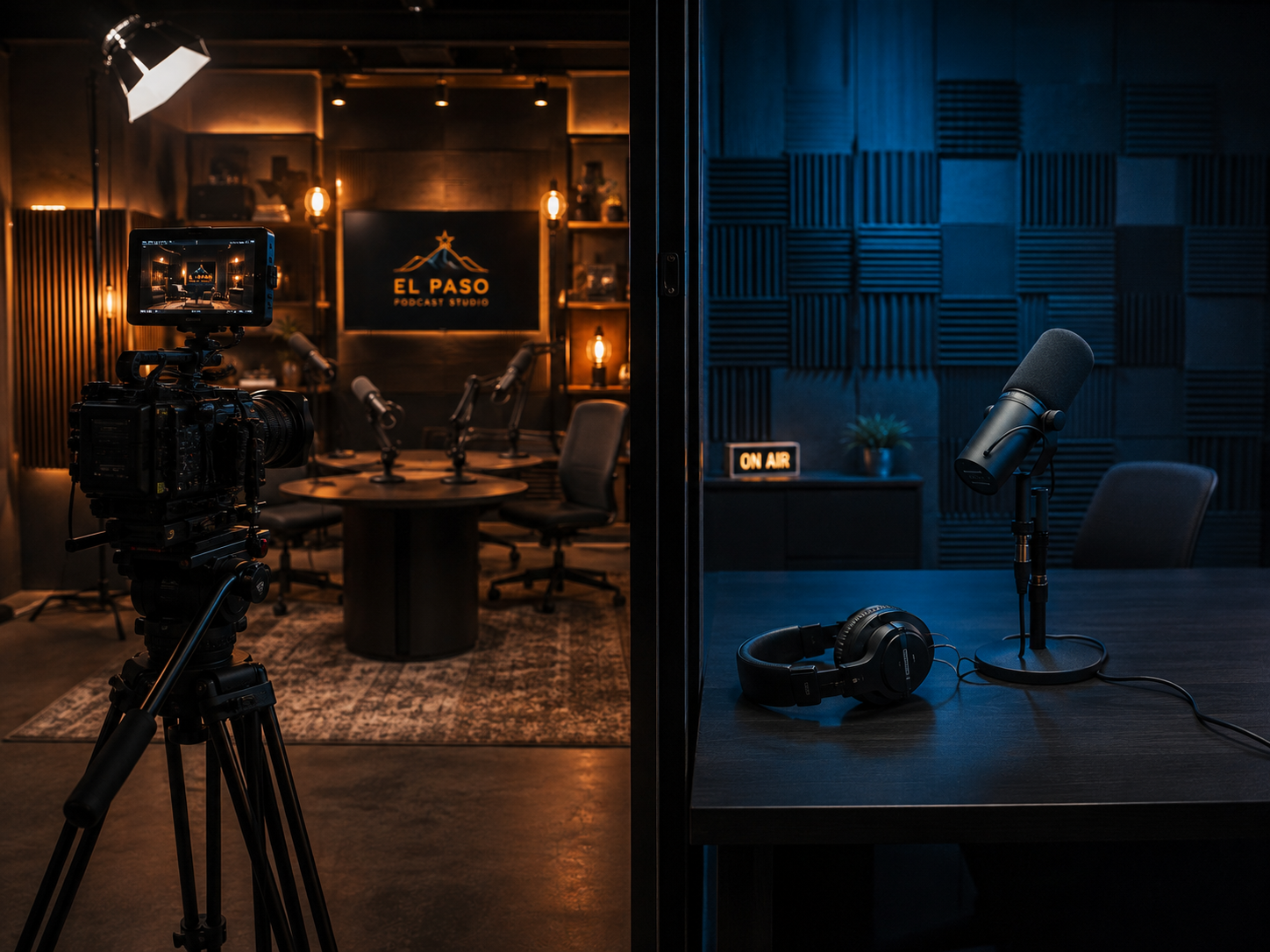
By contrast, video's case is reach. A filmed episode gives you the full show for YouTube plus podcast clips for social — the vertical cuts that travel on Reels and TikTok while your audio feed grows. Also, the set itself becomes brand equity: customizable lighting and cinema-grade cameras give a corporate series an on-brand look no audio feed can carry.
However, be honest about the demand side. Video adds framing decisions, lighting resets, wardrobe thought, and editing time to every single episode. In fact, that's the real cost — not the session, but the standard you've committed to keeping. This is also why podcast video production El Paso teams can outsource is worth pricing before you promise anyone a weekly show. Naturally, the demand shrinks with help: an engineer who resets the lighting, and a set that's already lit, remove most of the per-episode overhead.
Do People Actually Watch Podcasts Now?
Yes — and the shift is recent enough that a plan made three years ago is already dated. Indeed, a growing majority of weekly listeners now prefer shows they can watch, and YouTube has become a leading place new shows get discovered.
Of course, "watch" rarely means an hour on a couch. In practice it means a strong minute on Reels or TikTok that pulls a viewer toward the full episode. Therefore even audio-first shows benefit from planning a few filmable moments per season. Plan them the way you'd plan quotes — one visual moment, one strong claim, one exchange with a guest. Then film only those.
Which Format Fits Interview, Solo, and Brand Shows
Interview shows gain the most from video, because chemistry is visible — for example, our intake counseling episode shows how a two-guest conversation lands when you can see the room. Likewise, brand series lean video: the set is part of the message. A leadership series shot on a branded set does double duty — episodes for the audience, stills and clips for the sales deck.
Solo commentary, by contrast, thrives audio-first — it's the format you can sustain at volume, and your voice carries the whole brand. Meanwhile, a mixed rhythm is a legitimate answer: video for flagship interviews, audio between them. Ultimately, the audio only vs video podcast question doesn't need a once-for-all-time answer.
Recording Both in a Single Session
Here's the option most first-timers don't know exists: record both at once. A studio with cinema-grade cameras and broadcast microphones captures video and audio simultaneously, so one session produces a YouTube episode, a podcast feed, and vertical clips without a second booking. The audio gives up nothing in the process: the broadcast microphones run exactly as they would in an audio-only session.
Consequently, the choice stops being permanent. Start audio-only, then add video once your cadence is proven — same room, same engineer, no new vendor. In fact, recording both at once is also what narrows the cost difference between the formats.
Start a podcast in El Paso →A Five-Minute Decision Framework
Set a timer. So here are the five checks, one minute each — answer them in order and the format picks itself:
- Minute one: name your bandwidth. If publishing weekly already sounds heavy, audio-only wins — sustainability beats reach you can't maintain.
- Minute two: find your audience. If the people you want live on Reels, TikTok, or YouTube, then video's clips are your discovery engine.
- Minute three: match your show type. Interview and brand shows gain the most from video; meanwhile, solo commentary thrives audio-first.
- Minute four: check the budget honestly. Video sessions cost more — camera setup, lighting, editing — though recording both at once narrows the difference.
- Minute five: commit. Pick the format you'll still be running in December, then book the session and stop deliberating.
Granted, the budget decides some of this for you — the U.S. Small Business Administration covers marketing-budget fundamentals — but the framework settles the rest. So if your answer came up audio, start here:
Audio recording and voiceover →Frequently Asked Questions
Q1 Video podcast studio El Paso or audio-only: which is better? +
Q2 Do people actually watch video podcasts? +
Q3 Can you record video and audio in the same podcast session? +
Q4 Does video podcasting cost more in El Paso? +
Q5 What format is best for a first-time podcaster? +
Video Podcast Studio El Paso: Test Both Formats in One Session
That's the honest read from a video podcast studio El Paso brands use for both formats: start with what you can sustain, and let the room erase the technical gap between the two. So book a walkthrough, stand on the lit set, hear the booth, and decide with your own eyes. Five minutes, remember.