





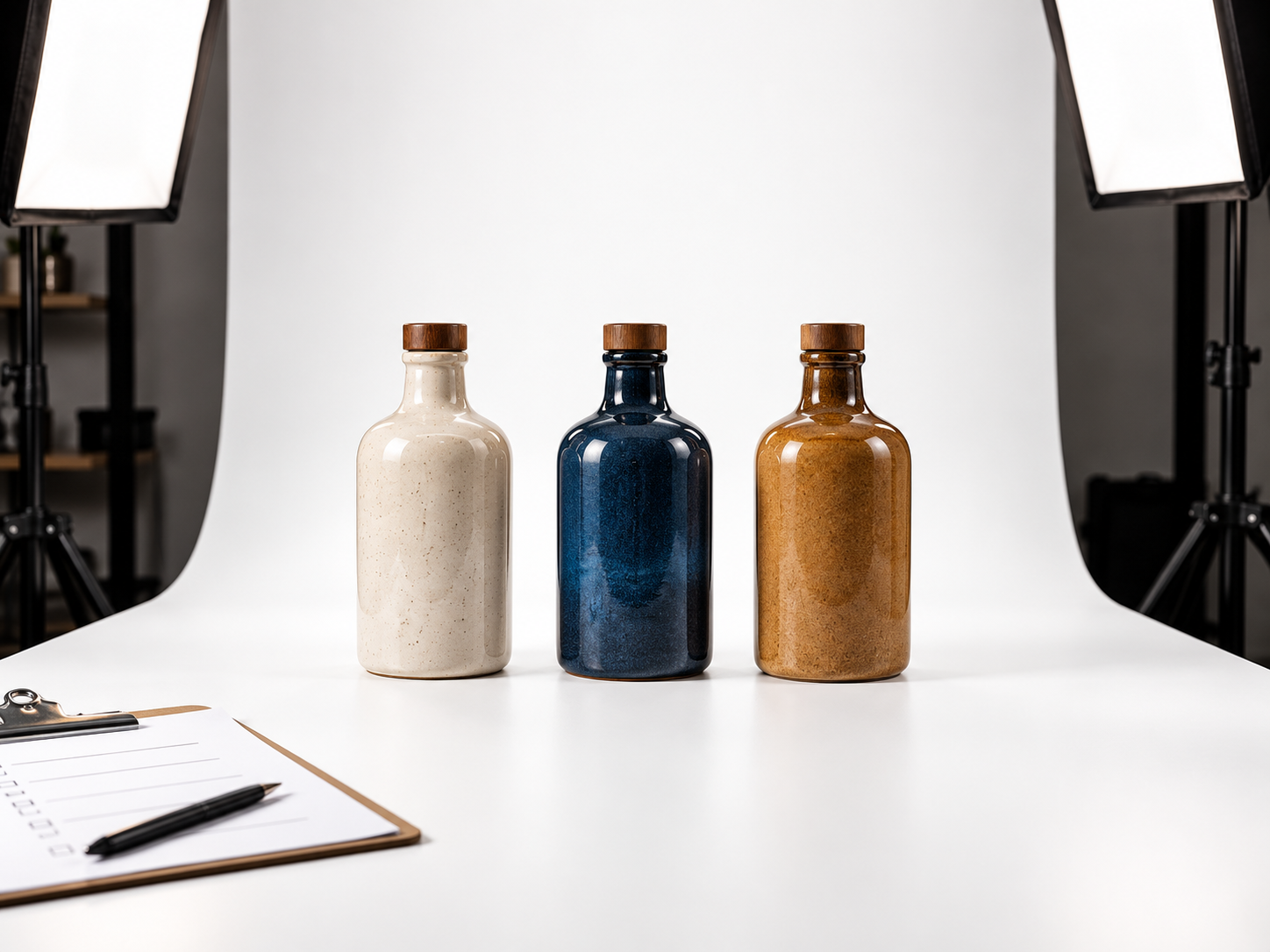
Product Photography El Paso: A Clean Background In Camera
Good product photography El Paso businesses can reuse starts with the background, not the camera. There are only two ways to get a clean white one. Shoot on a surface that is already seamless, or shoot on anything and cut every image out afterwards. So one of those finishes the moment the shutter closes. Meanwhile the other is an editing job on every single item, and in our experience it is why a catalog sits half-done.
Product Photography El Paso: The Short Answer
Why The Background Decides The Whole Shoot
A listing photo sells the product, but the background frames it. A messy one adds visual noise around the thing you are selling. So the eye spends its first moment sorting the scene instead of looking at the item.
Of course, you can fix a background afterwards. That is what masking is, and it works perfectly well. However, it works one image at a time, and hair, glass edges and soft outlines are the ones that slow an editor down.
So the two routes cost you in different places. First, seamless costs you a booking. Then masking costs you an evening for every batch you add. The Small Business Administration publishes guidance on marketing a business online, and the photography is the part no template can supply for you.
The background also decides whether your twentieth photo matches your first. A catalog shot across three evenings on three different surfaces reads as three catalogs, and that is the thing we most often see a seller redo. Getting it right once, in one place, is what stops the reshoot.
Product Session Choices At A Glance
First, here are the decisions that genuinely change what you leave with. None of them are about the camera.
| Decision | What it means | Where it comes from | What you notice |
|---|---|---|---|
| Two routes to white | Shoot on a seamless surface, or remove the background later. | The shape of the surface behind the item. | One is done at the shutter, one is not. |
| Consistency | Lighting and background stay identical across every item. | One lighting setup held for the whole block. | The listing page reads as a single catalog. |
| Reflective stock | Shiny surfaces pick up the lights and the room. | The physics of the surface, not the camera. | More time per item, so flag it when you book. |
| The shot list | Every item you want, written down before the day. | Planning rather than equipment. | It changes how many images you leave with. |
| Three shot types | Scale, lifestyle and detail out of one block. | What a listing page needs from a single session. | One booking covers the whole page. |
How Product Photography El Paso Sessions Run On A Cyc
The wall does the work an editor would otherwise do. The curve removes the corner, so the background reads as continuous space rather than as a wall behind a table. Then the item sits on a surface with no horizon line in it.
Small products sit on the flat of the sweep, close in, where we can keep the light most even. Meanwhile large items move back into the curve, because that is where the wall has the height to cover them. So the size of your stock decides where on the wall it goes, and not much else changes.
None of that needs explaining on the day. At our El Paso podcast studio for rent the sweep is lit and the camera is in position before your first box opens.
Reflective Products And The Problem They Create
Shiny surfaces pick up everything in the room. The lights, the ceiling, and the person holding the camera all turn up in the reflection. So glass, chrome, polished ceramics and anything glazed need a different lighting approach.
They are shootable. However, they take more time per item, which is exactly why it helps to say so when you book. Then we plan the session around the slow items rather than getting interrupted by them.
Separating them helps. Shoot the matte stock in one block and the reflective stock in another, so the lighting only changes once in the whole session.
Scale, Lifestyle And Detail From One Block
A listing page usually wants three kinds of image. First, a scale shot so the buyer knows the size. Then a lifestyle shot showing the item in use. Finally a detail shot for texture, stitching or finish.
So all three come out of the same session, provided you plan for them. Lifestyle shots need props, and props are the thing we most often see left at home. Bring them, or the lifestyle images become another booking.
Meanwhile, if the same brand also wants product video, the room covers that too. For instance, if you are working out how to start a podcast in El Paso alongside the catalog, both live in the same building. Then, if that video needs a voiceover, audio recording and voiceover handles it.
How Much You Can Realistically Shoot
It depends far less on the camera than on your preparation. A written shot list changes the count more than anything else you could bring through the door.
So write it before the day. Item, angle, and whether it needs a prop. Then the session becomes a list to work through rather than a run of decisions made under time pressure.
Group the list by lighting rather than by product line. Matte items together, reflective items together, large items last. Meanwhile, if you want to see the room in use before you book anything, our episode recaps show it from the inside.
Minerva Torres Shelton episode →What To Bring To A Product Session
First, the short version: bring the stock and a plan. Then the session runs on your list rather than on guesswork.
Consistency is the part that outlives any single image. One perfect photo is worth less than twenty that match, because a listing page reads as a set rather than one frame at a time. The lighting staying put across a whole block does quiet work you only notice once it is missing.
Then think about next year. A repeatable setup means the items you add in six months still sit beside the ones you shoot today. That only holds if the background and the lighting are the same both times, which is the argument for shooting somewhere you can come back to rather than on whatever surface happened to be free.
- Every item you want photographed. Including the ones you are unsure about. So the decision can happen in the room rather than in a second booking.
- Any packaging you want in frame. Boxes, labels, tags. Then the listing shows what actually arrives.
- Props, if you are shooting lifestyle. A lifestyle image without props is just a product shot with more space around it.
- A shot list. Specifically, item by item, with the angles you need beside each one.
Is A Studio Session Right For This Catalog?
Not every product needs one. So here is the short test we run when someone asks.
- You are listing on a marketplace. A messy background costs you attention on a page where every rival listing is one thumbnail away.
- You have more than a handful of items. Then consistency across the set matters more than any one image in it.
- Your stock is shiny, large or awkward. Those are the ones we see fail on a desk setup.
- You will add to the catalog later. A repeatable setup means next year's items still match this year's.
However, if you are still setting up the selling side around the photos, the City of El Paso keeps local business resources online. Meanwhile, choosing where to shoot is much the same question as choosing where to record.
Finding a podcast studio near you →Frequently Asked Questions
Q1 How does a product photography El Paso session actually work? +
Q2 How do I get a plain white background for product photos? +
Q3 Can I shoot a whole catalog in one session? +
Q4 What about shiny or reflective products? +
Q5 What should I bring to a product session? +
Booking Your Product Photography El Paso Session
So product photography El Paso businesses can actually repeat is less about the camera than about the wall behind it. Bring the stock, the packaging and a shot list. Then we will have the sweep lit and an engineer in the room, and the background will be finished before you open an editor. Ultimately that is the part that pays for the booking.