





Podcast Content Repurposing for Business: How to Turn One Recording Session Into 10 Pieces of Content
Most businesses treat a podcast episode as a single piece of content. Record it, publish it, move on. The businesses getting the most value from every recording session treat it differently — as raw material for an entire content library that distributes across every channel their audience uses, for weeks after the recording ends.
That’s the core idea behind podcast content repurposing for business. One session. Ten pieces of content. Audiences on platforms you’d never reach with the episode alone.
Quick answer: One podcast episode can produce ten pieces of content: the full episode (audio + video), short video clips for social media, an audiogram, a blog post or article, a show notes page, social media quote graphics, a LinkedIn article or newsletter section, email newsletter content, a YouTube video, and short-form Reels or TikTok content. The quality of the source recording determines the quality of every piece produced from it — which is why where and how you record matters as much as what you say.
Why Podcast Content Repurposing Is the Smartest Content Strategy for Business
Before the tactics, the math — because the math is what makes the podcast content strategy for business obvious to any owner who looks at it honestly.
Why should businesses repurpose their podcast content? A single 60-minute podcast recording session, properly repurposed, produces two to three weeks of consistent multi-channel content. The effort is front-loaded in the recording and the repurposing workflow. The distribution happens systematically. No additional recording time. No additional expertise required per channel. Just systematic conversion of one high-quality source asset into the formats each platform is built to reward.
The four compounding benefits:
Content multiplication: One recording becomes ten pieces distributed across audio platforms, video platforms, search engines, social media, and email — reaching audiences who would never find the original episode. A LinkedIn professional who ignores podcasts might engage with a 60-second video clip. A Google searcher who has never heard of your business might find the blog post version. The repurposed pieces open doors the original episode can’t reach alone.
Effort arbitrage: Creating ten original pieces of content from scratch requires ten times the creative effort. How to get more out of your podcast is answered by a single workflow that produces ten pieces from one creative effort. For business owners who are running businesses first and building content strategies second, this ratio is what makes consistent multi-channel presence achievable rather than aspirational.
Audience reach expansion: Different channels reach different audiences. Your podcast listeners, your Instagram followers, your LinkedIn connections, your email subscribers, and your Google search visitors are largely different people. A repurposing strategy reaches all of them from a single recording session without requiring separate content creation for each.
SEO compounding: Each repurposed piece — the blog post, the show notes page, the YouTube video, the LinkedIn article — builds independent search authority over time. Six months of consistent repurposing produces a content footprint that generates organic traffic continuously rather than the one-time spike of a single published episode.
For El Paso businesses competing in a market where most local competitors aren’t podcasting at all — let alone executing a podcast repurposing strategy for small business — the content authority compounds every week the strategy is consistently executed.
The 10 Content Pieces You Can Create From One Podcast Episode
How many pieces of content can you create from one podcast episode?
At minimum ten — and each one serves a different platform, reaches a different audience segment, and builds independent value beyond the original episode. Here they are in sequence, from source asset to fully distributed content library.
Content Piece #1 — The Full Episode (Audio + Video)
The source asset — and the foundation everything else is built from. Published on audio platforms (Spotify, Apple Podcasts, Amazon Music) and as a full video on YouTube, with an embedded player on the business website alongside show notes.
The quality decision that matters most here: a professionally recorded episode in a sound-treated studio with calibrated microphones and professional camera setup produces the source material that makes every downstream piece work at full value. If the source recording has background noise, inconsistent audio levels, or poor lighting, every clip, audiogram, and video piece produced from it carries that limitation into a professional social feed where it competes against content that doesn’t have that problem.
Content Piece #2 — Short Video Clips for Social Media
How do you turn a podcast into social media content? Identify the 60–90 second moments that work as standalone content — a strong insight, a surprising statistic, a compelling story, a clear opinion — and clip them for platform-specific distribution. Vertical for Instagram Reels, TikTok, and YouTube Shorts. Square or horizontal for LinkedIn. Add captions for sound-off mobile viewing, which represents the majority of social video consumption across every platform.
The studio quality connection is direct: 4K video shot in a well-lit, professionally designed studio environment produces clips that stand out in a social feed immediately. For El Paso business owners building a professional brand in the 915, LinkedIn video clips from a production-quality studio session build local brand authority in a way that phone-recorded content structurally cannot match — the difference is visible in the first second of the scroll before a single word is heard.
Content Piece #3 — Audiogram for Social Audio
An audiogram is a short audio clip (30–60 seconds) combined with a waveform visualization and subtitles, published as a video file to LinkedIn, Instagram, and Twitter/X. It’s the audio-first equivalent of a video clip — built for audiences who engage with audio content through visual platforms where video auto-plays.
Identify the single most quotable or insight-dense 30–60 second moment from the episode — the line that would make someone stop scrolling and want to hear the full conversation. That’s the audiogram candidate.
Clean, professionally recorded audio with consistent levels produces an audiogram that sounds like it belongs in a professional content feed. Audiograms built from noisy or inconsistent recordings announce the production limitation before the listener has heard the insight.
Content Piece #4 — Blog Post or Article
How do you turn a podcast into a blog post? Generate a transcript from the recorded episode using an automated transcription tool, then restructure the transcript into a readable written article — adding subheadings, trimming conversational filler, adding context that works in written form, and optimizing for a specific search query the episode’s topic naturally targets.
The result: repurpose podcast episodes into content that earns independent Google search traffic from readers who would never find the original audio episode. For El Paso businesses, this produces immediate local SEO value. A local real estate agent’s podcast episode on navigating El Paso’s housing market becomes a blog post targeting “El Paso housing market 2026.” A local attorney’s episode on immigration law updates becomes content targeting searches people are already making. The recording happened — the SEO value is captured in the repurposing.
Content Piece #5 — Show Notes Page
Show notes are the written companion to an episode published on the business website. A well-written show notes page includes an episode summary, key timestamps, resources mentioned, guest bio if applicable, and a call to action. It earns search traffic independent of the episode’s platform presence and gives the business website a reason to host podcast content that compounds SEO equity over time.
The show notes page is also where the professional studio video embed lives — giving website visitors who find the page through search a compelling visual reason to engage with the full video rather than just skim the summary and leave.
Content Piece #6 — Social Media Quote Graphics
Every podcast episode contains 3–5 genuinely quotable moments — lines that stand alone as insights, provocations, or observations worth sharing. Designed as branded quote graphics in the business’s colors and typography, these become 3–5 separate social media posts from a single recording session.
For El Paso business owners building a personal brand in the 915, consistent quote graphics from professional content compound brand recognition across the local professional community. A feed of branded, professional-quality quote graphics signals an intentional content strategy. A sporadic mix of phone screenshots signals the opposite — and audiences register the difference even when they can’t articulate why.
Content Piece #7 — LinkedIn Article or Newsletter Section
A LinkedIn long-form article expands one topic from the episode into a 500–800 word written piece published natively on LinkedIn, where the platform’s algorithm actively surfaces original long-form content to professional audiences. The workflow: identify the single most substantive topic from the episode, expand it into a structured argument, publish natively on LinkedIn, then write a shorter LinkedIn post referencing the article that drives readers to the full piece.
For service business owners in El Paso — attorneys, financial advisors, consultants, healthcare providers — LinkedIn articles build professional credibility with the exact audience most likely to become clients or referral sources. The podcast content ideas for business owners that produce the strongest LinkedIn articles are typically the topic areas where the business owner has a genuine opinion or proprietary experience.
Content Piece #8 — Email Newsletter Content
Every episode summary becomes a newsletter section: 3–4 sentences summarizing the episode’s core insight, a key quote, and a link to listen. For businesses with an existing email list, this is the highest-ROI distribution channel available — reaching an audience that has already opted in and expressed ongoing interest in what the business has to say.
The compounding effect: every newsletter mention of a new episode grows the podcast’s listener base from an audience the business already owns. No paid distribution. No algorithm dependency. Consistent value delivered to people who asked for it.
Content Piece #9 — YouTube Video
YouTube is the second-largest search engine in the world — and most business podcasters ignore it entirely because they think of it as a video platform rather than a search platform. A full video recording of the podcast episode, optimized with a searchable title, description, and tags, earns YouTube search traffic independently of every other distribution channel.
How to use your podcast to grow your business through YouTube: the video version of each episode builds a searchable content library that compounds over time, with each video earning independent views from YouTube search and recommendations. The studio quality argument is most visible here — a YouTube video from a professionally lit, camera-optimized studio setup competes visually with professional content creators. A webcam recording in a home office loses the visual comparison before the content is evaluated.
Content Piece #10 — Short-Form Reels and TikTok Content
Vertical short-form video (15–60 seconds) for Instagram Reels, TikTok, and YouTube Shorts is the highest-reach organic distribution format available right now. The algorithm on all three platforms actively surfaces short-form content to non-followers — meaning a 30-second clip from a podcast episode can reach people who have never heard of the business and would never have found the original episode.
For El Paso businesses: the local demographic skews younger and more mobile-dominant than many comparable U.S. markets, making how to repurpose podcast episodes for social media into short-form video one of the highest-leverage content decisions available for local brand building. Sun City SITREP Studio’s repositionable sets mean every session can look visually distinct — preventing the content feed from becoming a single repeated background that signals low production investment.
What Makes Repurposing Actually Work — The Quality Foundation
The repurposing strategy above works at full value when the source material is worth repurposing. That’s not a minor qualification — it’s the central variable that separates a professional content strategy from content that exists but doesn’t perform.
What makes podcast content repurposing effective for business? Source recording quality. A phone recording repurposed into ten pieces produces ten pieces of phone-recording quality. A professionally recorded studio session repurposed into ten pieces produces ten pieces of professional quality. The multiplication works identically. The output is categorically different.
The specific quality factors that affect repurposing ROI:
- Audio clarity: Clean, professionally leveled audio produces audiograms and video clips that sound like they belong in a professional content feed. Background noise and inconsistent levels follow every repurposed format downstream without exception
- Video quality: 4K video from a properly lit studio produces clips that look intentional on LinkedIn and Instagram. Poor lighting and webcam resolution produce clips that look like they were recorded between meetings
- Visual variety: A studio with repositionable sets and customizable looks means each episode session can produce clips that look visually distinct — building a content library that looks like a content strategy rather than a single repeated setting
- Production consistency: Professional studio sessions produce consistent quality across every recording — which is what allows a content calendar to be planned and executed reliably rather than quality varying by how much time was available on any given recording day
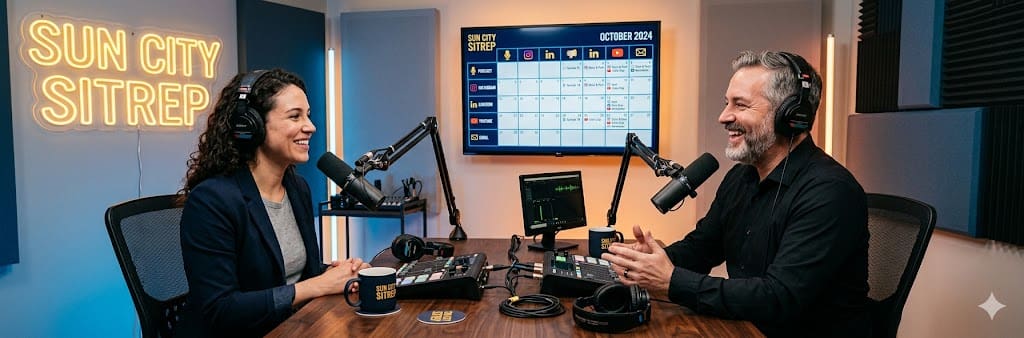
Sun City SITREP Studio is built specifically to produce source material that repurposes well across every format and platform. The sound-treated environment, professional lighting, 4K video capability, and repositionable sets are the infrastructure that makes the what to do with podcast content after recording question answerable with “everything” rather than “not much.”
How to Build a Podcast Repurposing Workflow
How do you build a podcast repurposing system? Six steps that convert every recording session into a fully deployed content calendar without requiring a dedicated content team.
- Record the full episode in a professional studio — audio and video simultaneously. One session produces the audio-first podcast and the video-first YouTube and social content from a single appearance
- Generate a transcript immediately after recording — automated tools (Otter.ai, Descript, Riverside) produce working transcripts in minutes. The transcript is the raw material for the blog post, show notes, LinkedIn article, and quote extraction that follow
- Identify the best moments from the transcript — 3–5 clip candidates (60–90 seconds each), 3–5 quote candidates (1–2 sentences each), 1–2 core topics for written expansion. This takes 20–30 minutes and produces the asset map for every downstream piece
- Assign each content piece to a channel and schedule — map each of the ten content types to a specific platform and publication date. The full episode publishes first. Short-form clips follow over the next week. The blog post and LinkedIn article publish in subsequent days
- Publish and distribute systematically — execute the schedule. The newsletter goes to the email list. The clips go to social. The blog post goes live on the website with SEO optimization. The YouTube video publishes with a searchable title and description
- Track performance and refine — after 4–6 episodes, patterns emerge: which clip format performs best on which platform, which quote style gets shared most, which blog post topics earn the most search traffic. The data refines the asset selection process for future episodes
The practical time investment: one 60-minute recording session plus 3–4 hours of repurposing work produces two weeks of consistent multi-channel content. For a podcast repurposing strategy for small business to work sustainably, this ratio needs to make sense against the business owner’s time — and it does, compared to the alternative of producing each piece of content independently from scratch.
Ready to Record? Your Content Library Starts at Sun City SITREP Studio
The repurposing strategy in this post is only as strong as the source material it’s built from. Ten pieces of content from a professional recording session. Ten pieces of content from a phone recording. The multiplication works the same way. The quality of what reaches your audience does not.
Three paths forward based on where you are:
- Already podcasting? If your current setup is limiting the quality of your repurposed content — clips that don’t perform, audiograms that sound amateurish, YouTube videos that lose viewers in the first three seconds — a professional studio session produces the source material your repurposing strategy actually needs to compete
- Considering starting a podcast? One session at Sun City SITREP Studio produces the full episode, the video, the clips, the audiogram, the blog post raw material, the quote graphics, and the YouTube video. The ROI of the first session is ten pieces of content that establish your brand’s presence across every channel simultaneously — which answers the question of whether a podcast is worth the investment before the second session is ever booked
- Not sure where to start? Sun City SITREP Studio works with brands, creators, and businesses at every stage — from concept to published episode. The process is designed to be seamless, and every session is built to produce source material that works everywhere your business needs to show up
Sun City SITREP Studio is located at 9400 Viscount Blvd., El Paso, TX — El Paso’s premier podcast studio built for brands, creators, and businesses that want professional source material worth repurposing everywhere.
Book your session and start building your content library from the session up.
Frequently Asked Questions About Podcast Content Repurposing for Business
What is podcast content repurposing?
Podcast content repurposing is the process of taking a recorded podcast episode and converting it into multiple content formats for distribution across different platforms. Instead of treating a podcast episode as a single piece of content, repurposing treats it as a source asset that produces blog posts, social media clips, audiograms, quote graphics, email content, LinkedIn articles, YouTube videos, and short-form Reels — all from a single recording session with no additional recording time required.
How many pieces of content can you get from one podcast episode?
At minimum ten: the full episode, short video clips for social media, an audiogram, a blog post, a show notes page, social media quote graphics, a LinkedIn article or newsletter section, email newsletter content, a YouTube video, and short-form Reels or TikTok content. Longer, more substantive episodes yield more clip and quote candidates. How to repurpose podcast content effectively starts with recording an episode dense enough to produce multiple strong moments worth extracting.
How do you turn a podcast into a blog post?
Generate a transcript from the recorded episode using an automated transcription tool, restructure the transcript into a readable written format with subheadings and edited prose, and optimize the piece for a specific search query the episode’s topic naturally addresses. The result earns independent Google search traffic from readers who would never find the original audio episode — building SEO authority from a recording session that already happened.
Do I need professional equipment to repurpose podcast content effectively?
For basic repurposing — transcripts, show notes, quote graphics — a well-recorded USB microphone setup produces usable source material. For competitive repurposing — video clips that perform on LinkedIn, YouTube videos that hold attention against professional creators, audiograms that sound studio-quality in a professional content feed — professional equipment and a sound-treated recording environment produce source material that repurposes into content that can actually compete. The quality of the source recording sets the ceiling for every piece produced from it. Podcast marketing for small business that’s built to scale eventually hits the ceiling of DIY recording quality.
How often should a business publish new podcast episodes?
Consistency matters more than frequency. One well-produced episode per week that generates ten pieces of repurposed content distributed across two weeks is more effective than three inconsistently produced episodes that generate nothing downstream. Most business podcasters find that one episode every one to two weeks is sustainable at production quality worth repurposing — and that the repurposing workflow extends the content presence of each episode far beyond the original publication date.