





Podcast Studio for Business El Paso: One Day, One Fall Calendar
A podcast studio for business El Paso marketers actually use solves a calendar problem, not an audio problem. School is back, Q3 budgets are moving, and your fall content plan is either locked or already late. However, nobody on your team has time for weekly shoots — that's the part that kills these plans. So here's the alternative: batch record podcast episodes for the whole quarter in one booked studio day. This guide shows you how, hour by hour.
Podcast Studio for Business El Paso: The Short Answer
The Consistency Problem Every Local Brand Has
You've seen the pattern, and maybe lived it: three videos in September, nothing in October, a scramble in November. In fact, inconsistency is what kills momentum, and it usually comes from trying to record one episode at a time. The fix isn't more discipline; it's fewer, bigger recording days.
For example, each one-off shoot carries the same overhead — scheduling, setup, warm-up — for a single piece of content. Consequently, the shoots feel expensive in time even when they go well, and the calendar loses every tug-of-war with daily operations. Also, every skipped week makes the next shoot feel heavier, because now it has to justify the gap too. Batching breaks that cycle at the root.
Meanwhile, August is El Paso's re-entry month. School is starting across the city, budgets are in motion, and the City of El Paso business community shifts back into full speed. In short, the brands that lock their fall content now are the ones still publishing in November — and batching is how they do it. For the wider playbook on small-business marketing, the U.S. Small Business Administration is the standing reference.
A Sample Batch Day, Hour by Hour
First, the schedule itself — this is the shape we run most often, so trade the clock for your own start time. Also, feel free to forward this table to whoever signs off on the budget; it answers most of their questions before they ask.
| Time | What happens | Why it's scheduled there |
|---|---|---|
| 9:00 | Arrival, mic checks, set one lit and framed | The engineer handles setup while you review the run sheet |
| 9:30 | Episode one — your strongest topic | Fresh voices and fresh energy go to the flagship episode |
| 10:45 | Reset: set, lighting, and wardrobe change | Each episode should read as its own shoot |
| 11:00 | Episode two, then a working break | Momentum is high; the break protects your voice |
| 12:45 | Episodes three and four — shorter formats | Afternoon slots suit quick, scripted segments |
| 3:00 | Wrap and deliverables review | You leave knowing what lands and when |
Podcast Studio for Business El Paso: What Batch Recording Means in Practice
Batch recording means treating the studio day like a production sprint: several episodes scripted ahead, recorded back to back, with deliberate resets in between. So instead of four separate shoots across four busy weeks, you make one calendar block and defend it.
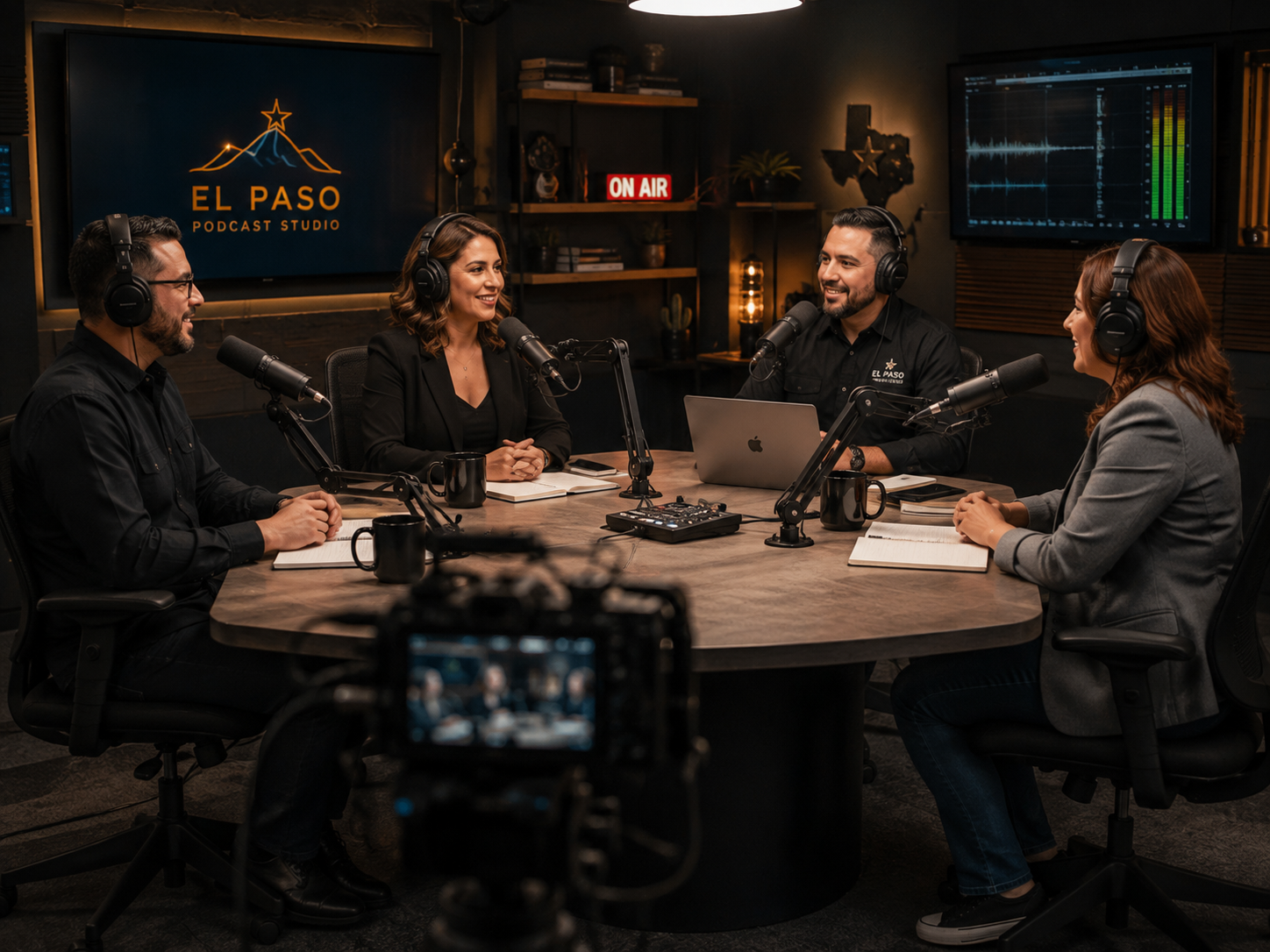
The studio's job is to make that sprint feel easy. An engineer runs every session, resets happen between episodes, and the room is built for long days. Additionally, cinema-grade cameras and broadcast audio run simultaneously, which means a corporate video podcast El Paso audiences can watch and a podcast feed they can subscribe to come out of the same take.
One more thing batch recording changes: who has to care. A weekly shoot needs your whole team bought in for months. A batch day needs them for one date. So the plan survives vacations, quarter-end crunch, and the colleague who was never going to show up four separate times.
How Many Episodes You Can Realistically Record in One Day
Three to four is the sustainable range for most teams, and shorter formats stretch to six — beyond that, vocal fatigue shows up in the audio. Granted, ambition says eight; your voice on episode seven disagrees.
Meanwhile, experienced teams with prepared scripts finish three or four episodes in a half day. However, first-timers should plan a full day, then treat anything past episode four as a bonus. Episode length matters too: two twenty-minute conversations cost less voice than one meandering hour, which is why the run sheet fixes lengths in advance. Ultimately, the target isn't a number — it's a quarter of publishing covered without a second booking.
Scripting a Batch Before You Arrive
Scripts are where batch days are won. Of course, "script" doesn't have to mean a word-for-word read — bullet outlines work, as long as every episode has a shape before you walk in. Then sort the batch by energy, not by logic: the sharpest topic goes first, the routine one after lunch. Here's the planning checklist to bring to your first session:
- Episode topics. One line per episode, sorted with the strongest first.
- Speaking order. Who opens, who closes, and who fields which questions.
- Guest confirmations. Names, arrival times, and also a backup plan per guest.
- Branded elements for the set. Products, signage, wardrobe — anything the camera should see.
- A cutoff rule. Decide in advance when a take is good enough, so perfectionism can't eat episode four.
Notably, this list is also your budget defense: a scripted batch day is the business content strategy El Paso marketers can actually show their manager on one page.
Making Each Episode Look Different: Sets, Lighting, and Framing
The classic worry: won't four episodes from one day look identical? No — if sets, lighting, and wardrobe change between episodes. Specifically, repositionable sets and customizable lighting make each one distinct, and that reset is the engineer's job, not yours.
Framing does the rest. For example, a two-camera interview look for episode one, a tighter solo frame for episode two, a standing product segment after lunch. To see how a single-guest set reads on camera, the Minerva Torres Shelton episode is a good reference point from our own room. Wardrobe, meanwhile, is the zero-cost trick: a jacket change between episodes reads as a different session on camera.
Managing Vocal Fatigue Across a Long Session
Voices wear out before enthusiasm does, and the audio shows it first. So the schedule protects your voice on purpose: hardest episode first, a real break mid-day, shorter formats in the afternoon. Plan your speaking order, too, so the same person isn't carrying every opening segment.
Then there are the small habits we coach teams through on the day — water instead of iced soda, resetting your posture between takes, and letting the engineer flag the moment your energy dips. Also, the reset breaks between episodes double as voice breaks, which is one more reason not to skip them. Hosts are often surprised by which episode sounds best — in fact, it's rarely the one that felt best in the room. Trust the engineer's ear over your adrenaline.
Start a podcast in El Paso →Repurposing a Batch Day Across Q3 and Q4
One batch day is really a content library in disguise. A podcast gives a local brand searchable, repurposable content and direct authority with its market — that's what makes batch production cost-effective. Here's how the same four episodes stretch across two quarters:
- Weekly episodes. Four full episodes release through September, then into October on a fixed day.
- Short vertical clips. Each episode yields social cuts that fill the gaps between releases.
- Quotes and stills. Strong lines become email content and ad creative through Q4.
- Transcripts. Episode pages give your website searchable text that keeps working after the feed moves on.
In essence, your fall content calendar stops being a list of deadlines and becomes a release schedule. Then Q4 gets the second wind: holiday promotions borrow clips from episodes recorded in August, and January's planning meeting starts from a library rather than a blank page. If you're still comparing rooms, our guide to finding a podcast studio near you covers what to look for.
El Paso podcast studio for rent →Frequently Asked Questions
Q1 Podcast studio for business El Paso: how many episodes fit in one session? +
Q2 Will batch-recorded episodes look repetitive? +
Q3 Is a podcast worth it for a small business in El Paso? +
Q4 What should a business prepare before a batch session? +
Q5 How long does a batch recording day take? +
Podcast Studio for Business El Paso: Book Your Batch Day
So that's the case for a podcast studio for business El Paso teams can batch in: one scripted day, three to six episodes, and a fall calendar that runs on schedule through Q4. Momentum is the strategy, and August is the month to buy it. The room, the resets, and the engineer are ready — bring the scripts.