





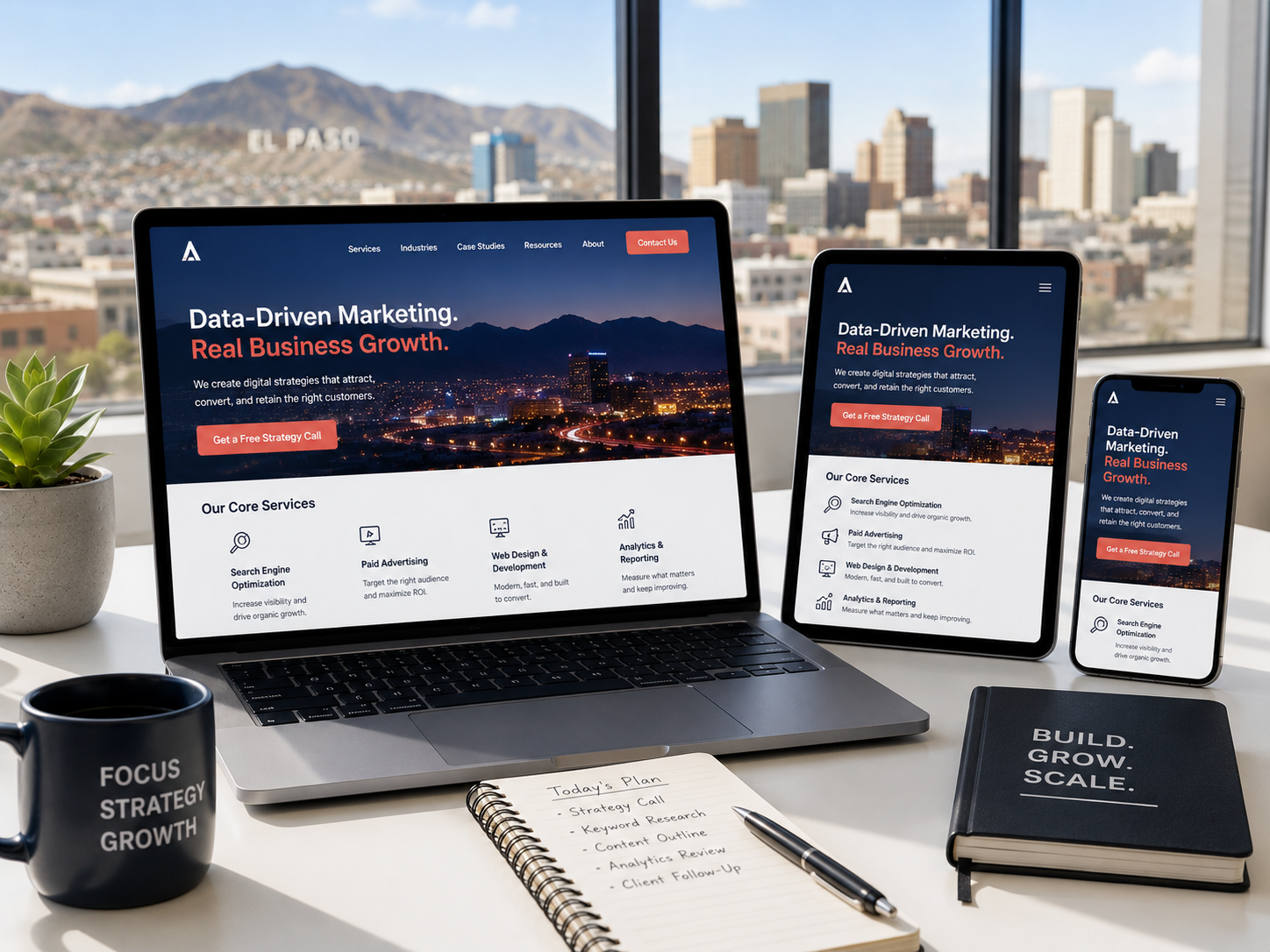
Scalable Website Design El Paso: Build a Site That Grows With You
scalable website design El Paso is not just about launching a better-looking site. It is about building a digital foundation that can grow with your business, support SEO, handle new pages, improve conversions, track leads, and adapt as your marketing becomes more advanced. A scalable website gives your business room to move instead of forcing another rebuild every time you need to grow.
What Is Scalable Website Design El Paso?
Why El Paso Businesses Need More Than a Brochure Website
A brochure website can introduce your business, list your services, and provide basic contact information. That may be enough when a company is brand new. However, once the business starts competing for search visibility, leads, local trust, and stronger customer journeys, a basic brochure site often starts to show its limits.
For example, a small business may need new service pages, location pages, blog content, online booking, call tracking, CRM integrations, landing pages, or multilingual content. If the original website was not built with that future in mind, each upgrade becomes harder than it should be.
Google’s SEO Starter Guide explains that site structure, helpful content, links, and technical accessibility help search engines understand pages and help users find useful information. Google’s PageSpeed Insights documentation also shows why performance matters for real user experience. Review Google’s SEO Starter Guide and Google PageSpeed Insights.
Build a scalable business website →Scalable Website Design El Paso at a Glance
The difference between a brochure website and a scalable website is not only visual. It is strategic, technical, and operational.
| Website area | Brochure website | Scalable website | Business value | What to check |
|---|---|---|---|---|
| Site structure | Few basic pages | Organized service, location, and content architecture | Easier growth | Can new pages fit naturally? |
| SEO foundation | Minimal optimization | Keyword, metadata, internal links, schema-ready content | Better visibility | Can search engines understand the site? |
| Content system | Hard to expand | Repeatable page and blog templates | Faster publishing | Can the team add content easily? |
| Conversion paths | Generic contact button | Clear CTAs, forms, calls, booking, lead magnets | More leads | Does each page guide action? |
| Performance | Looks fine but may be slow | Built for speed, mobile use, and accessibility | Better experience | Does it pass speed and usability checks? |
| Analytics | Basic traffic view | Lead tracking, events, forms, calls, and campaign data | Smarter decisions | Can you see what creates leads? |
| Integrations | Disconnected tools | CRM, email, automation, ads, AI, and reporting connections | Less manual work | Can tools work together? |
Start With Website Architecture
Scalable website design El Paso starts with architecture. Before colors, photos, or layouts are finalized, the business needs a clear structure for pages, services, topics, locations, and conversion paths.
This matters because website architecture affects both users and search engines. A clear structure helps visitors find the right service quickly. It also helps search engines understand which pages are most important and how topics connect.
For example, a service business may need a homepage, core service pages, individual service detail pages, local landing pages, case studies, blog resources, pricing information, and contact paths. Additionally, each page should have a clear role. Some pages educate. Some compare. Some convert. Some build trust.
Build an SEO Foundation From the Beginning
SEO should not be added after the website is finished. It should shape the site from the beginning.
A strong SEO-friendly website design includes clean URLs, useful title tags, strong internal links, fast page loading, mobile-friendly layouts, accessible content, optimized images, and clear page hierarchy. It also includes enough content depth for service pages to answer real buyer questions.
This is especially important for local businesses in El Paso. Local buyers often search with intent. Therefore, the site needs pages that match those searches and explain why the business is relevant.
Connect web design with SEO strategy →Design Page Templates That Can Expand
A scalable website should not require a custom rebuild every time the business needs a new page. Instead, it should use flexible page templates that support future content.
For example, a service page template might include a clear headline, service summary, benefits, process, FAQs, proof, CTA, and related links. A blog template might support an intro, answer block, table, internal links, FAQs, and CTA. A location page template might include local context, services, testimonials, map information, and contact options.
Templates create consistency. They also make content production faster because the team does not have to reinvent the layout every time. However, scalable templates should not feel generic. They should give the business structure while still allowing each page to answer a specific customer need.
Connect Design to Conversion Paths
A website can look polished and still fail to convert. That is why scalable website design El Paso should include clear conversion paths from the beginning.
Every important page should guide users toward the next step. That may be a phone call, form submission, consultation booking, quote request, download, newsletter signup, or project inquiry. The right CTA depends on the buyer stage and the page intent.
For instance, a homepage may guide visitors to services or contact options. A service page may invite them to request a quote. A blog post may lead to a related service page. A pricing page may reduce hesitation. A project page may build confidence.
See how websites become growth engines →Make Performance and Accessibility Part of the Build
Scalability is not only about adding more pages. It is also about keeping the website usable as it grows.
Performance matters because visitors expect pages to load quickly, especially on mobile. If a site becomes slower every time new content, scripts, images, or plugins are added, the business will eventually pay for that complexity. Therefore, scalable websites should use smart image handling, clean code, reliable hosting, thoughtful plugins, and performance testing.
Accessibility also matters. Clear contrast, readable text, keyboard-friendly navigation, descriptive links, form labels, and logical headings help more people use the site. Additionally, accessible structure usually supports better SEO because both users and search engines benefit from clarity.
Plan for Analytics, Automation, and Integrations
A scalable website should connect to the tools the business uses. Otherwise, the site may collect attention without turning that attention into usable data or follow-up.
At a minimum, a growth-ready website should track forms, calls, button clicks, important page visits, traffic sources, and campaign performance. Then, that information should connect to reporting, CRM systems, email marketing, or sales workflows when possible.
This is where website infrastructure meets marketing operations. A strong site can support future ads, SEO campaigns, AI-powered workflows, email nurture, booking tools, chat, customer portals, and reporting dashboards.
Explore digital ecosystems that scale →Scalable Website Design El Paso Checklist
Use this checklist before hiring a web design partner or rebuilding your site.
- Define the business growth goal. Decide whether the site needs to support more leads, better local visibility, new services, hiring, ecommerce, automation, or stronger brand trust.
- Map your core pages. Plan the homepage, service pages, location pages, about page, project pages, pricing content, blog resources, and contact paths.
- Build around search intent. Make sure each important page answers what local buyers are actually searching for.
- Create flexible templates. Use repeatable layouts for services, blogs, projects, landing pages, and location content.
- Plan internal links. Connect related pages so visitors and search engines can move through the site clearly.
- Design conversion paths. Give each page a useful next step, such as a call, form, booking, download, or related service page.
- Prioritize mobile performance. Test speed, image size, layout stability, and mobile usability before launch.
- Check accessibility basics. Use clear contrast, readable fonts, descriptive links, logical headings, and accessible forms.
- Set up analytics and lead tracking. Track organic traffic, form submissions, calls, button clicks, campaigns, and qualified leads.
- Plan content expansion. Make sure the site can support future blogs, service pages, FAQs, resources, and campaigns.
- Choose scalable tools. Use a CMS, hosting setup, plugins, and integrations that can support growth without creating clutter.
- Review and improve regularly. Update pages, test CTAs, refresh content, monitor performance, and improve based on data.
Common Website Scaling Mistakes to Avoid
Many businesses outgrow their websites sooner than expected because the site was designed only for launch day. However, a website should be built for the next stage of the business.
- Designing only for appearance. Visual design matters, but structure, speed, SEO, and conversion paths matter too.
- Skipping SEO during the build. Adding SEO later usually creates extra work and missed opportunities.
- Using thin service pages. Pages need enough helpful content to answer real customer questions.
- Choosing tools without a growth plan. The wrong plugins, builders, or hosting can make future updates harder.
- Ignoring analytics. Without tracking, the business cannot see which pages create leads.
- Using one CTA everywhere. Different pages and buyer stages need different next steps.
- Forgetting content expansion. A site that cannot support future content will limit marketing growth.
Frequently Asked Questions
Q1What is scalable website design El Paso?+
Q2Why does a business need a scalable website?+
Q3What makes a website scalable?+
Q4How is a scalable website different from a brochure website?+
Q5Can VenPro help with scalable website design in El Paso?+
Build a Website That Can Keep Up
scalable website design El Paso is about building for the business you are becoming, not only the business you are today. A scalable site gives your team a stronger foundation for SEO, content, conversions, analytics, automation, and future marketing campaigns.