





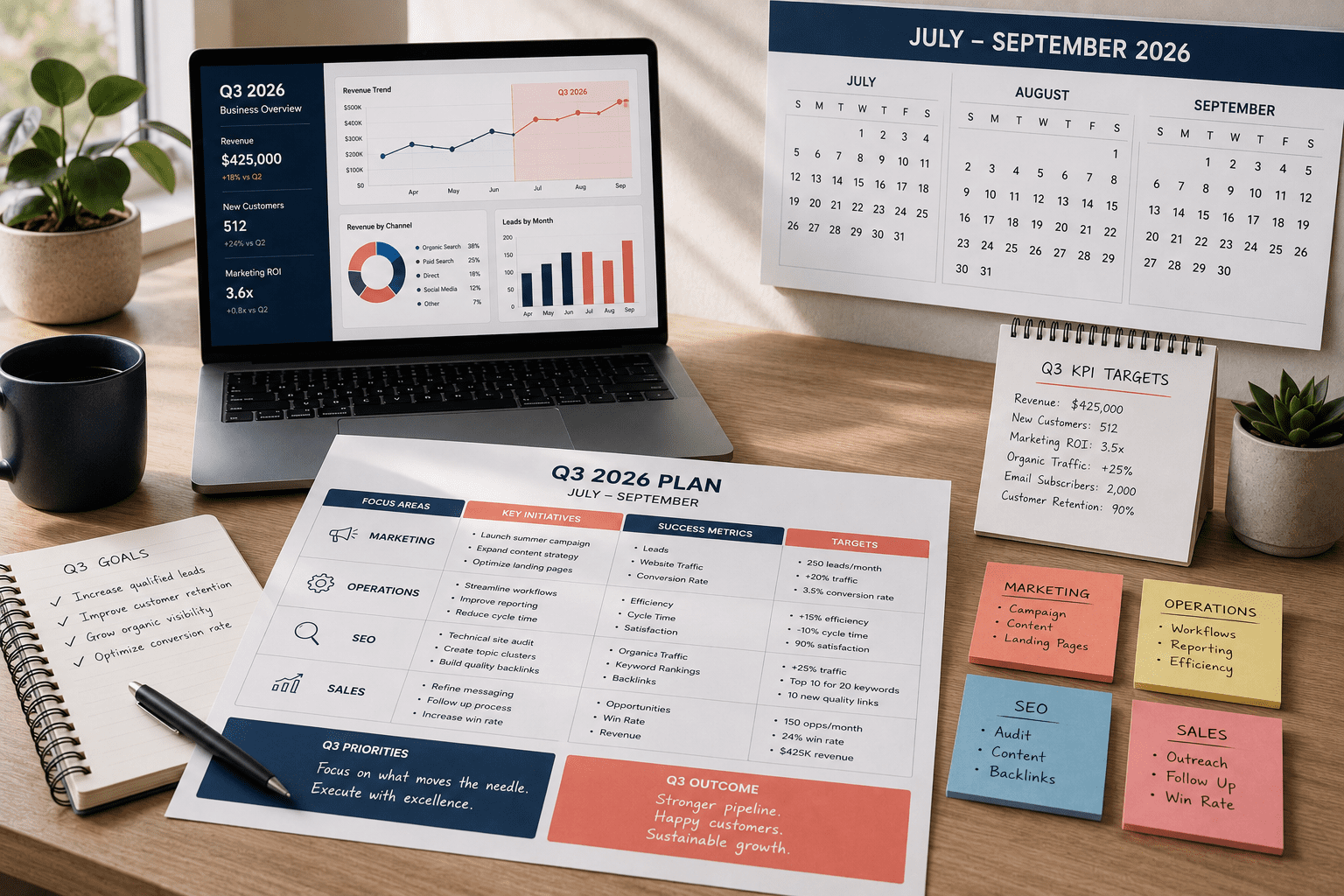
Q3 Business Planning Template June 2026
A q3 business planning template june 2026 gives your business one clear job before July arrives: turn mid-year review into Q3 execution. June is the planning window. Q3 is the execution window. If the team waits until July to decide priorities, the quarter starts with confusion instead of momentum.
What Should a Q3 Business Planning Template Include in June 2026?
Why a Q3 Business Planning Template June 2026 Matters
A q3 business planning template june 2026 matters because mid-year is where many plans start drifting. January goals may no longer match the market. Campaigns may have changed. Leads may be coming from different channels. Costs may be higher. Team capacity may be tighter.
Therefore, June is the right time to pause and reset. A June planning session lets you compare first-half performance against actual business conditions. Then, you can decide which priorities deserve attention in July, August, and September.
This is also the moment to separate activity from progress. A business may have posted more content, launched more ads, or attended more meetings. However, if those actions did not improve qualified leads, sales conversations, retention, traffic quality, or conversion rates, Q3 needs a sharper plan. The U.S. Small Business Administration’s business guide reinforces the value of planning, managing, and growing with clear fundamentals.
Q3 Business Planning Template June 2026 at a Glance
Use this table as the core planning worksheet. Each section turns a June review question into a Q3 action with a metric and owner.
| Planning Section | June Question | Q3 Action | KPI | Owner |
|---|---|---|---|---|
| Mid-Year Review | What worked and what stalled in H1? | Keep, cut, or adjust priorities before July | Revenue, leads, conversion rate | Leadership |
| Revenue Goals | What must Q3 produce? | Set July–September sales targets | Monthly revenue, pipeline value | Sales / Owner |
| Marketing Campaigns | Which offers need attention? | Build Q3 campaign calendar | Leads, CPL, booked calls | Marketing |
| SEO and Content | What should buyers find us for? | Update service pages, blogs, FAQs, and internal links | Rankings, clicks, qualified traffic | SEO / Content |
| Website Conversion | Where are prospects dropping off? | Improve CTAs, forms, landing pages, and proof points | Form fills, calls, conversion rate | Web / Marketing |
| Automation | What repeat work slows the team? | Add follow-up, reminders, routing, or reporting workflows | Response time, saved hours | Ops / CRM |
| Weekly Review | How will we stay on track? | Schedule weekly KPI and blocker reviews | Tasks completed, KPI movement | Team Lead |
Start With a Mid-Year Review Before Setting Q3 Goals
The first section of your Q3 business planning template should review the first half of 2026. Do not start with new goals until you know what the current numbers are saying.
Start with revenue. Did the business hit its monthly targets? Which products, services, locations, or customer segments performed best? Which offers underperformed? Then, review lead quality. More leads are not always better if they are the wrong leads.
Next, review marketing activity. Which campaigns created real conversations? Which channels brought traffic but not buyers? Which content helped sales? Which pages on the website carried the most weight? Finally, look at operational friction, including response time, proposal delays, repeated manual tasks, and disconnected tools.
Set Q3 Revenue, Marketing, and Operations Priorities
After the mid-year review, set Q3 goals that your team can actually execute. July, August, and September move quickly, so too many priorities can weaken the whole plan.
Start with three revenue priorities. For example, you may want to grow a core service, improve repeat sales, increase local visibility, or push a seasonal offer. Then, connect each priority to a clear business outcome.
Next, set marketing priorities. These may include campaign planning, content production, Google Business Profile updates, SEO page improvements, email follow-up, paid media testing, or review generation. Then, set operations priorities such as faster response time, cleaner lead routing, better CRM use, and automated follow-up.
Build SEO, Content, and AI Discovery Into the Plan
A q3 business planning template june 2026 should include SEO and content because Q3 visibility depends on what gets planned before the quarter starts. If your team waits until July to decide content topics, publish service-page updates, or fix search gaps, the quarter starts behind.
Google’s Search Essentials emphasize helping search engines find, crawl, index, and understand content. That means Q3 planning should include clear pages, useful answers, crawlable internal links, and language your buyers actually use.
For a small business, this may include updating service pages, adding FAQs, improving local landing pages, publishing comparison posts, refreshing old blogs, or building stronger internal links between core pages. Additionally, Google Business Profile performance data can show how people find and interact with a business through calls, directions, bookings, messages, and website clicks.
Plan Website and Conversion Improvements Before Campaigns
Q3 campaigns can create attention, but the website has to turn that attention into action. Therefore, your planning template should include website conversion work before the campaign calendar is finalized.
Start with the highest-value pages. Review the homepage, service pages, pricing page, contact page, and landing pages. Ask whether each page explains the offer clearly, shows proof, answers objections, and gives visitors an obvious next step.
Next, check conversion paths. Are forms easy to complete? Are phone numbers visible? Are CTAs specific? Does the website show who the business helps and why buyers should trust it? If not, more traffic may only expose the problem faster.
How to Use This Q3 Business Planning Template June 2026
A q3 business planning template june 2026 works best when it is used in two sessions: one planning session in June and one weekly review rhythm during Q3.
First, schedule a 60–90 minute June planning meeting. Bring first-half revenue numbers, website analytics, lead data, campaign results, customer feedback, and team capacity notes. The goal is to identify what should continue, what should stop, and what should change.
Second, choose three to five Q3 priorities. Each priority needs an owner, a KPI, a deadline, and a next action. If nobody owns the priority, it is not a plan. If there is no KPI, it is only a wish.
Review VenPro pricing →How VenPro Builds Q3 Planning Into a Growth System
VenPro treats planning as the front end of execution. For growing businesses, a Q3 plan should connect strategy, brand, SEO, website performance, content, automation, AI, analytics, and lead generation.
That matters because isolated plans often fail. A marketing campaign without a conversion path wastes attention. SEO without content production stalls. Automation without clean messaging feels robotic. Reporting without ownership becomes noise.
VenPro’s pricing and discovery process is scoped around business goals, market, and growth stage rather than one-size-fits-all packages. That approach fits Q3 planning because the right plan depends on the company’s current bottleneck.
Explore VenPro SEO services →Frequently Asked Questions
Q1 What should a q3 business planning template june 2026 include? +
Q2 When should businesses start Q3 planning in 2026? +
Q3 What are the months in Q3 2026? +
Q4 How do you create a quarterly business plan? +
Q5 What KPIs should be in a Q3 business plan? +
Turn June Planning Into Q3 Execution
A q3 business planning template june 2026 helps your business start Q3 with direction instead of scrambling. June gives you the time to review what worked, choose the right priorities, assign owners, and build a practical July–September action plan. The best Q3 plans are clear, visible, measurable, and reviewed often.