





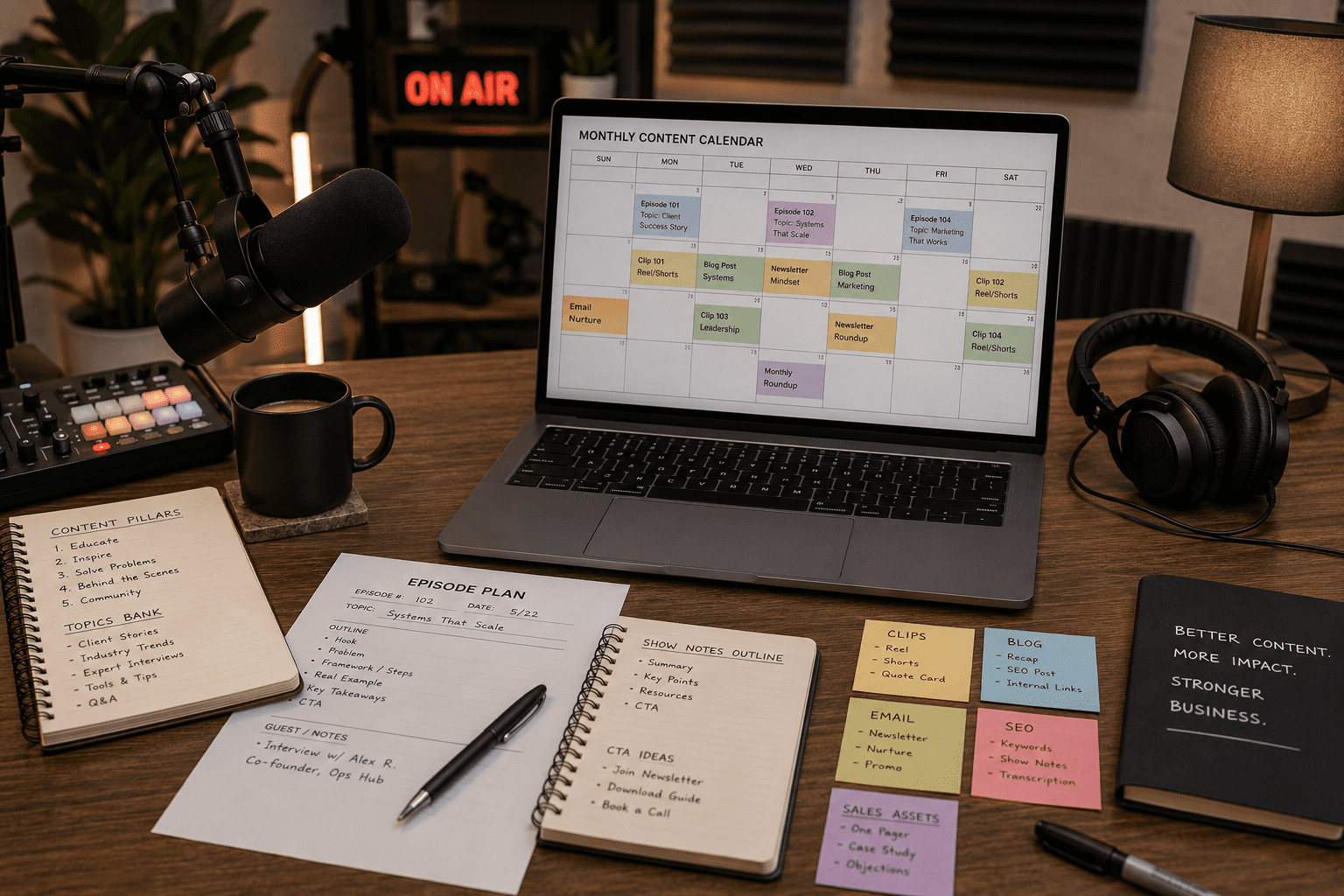
Podcast Studio Business Content Calendar
A podcast studio business content calendar helps your team turn one recording session into weeks of useful marketing content. Instead of treating a podcast episode as one isolated asset, the calendar connects studio time to clips, blogs, email, social posts, SEO topics, sales follow-up, and brand visibility.
How Do You Create a Podcast Studio Business Content Calendar?
Why a Podcast Studio Business Content Calendar Matters
A podcast studio business content calendar matters because business content needs consistency, not random bursts of activity. A podcast studio gives you the environment to record higher-quality conversations. However, the calendar gives that content a second life across marketing channels.
For example, one 45-minute episode can become a full podcast episode, five short clips, one blog recap, one email newsletter, several quote graphics, a LinkedIn post, a Google Business Profile update, and a sales enablement snippet. Therefore, the return on the recording session depends on the repurposing plan.
This also helps with internal alignment. Marketing knows what to publish. Sales knows which episode to share with prospects. Leadership knows which topics support business priorities. Additionally, the studio team knows which shots, audio segments, and talking points need to be captured.
Podcast Studio Business Content Calendar at a Glance
Use this production framework to connect studio work to publishing, repurposing, and business goals.
| Calendar Section | Studio Task | Repurposed Assets | Publishing Channel | Business Goal |
|---|---|---|---|---|
| Monthly Theme | Choose a business priority or campaign topic | Topic bank, talking points, CTA direction | Website, email, social, sales | Align content with growth goals |
| Episode Plan | Record one focused conversation | Full episode, transcript, key quotes | Podcast platforms, YouTube, blog | Build authority and trust |
| Short Clips | Capture strong 30–90 second moments | Reels, Shorts, TikToks, LinkedIn clips | Social video platforms | Increase reach and awareness |
| Blog Recap | Turn the episode into a written article | SEO recap, FAQ, internal links | Website blog | Support search visibility |
| Email Follow-Up | Package the main lesson for subscribers | Newsletter, nurture email, sales follow-up | Email platform, CRM | Move leads toward action |
| Sales Asset | Pull proof, stories, or objections answered | Proposal snippet, case-story clip, FAQ answer | Sales calls, follow-up emails | Help prospects decide |
| Performance Review | Review views, clicks, leads, and engagement | Reporting notes, next-topic ideas | Dashboard, planning doc | Improve future content |
Start With the Business Goal Before the Episode Topic
The first step in building a podcast studio business content calendar is choosing the business goal. Do not start with “What should we talk about?” Start with “What should this content help the business accomplish?”
A business may want to attract better leads, explain a service, answer common objections, build founder authority, support recruiting, promote a campaign, or educate local customers. Each goal leads to a different episode angle.
For instance, a service business trying to improve lead quality may record an episode answering the questions buyers should ask before hiring a provider. Meanwhile, a brand trying to support sales may record a conversation that addresses objections heard on calls. Once the goal is clear, the episode becomes easier to plan.
Plan the Recording Session for Repurposing
A strong content calendar starts before the recording session because repurposing is easier when the episode is structured intentionally. If the conversation wanders too much, the editing team may struggle to find clean clips, clear quotes, and usable sections.
Start by building a simple run-of-show. Include the hook, three to five major questions, key stories, proof points, CTA, and a few short answer prompts. These prompts should create natural clips, such as answers to common mistakes, first steps, myths, or buyer questions.
Also, identify the written content angle before recording. If the episode can become a blog recap, the host should ask questions that create definitions, lists, examples, and practical steps. Google’s Search Essentials emphasize clear, helpful content that search engines can understand, so a structured episode can support both video and written search content.
Turn One Studio Episode Into a Multi-Channel Content Calendar
One of the biggest benefits of a podcast studio business content calendar is that it turns one recording into many assets without making the team start from scratch each time.
- Publish the full episode. Upload the video or audio episode with a clear title, description, and CTA.
- Cut short clips. Pull three to seven moments that answer a question, share a story, or make a strong point.
- Write the blog recap. Turn the episode into an SEO-friendly article with key takeaways, FAQs, and internal links.
- Send the email. Share the main lesson with subscribers or prospects.
- Support sales. Save the best clip or quote for follow-up conversations.
- Review performance. Track which topics, hooks, and clips created useful engagement.
Spotify for Creators recommends promoting podcast episodes through channels such as social media, newsletters, video, and cross-promotion. That same idea becomes stronger when the business plans those assets before the recording session.
Connect Podcast Content to SEO and AI Discovery
Podcast content should not live only on podcast platforms. A strong business content calendar should connect each episode to search visibility, website structure, and AI discovery.
Google’s Search Essentials focus on making content findable, crawlable, and understandable. Therefore, a podcast episode can become more valuable when it is supported by a blog recap, optimized title, transcript, FAQ section, internal links, and clear service context.
This matters for AI answer engines too. AI systems often summarize clear definitions, lists, comparisons, and direct answers. If your podcast content is only locked inside audio, it may be harder for search and AI tools to understand. By contrast, a written recap gives the episode more surfaces to be discovered.
Use a Simple Weekly Publishing Rhythm
A podcast studio business content calendar does not need to be complicated. In fact, a simple weekly rhythm is usually easier to maintain.
For example, the business might publish the full episode on Monday, post the first short clip on Tuesday, send an email on Wednesday, publish the blog recap on Thursday, and post a second clip on Friday. The next week, the team can publish additional clips, quotes, and sales-support content from the same recording.
YouTube Help recommends using strong titles, descriptions, thumbnails, and consistent publishing practices to help people understand and discover video content. For business podcasts, that means every upload should have a clear purpose, not just a file name and a vague description.
How to Build a Podcast Studio Business Content Calendar
A podcast studio business content calendar works best when it is built around monthly themes, weekly publishing, and clear ownership.
First, choose one monthly theme tied to a business priority. This could be lead generation, customer education, brand authority, hiring, a new service, a seasonal campaign, or a common sales objection. Then, plan two to four episode topics under that theme.
Second, map each episode to repurposed assets. Decide how many clips, blog posts, emails, quote graphics, and sales snippets should come from the recording. Third, assign an owner for editing, writing, approval, publishing, and reporting.
Read Content With Purpose →How VenPro Turns Studio Content Into a Growth System
VenPro’s Podcast & Media Studio is designed for businesses that want more than a recording. The goal is to help brands capture professional content with intention, then turn that content into clarity, credibility, and reach.
That matters because a studio session is only one part of the system. The real value comes from planning, editing, repurposing, publishing, SEO support, website alignment, and performance review. A great conversation can support social media, blogs, sales enablement, email nurturing, local visibility, and brand trust.
VenPro’s content strategy approach connects storytelling with sales, while its broader growth ecosystem connects content to SEO, web design, automation, analytics, and AI-assisted workflows. In short, the studio becomes a source for reusable business assets.
Explore The Content Compass →Frequently Asked Questions
Q1 What should a podcast studio business content calendar include? +
Q2 How often should a business record podcast episodes? +
Q3 How do you repurpose a podcast episode for marketing? +
Q4 Why should a business use a podcast studio instead of recording casually? +
Q5 How do you measure a podcast content calendar? +
Record Once, Repurpose for Weeks
A podcast studio business content calendar turns recording day into a repeatable content system. Instead of publishing one episode and moving on, the business can create clips, blogs, emails, social posts, sales assets, and SEO support from the same conversation.