A podcast content repurposing strategy helps businesses turn one episode into a full content system. Instead of publishing a podcast once and hoping people find it, repurposing gives the episode more life across short clips, blog recaps, email, social posts, SEO content, sales follow-up, and customer education.
Quick answer block
Why a Podcast Content Repurposing Strategy Matters
A podcast content repurposing strategy matters because long-form content takes time to create. If a business records a thoughtful 45-minute conversation, that conversation should become more than one upload and one social post.
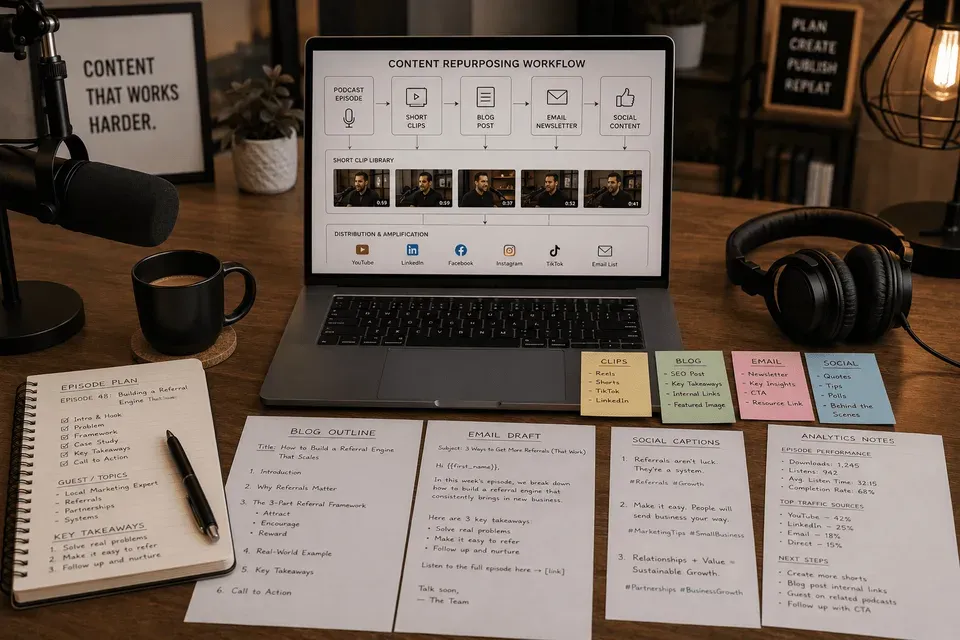
For example, one episode can become a YouTube video, audio episode, five short clips, one blog recap, one email newsletter, several social captions, quote graphics, FAQ answers, sales follow-up snippets, and a future content brief. Therefore, repurposing improves the return on the original recording.
It also helps different audiences consume the same idea in different ways. Some people will watch a full episode. Others will only see a 60-second clip. Some will read the blog. Others may respond to the email or hear about the idea in a sales conversation.
Podcast Content Repurposing Strategy at a Glance
Use this framework to connect each podcast source asset to a format, channel, business goal, and tracking metric.
| Source Asset | Repurposed Format | Best Channel | Business Goal | Tracking Metric |
|---|---|---|---|---|
| Full Episode | Long-form video or audio | YouTube, Spotify, Apple Podcasts | Build authority and depth | Views, listens, watch time |
| Strong Answer | 30–90 second clip | Reels, Shorts, TikTok, LinkedIn | Grow reach and awareness | Plays, saves, shares |
| Episode Transcript | Blog recap or article | Website blog | Support SEO and AI discovery | Organic clicks, page views |
| Key Quote | Graphic or carousel | Instagram, LinkedIn, Facebook | Reinforce brand message | Engagement, profile visits |
| Common Objection | Sales snippet or follow-up email | CRM, sales email, proposals | Help prospects decide | Reply rate, booked calls |
| Practical Tip | Newsletter section | Email list | Nurture leads and customers | Opens, clicks, replies |
| Expert Insight | FAQ or resource page section | Website, service pages | Build trust and clarity | Assisted conversions |
Start Before Recording, Not After Editing
The strongest podcast content repurposing strategy starts before the episode is recorded. If the team waits until editing to decide what to repurpose, they may discover the episode does not have enough clean clips, clear answers, or useful sections.
Start with the audience. Who should care about this episode? Then define the core message. What should the viewer, listener, reader, or prospect understand after consuming the content?
Next, plan the CTA. This could be booking a consultation, reading a related guide, joining an email list, visiting a service page, downloading a resource, or sharing the episode with a team member. Finally, design recording prompts that create standalone moments, such as common mistakes, first steps, customer questions, and success examples.
Turn the Full Episode Into Short-Form Clips
Short-form clips are often the most visible part of a podcast repurposing plan. However, the best clips are not random highlights. They are self-contained moments that answer a question, challenge a belief, explain a process, or tell a quick story.
A strong clip usually has a clear hook, one idea, and a natural ending. It should not require the viewer to know the entire episode context. Additionally, the caption should add meaning instead of simply repeating the clip.
For business podcasts, useful clip types include mistake clips, myth clips, quick tips, customer questions, founder opinions, behind-the-scenes insights, objection answers, and proof moments. Spotify for Creators recommends promoting podcast episodes through social media, video, newsletters, and cross-promotion, which works best when clips are selected for specific channels and audience behaviors.
Turn Podcast Episodes Into SEO and Blog Assets
A podcast content repurposing strategy should include written content because search engines and AI systems need text they can understand, crawl, and summarize. A podcast episode may be excellent, but if the ideas are only inside audio or video, they can be harder to discover.
Google’s Search Essentials emphasize helpful, crawlable, understandable content. Therefore, a podcast episode can become more valuable when it is supported by a blog recap, transcript highlights, FAQ section, internal links, optimized title, and clear service context.
A blog recap should not be a raw transcript. Instead, it should turn the episode into a structured article with a clear opening answer, section headings, takeaways, examples, and a CTA. This makes the content easier for readers, search engines, and AI answer engines to use.
Use Podcast Content for Email, Sales, and Lead Nurture
Not every repurposed asset needs to be public. Some of the most valuable podcast content can support email, sales, and lead nurturing.
For example, if an episode answers a common customer objection, that answer can become a sales follow-up email. If a guest explains a process clearly, that section can become a nurture email. If a founder shares a strong point of view, that quote can become a message used in proposals or onboarding material.
This matters because prospects often need repeated clarity before they take action. As a result, repurposing supports both marketing and sales. Marketing gets more content, while sales gets better proof, clearer explanations, and useful follow-up material.
Build a Multi-Channel Publishing Rhythm
A podcast content repurposing strategy needs a publishing rhythm. Otherwise, the team may create assets but never release them consistently.
A simple rhythm could look like this: publish the full episode on Monday, post a short clip on Tuesday, send an email on Wednesday, publish the blog recap on Thursday, post a quote graphic on Friday, and save one sales snippet for follow-up conversations. The next week, publish two more clips and link back to the blog.
YouTube Help recommends using clear titles, descriptions, thumbnails, and consistent publishing practices to help viewers understand and discover videos. For business podcasts, those details should connect back to the larger repurposing plan.
How to Build a Podcast Content Repurposing Strategy
A podcast content repurposing strategy works best when it follows a repeatable process. The goal is to make repurposing normal, not heroic.
First, choose the episode goal. Decide whether the episode should support awareness, search visibility, sales enablement, customer education, retention, recruiting, or authority.
Second, map the repurposed assets before recording. Decide which clips, blog sections, email topics, social posts, FAQs, and sales snippets should come from the conversation. Finally, assign publishing dates, owners, channels, captions, titles, thumbnails, CTAs, and tracking metrics.
How VenPro Turns Podcast Content Into a Growth System
VenPro’s Podcast & Media Studio is designed for businesses that want more than a recording. The goal is to help brands capture professional content with intention, then turn that content into clarity, credibility, and reach.
That matters because a podcast episode is only one part of the system. The real value comes from planning, editing, repurposing, publishing, SEO support, website alignment, email follow-up, sales enablement, automation, and performance review.
VenPro’s broader growth ecosystem connects content to SEO, web design, analytics, AI-assisted workflows, automation, and brand strategy. Therefore, podcast content can support more than awareness. It can help the business educate buyers, strengthen search visibility, create sales resources, and build trust over time.
Frequently Asked Questions
A podcast content repurposing strategy is a plan for turning one podcast episode into multiple marketing and sales assets. It may include short clips, blog recaps, email topics, social posts, quote graphics, SEO content, FAQ answers, sales snippets, and follow-up resources tied to a clear business goal.
One podcast episode can often create 10 or more pieces of content, including a full video, audio episode, three to seven short clips, one blog recap, one email newsletter, quote graphics, social captions, FAQ answers, and sales follow-up snippets. The exact number depends on the episode structure and topic depth.
Repurpose a podcast episode for SEO by turning it into a structured blog recap with a clear title, headings, summary, key takeaways, FAQ answers, internal links, and a CTA. You can also use the transcript to identify search-friendly phrases and customer questions for future content.
The best podcast clips for social media are short, clear, and self-contained. Strong formats include mistake clips, myth-busting clips, quick tips, customer questions, founder opinions, behind-the-scenes moments, objection answers, and practical lessons that do not require the full episode for context.
Measure podcast repurposing success by tracking views, watch time, saves, shares, website visits, blog traffic, email clicks, replies, booked calls, lead form submissions, and sales conversations influenced by the content. The best metric depends on the business goal for the episode.
Turn Every Episode Into a Content System
A podcast content repurposing strategy helps every recording work harder. Instead of treating the episode as a single asset, the business can turn it into clips, blogs, emails, social posts, sales resources, SEO content, and follow-up tools.