





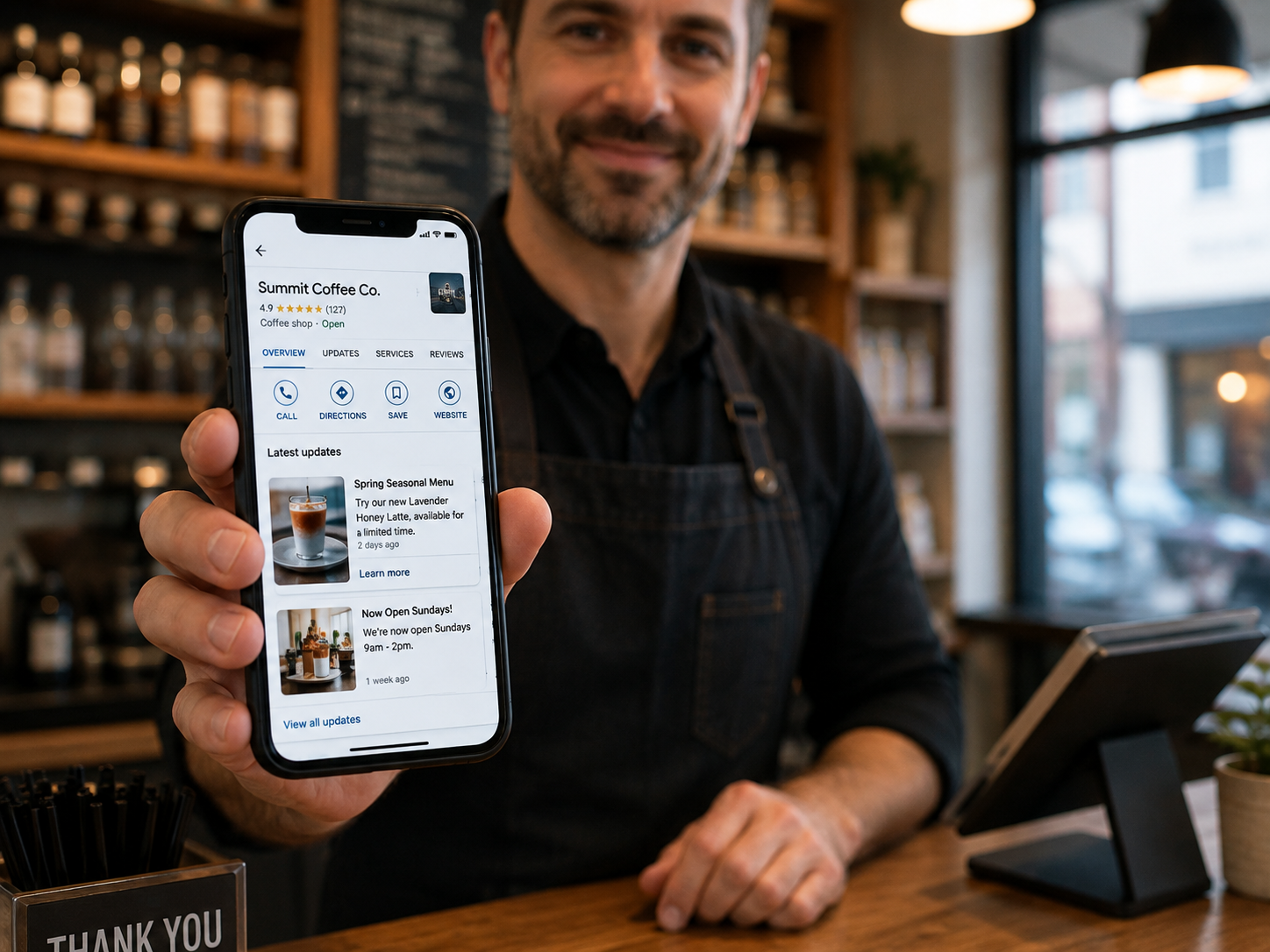
Google Business Profile Posts: What to Publish Every Week
Most Google Business Profile posts stop after about three weeks, and the reason is almost never laziness. It is that nobody decided in advance what each week's post is for. So the fourth week arrives, the blank box asks a question nobody has answered, and the habit quietly ends. This is a rotation instead: five post types, a four-week template, and the formatting rules that keep a post from getting rejected.
What Google Business Profile Posts Should Contain
Why Google Business Profile Posts Affect Local Visibility
A profile is not a static listing. It is the page most local searchers actually read, often without ever reaching your website. So what sits on it decides a great deal about whether someone calls.
Posts are worth being precise about here. They influence engagement and conversion signals more directly than rankings themselves. Notably, that is a useful distinction rather than a disappointing one, because engagement is the thing you can see and act on within a week. Standard posts remain visible until replaced or expired, so a weekly cadence keeps the profile looking current.
Here is the honest trade-off. This is small, repetitive work that never feels urgent, and the payoff shows up as calls rather than as a chart anyone celebrates. Also, a stale profile does real damage: a visitor reading a promotion from last spring learns something about how the business is run. Outcome: a profile that looks tended, which is most of what local trust is.
The Five Post Types Worth Rotating
Each type does a different job, so rotating them stops the profile reading like one long advert. The table below sets out what each type is for and where it comes from.
| Trait | What it means | Where it comes from | What you notice |
|---|---|---|---|
| The offer | Specifically, a dated promotion with one clear action. | Brief outline, H2 2: the five post types worth rotating. | Notably, vague discounts get ignored while dated ones get used. |
| The update | Basically, what changed this week: hours, staff, stock, or a finished job. | Brief secondary keywords: local business updates. | So the profile reads as tended rather than parked. |
| The event | Anything with a date and a place attached to it. | Brief outline, H2 2. | Meanwhile, events give people a reason to come rather than click. |
| The spotlight | One service or product, explained properly instead of listed. | Brief search intent: knowing what to actually write each week. | For example, the service you assume everyone knows about. |
| The answer | A question customers genuinely ask, answered in full. | Brief outline, H2 2, plus the profile's own question feature. | In short, these save your team the same phone call twice a week. |
A Four-Week Rotation Template
First, four weeks is the right unit because it fits a month without needing a calendar. So assign each week a type now, and the writing becomes filling a slot rather than inventing one.
- Week one: the offer. Start the month with something dated, because a fresh offer gives the other three weeks something to reference.
- Week two: the spotlight. Take one service and explain what it actually involves. Then link it to the matching page on your site.
- Week three: the answer. Pull a question straight from your inbox or the front counter. So the writing is already done for you.
- Week four: the update or event. Whichever is true that month. Notably, if neither is, a finished job with a photo works fine.
Then repeat the shape each month and vary the content. Also, write all four in one sitting and schedule them, because the failure mode is the weekly decision rather than the weekly writing. Our guide to local SEO fundamentals covers where the profile sits in the wider picture. Outcome: a month of posts decided in an hour.
Engaging local customers online →Writing Posts That Do Not Get Rejected
Of course, rejections are common and rarely mysterious. Most rejections trace to restricted content, contact details in the body, or overly promotional claims. So the fixes are mechanical.
- Keep contact details out of the body. The profile already carries your number, so repeating it in the text is the most common trigger.
- Avoid absolute claims. Words like best, guaranteed, and number one invite trouble. Then say the specific thing instead.
- Check restricted categories. Some sectors have rules others do not, and the Google Business Profile Help documentation is the place to confirm yours.
- Keep promotional language honest. Notably, the FTC's advertising rules apply to a profile post exactly as they apply to an advert.
If a post is rejected, edit rather than resubmit unchanged. Also keep a note of what triggered it, because the same phrasing tends to reappear. Outcome: fewer rewrites and no quiet gaps in the schedule.
Photos and Formatting That Perform
A post with a real photograph reads differently from one with a stock image, and local searchers are unusually good at spotting the difference. So use your own premises, your own team, and your own finished work.
Then keep the text short. Lead with the point in the first line, because that is what shows before anyone taps. One action per post, one link, no wall of hashtags. In short, treat it like a shop window rather than a newsletter.
Also, size the photo for a phone, since that is where nearly all of these get seen. A wide shot of the storefront often works better than a tight product crop, because it gives someone a landmark to recognise. Then reuse nothing, as a photo already sitting on the profile adds no reason to look twice.
Measuring Post Performance
First, decide what a good week looks like before you look at any number. Calls, direction requests, and website clicks are the three worth watching, since those are actions rather than impressions.
Then compare post types against each other rather than week against week. So after two rotations you will know whether offers or answers do more for you, which is the only comparison that changes what you write next. Our notes on what small teams should measure cover keeping that lightweight. Outcome: a rotation shaped by evidence rather than habit.
Automating the Boring Parts
Some of this should be automated and some of it genuinely should not. So draw the line deliberately.
- Automate the scheduling. Writing four posts monthly and queuing them removes the weekly decision entirely.
- Automate the reminders. A recurring calendar block beats good intentions, so put the writing hour somewhere real.
- Keep the photographs manual. Notably, this is the part that proves a human runs the business.
- Keep the answers manual. A real customer question deserves a real reply, and generated text reads exactly like generated text.
Automation here buys back the tedium, not the judgement. However, a queue still needs someone checking it monthly, because an offer that expired two weeks ago is worse than no offer at all. If handing the whole rotation over makes more sense, that is what our social media marketing in El Paso work covers. Outcome: a profile that stays current without eating a morning a week.
Marketing automation made simple →Frequently Asked Questions
Q1 What should Google Business Profile posts actually say? +
Q2 How often should I post to Google Business Profile? +
Q3 Do Google posts affect rankings? +
Q4 Why do posts get rejected? +
Q5 How long do posts stay live? +
Make Google Business Profile Posts a Weekly Habit
Google Business Profile posts fail on decisions, not on effort. So decide the rotation once, write a month at a time, keep the photographs real, and check the queue before the offers go stale. Ultimately, a profile that looks current is doing quiet work every day for the people who never reach your website at all.