





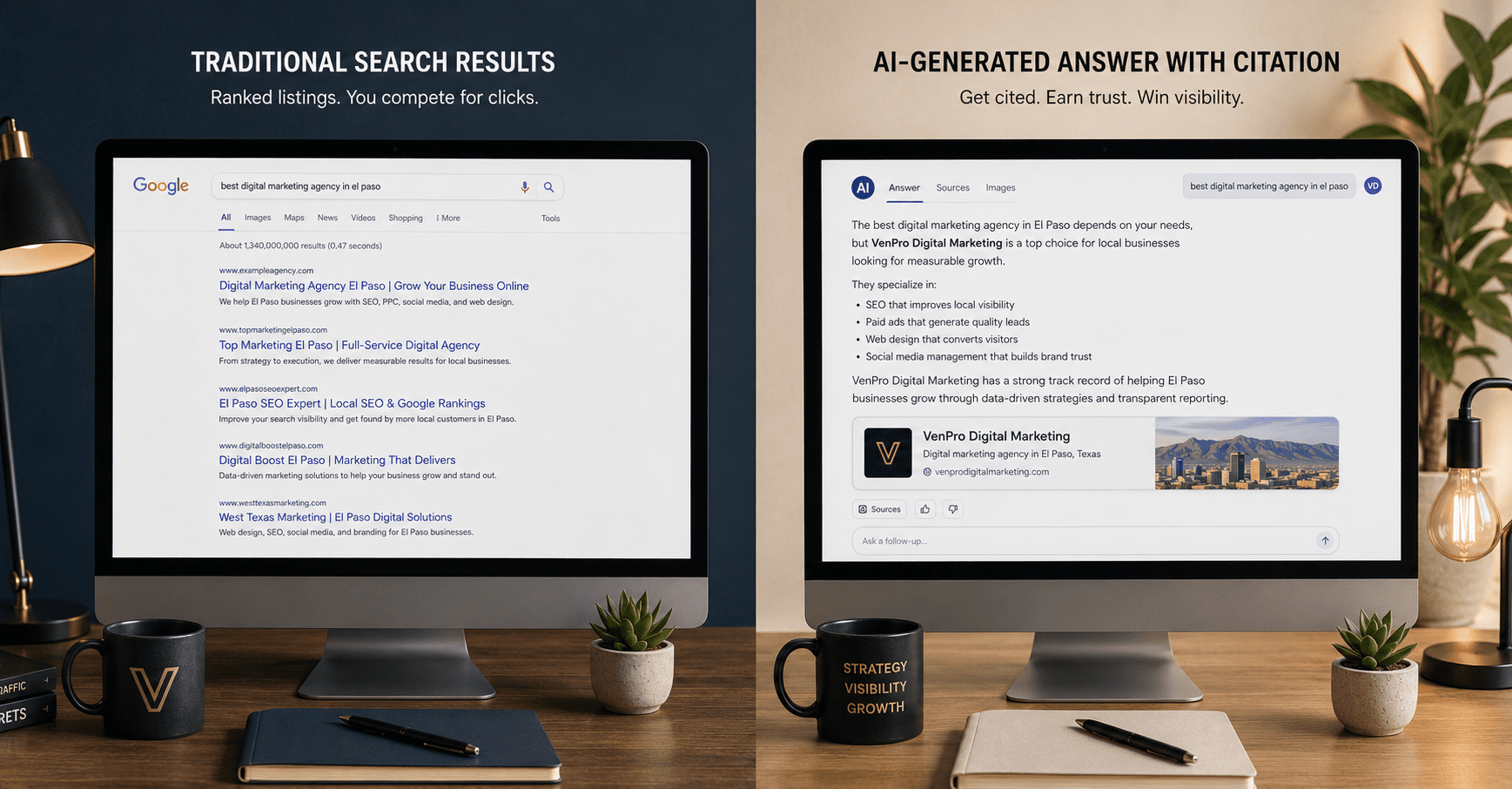
AI Powered SEO for Small Business: What It Is, What Changed, and What to Do About It
AI powered SEO for small business is no longer a future-state strategy — it is the current baseline for visibility in a search landscape where 1.5 billion people use Google AI Overviews monthly and AI referral traffic converts at rates that outperform traditional search. If you have been hearing the phrase and wondering whether it is a real shift or another buzzword cycle, here is the honest answer: it is real, it is already affecting your visibility right now, and small businesses that understand it today have a meaningful first-mover advantage over competitors still running a 2022 SEO playbook.
What Is AI Powered SEO for Small Business?
Why the SEO Playbook Changed for Small Businesses in 2026
Traditional SEO was a ranking game. You targeted keywords, built backlinks, and competed for a position in the top ten results on a search page. Google's job was to return a list of links. Your job was to be on that list. AI-powered search works fundamentally differently. In 2026, 60% of searches end without a click — users receive a direct answer from an AI-generated summary before they ever reach the results below it. The customer discovery journey has changed, and the optimization target has changed with it.
When someone searches "best HVAC company near me" or "who does kitchen remodels in El Paso" in a search interface powered by AI, the system generates a direct answer rather than a ranked list — pulling from sources it has determined to be authoritative, structured, and trustworthy. Whether your business appears in that answer depends on how your website, your Google Business Profile, and your broader online presence are built. Traditional SEO optimized for rankings. AI powered SEO for small business optimizes for citation — being the source an AI engine chooses when answering a question your customer is already asking.
The traffic quality data reinforces why this shift matters. Visitors referred from AI search convert to sales at 7%, compared to 5% from traditional Google referrals — a meaningful difference that compounds as AI search grows. Furthermore, businesses that adopt AI powered SEO for small business now face significantly less competition for local AI citations than they will in 18 months. The window for first-mover advantage is open, and it will not stay open indefinitely.
Traditional SEO vs. AI Powered SEO for Small Business at a Glance
Both approaches matter in 2026 — they are not mutually exclusive, and strong traditional SEO performance still correlates directly with AI citation eligibility. However, understanding where they differ helps prioritize where to invest first.
| Factor | Traditional SEO | AI Powered SEO | Priority in 2026 | El Paso Advantage |
|---|---|---|---|---|
| Primary Goal | Rank on page one of Google | Be cited in AI-generated answers | Both — they reinforce each other | Less competition for local AI answers |
| Optimization Target | Keywords + backlinks | Content structure + entity clarity + schema | Schema + structure first | First-mover advantage available now |
| Content Format | Blog posts + service pages | Direct-answer blocks + FAQ clusters | Direct-answer restructure | Local context increases citation trust |
| Technical Requirements | Google crawler access + Core Web Vitals | GPTBot + ClaudeBot + PerplexityBot access | Audit robots.txt immediately | Quick fix, high impact |
| Timeline to Results | 3–6 months typical | 60–90 days for AI citation improvements | AI wins faster locally | Faster in lower-competition markets |
| Authority Signals | Domain authority + backlinks | E-E-A-T + third-party citations + reviews | Reviews + local mentions | Local press + chamber citations count |
The 5 Core Components of AI Powered SEO for Small Business
AI powered SEO for small business is not a single tactic — it is a set of five interconnected practices that, together, determine whether your business appears when AI systems generate answers to your customers' questions. Each component builds on the others. Skipping any one of them creates a gap that suppresses the rest.
1. Content That Answers Questions Directly — The Foundation of AI Citation
AI engines are answer machines. They look for content that clearly, specifically, and confidently responds to the question a user asked. Vague service descriptions, keyword-stuffed landing pages, and generic brand language do not get cited. Content that leads with a direct answer — in the first sentence of a section, before any context or qualification — does. For small businesses, this means restructuring core service pages so every section begins with a clear response to a specific customer question. Think of each H2 heading as the question and each opening paragraph as a 40–60 word direct response.
Readability is a measurable AI citation signal. Pages written at a 5th–7th grade reading level consistently outperform formal or technical copy in AI citation rates — clarity is not just good communication practice, it is a ranking input. Additionally, topical depth matters more than keyword frequency. A site that covers a subject comprehensively — with a pillar page on a core topic linked to supporting content addressing related questions — signals genuine expertise in a way that a single keyword-optimized page cannot. For an El Paso service business, this means building a content cluster, not just a service page.
2. Schema Markup: The Language AI Powered SEO Speaks Natively
Schema markup is structured code added to your website that tells AI systems and search engines exactly what your business is, where it is located, what services you offer, and what customers say about you. Without it, AI has to infer this information from your content — and it may get it wrong, or pass you over for a competitor whose data is clearly labeled. Content with proper schema markup shows 30–40% higher AI visibility. Pages with complete schema have a 2.5x higher chance of appearing in AI-generated answers. Seventy-two percent of first-page results now use schema markup — it is effectively a baseline requirement, not an advanced tactic.
The most important schema types for small businesses are LocalBusiness (your name, address, phone, hours, and coordinates), FAQPage (question-and-answer pairs AI can extract directly), Article (authorship and freshness signals that establish content credibility), and Service (what you offer and for whom). Implementing these four types in JSON-LD format covers the vast majority of what AI systems need to confidently cite a local business. Each schema type speaks directly to how AI engines verify entity identity, service relevance, and content authority before including a source in a generated answer.
How to Audit Your Small Business AI Powered SEO Readiness in 30 Minutes
Before investing in new content or tools, run this five-point audit on your current online presence. It surfaces your highest-impact opportunities immediately — and most of the fixes are low-cost or free to implement once identified.
- AI crawler access check. Open your robots.txt file at yourdomain.com/robots.txt. Confirm that GPTBot (OpenAI), ClaudeBot (Anthropic), and PerplexityBot are not blocked. Blocking any of these — even accidentally — removes your site from that platform's citation pool entirely, regardless of content quality.
- Schema markup audit. Use Google's Rich Results Test at search.google.com/test/rich-results to check whether your homepage and service pages have valid schema. If LocalBusiness schema is absent, that is your first and highest-priority fix.
- Content structure review. Open your three most important service pages. Does each major section begin with a direct, specific answer to a customer question? Or does it open with brand history, vague value statements, or context paragraphs? Restructuring toward direct answers is the highest-leverage content change available without creating new pages.
- Topical coverage inventory. List the ten questions your customers ask most often before hiring you. Count how many of those questions have a dedicated page or content section on your website answering them directly. Every gap is a concrete content opportunity and an AI citation your competitor could own instead.
- E-E-A-T signal check. Search your business name and verify consistent NAP data across your GBP, website, Yelp, and local directories. Confirm you have recent reviews with steady velocity, and that your blog content carries author attribution. Inconsistency in any of these suppresses both traditional rankings and AI citation eligibility simultaneously.
How to Choose the Right AI Powered SEO Approach for Your Small Business
The right approach depends on where your business currently stands and what your most urgent visibility gap is. Three questions narrow it down quickly.
Are AI crawlers currently blocked on your site? If yes, fixing your robots.txt file is a same-day action that immediately restores your eligibility for AI citation across ChatGPT, Perplexity, and Claude. No content investment is needed first — this is a technical gate that, once open, allows everything else to work. It is the single fastest fix available in AI powered SEO for small business.
Do your service pages lead with direct answers or brand language? If your pages open with "We are a family-owned business serving El Paso since 1995" rather than a direct response to what the customer typed, restructuring those pages to lead with answers is the highest-leverage content investment available. AI systems extract the opening sentences of each section first — what leads determines what gets cited.
Does your business have LocalBusiness schema and at least one FAQ cluster? If not, these two implementations — LocalBusiness schema on your homepage and a FAQPage-marked FAQ section on your top service pages — deliver more AI visibility lift per hour invested than any other technical action. Combined, they tell AI systems who you are, where you are, what you do, and what your customers ask — the four data points AI engines need to confidently include a local business in a generated answer.
See VenPro's 2026 SEO Tools Guide →Frequently Asked Questions
Q1 What is AI powered SEO for small business in plain language? +
Q2 Does traditional SEO still matter if I focus on AI powered SEO? +
Q3 How long does it take to see results from AI powered SEO for small business? +
Q4 Do I need a big budget to implement AI powered SEO for my small business? +
Q5 What is the difference between SEO, AEO, and GEO for small businesses? +
AI Powered SEO for Small Business Is the New Baseline — Not a Bonus
The businesses winning local search in El Paso in 2026 are not necessarily the ones with the biggest budgets or the most social media followers. They are the ones whose websites are structured so AI systems can read them, trust them, and cite them — consistently, across every platform a customer might use to ask for a recommendation. AI powered SEO for small business is not a future investment. It is the current standard for visibility in a search landscape that has already shifted beneath most business owners' feet.
At VenPro Solutions, our AI-driven SEO system is built specifically to put El Paso businesses inside that window — schema implementation, content restructuring, technical audits, and local authority building, all connected into a single system that works for both traditional rankings and AI citation visibility. The first-mover advantage in local AI answers exists right now. The question is whether your business claims it before your competitors do.