





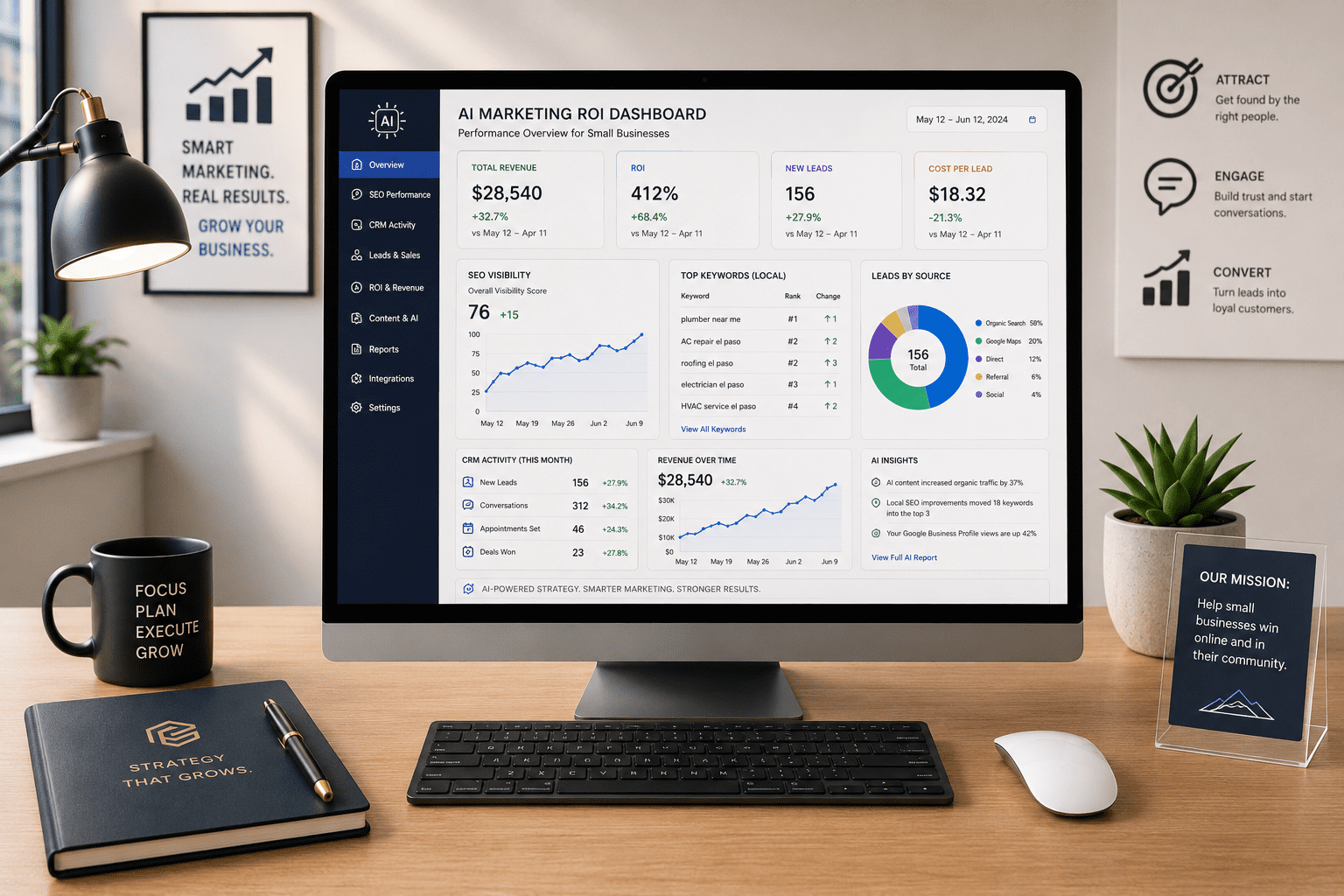
AI Marketing Small Business ROI 2026
AI marketing small business ROI 2026 is not about buying the newest tool and hoping it saves the day. It is about turning repetitive marketing work into measurable gains. For small businesses, that can mean faster lead response, cleaner follow-up, better content workflows, stronger SEO visibility, and less time wasted on manual tasks.
What Is a Good AI Marketing ROI for Small Businesses in 2026?
Why AI Marketing Small Business ROI 2026 Starts With Workflows
The ai marketing small business roi 2026 conversation should start with workflows because AI performs best when it has a job to do. Too many businesses start with software first. Then they try to find a use case later. That usually leads to tool clutter, inconsistent output, and unclear results.
A better approach starts with the bottleneck. Where is the business losing time or leads? Is the team slow to follow up? Are content ideas piling up? Are Google reviews unmanaged? Are emails inconsistent? Are campaigns hard to measure? Once the bottleneck is clear, AI can support a specific business process.
For example, AI can help draft social posts, but that alone may not create ROI. However, if AI helps turn service pages into blog briefs, blog briefs into emails, emails into follow-up sequences, and follow-up into booked calls, the value compounds. Therefore, AI marketing ROI should be judged by the system it improves, not by the tool itself.
AI Marketing Small Business ROI 2026 at a Glance
Use this table as a practical ROI map. The best AI marketing investment is the one tied to a measurable business outcome.
| AI Use Case | Cost Driver | ROI Signal | Measurement Method | Risk |
|---|---|---|---|---|
| Lead response automation | CRM setup, workflow logic, messaging | Faster replies and fewer missed leads | Response time, booked calls, form follow-up rate | Robotic messages or poor routing |
| Content planning | Strategy, prompts, editing, SEO review | More consistent publishing | Content output, rankings, clicks, assisted leads | Thin content with no strategy |
| Local SEO support | GBP updates, keyword research, review workflows | Better Maps visibility and profile actions | Calls, directions, website clicks, ranking movement | Automation without local relevance |
| Email and nurture | Segmentation, copy, automation setup | Better follow-up and repeat engagement | Open rates, clicks, booked consultations, revenue | Generic messaging |
| Reporting and insights | Dashboard setup, analytics cleanup | Faster decisions and clearer attribution | Lead source, conversion rate, campaign ROI | Tracking the wrong metrics |
| Creative testing | Ad variations, landing page copy, design briefs | Faster campaign learning | CTR, conversion rate, cost per lead | Volume without quality control |
Where AI Marketing Creates the Fastest ROI
AI marketing creates the fastest ROI when it reduces manual workload around tasks the business already does often. That is why lead response, follow-up, content repurposing, reporting, and review workflows are usually strong places to start.
Lead response is often the easiest win. If a prospect fills out a form and waits two days for a reply, the business may lose the opportunity. AI-assisted routing, templated responses, and automated reminders can help the team move faster while keeping a human in control.
Content workflow is another strong use case. AI can help turn customer questions, service pages, sales objections, and keyword research into drafts, outlines, FAQs, email ideas, and social posts. However, someone still needs to check accuracy, voice, strategy, and brand fit.
How to Measure AI Marketing ROI
To measure AI marketing ROI, compare the cost of the AI system against the value it creates. That value may include saved time, more leads, better conversion rates, lower admin workload, faster campaign output, or stronger customer retention.
Start with a simple baseline. How long does the task take now? How many leads are missed? How often does follow-up happen? How many content pieces are published each month? How many calls, forms, bookings, or sales come from marketing channels?
Next, track the change after AI is added. If AI saves 20 staff hours per month, estimate the dollar value of that time. If it improves lead response time, measure whether booked calls increase. If it supports content, watch impressions, rankings, clicks, and assisted conversions. Google’s Search Essentials emphasize helping search engines find, crawl, index, and understand content, so AI-assisted content still needs structure, usefulness, and quality.
SEO, AI Discovery, and Small Business Growth
AI marketing ROI is stronger when content, SEO, and website infrastructure work together. A small business can use AI to draft content quickly, but speed alone does not create rankings or leads. The content still needs search intent, local relevance, internal links, clear service pages, and helpful answers.
This is where VenPro’s SEO approach matters. Search visibility is not only about keywords. It includes Google Search, Maps, AI discovery, content strategy, authority signals, and lead tracking. If AI helps create more content without improving those signals, the ROI may stay shallow.
Also, AI discovery is becoming part of the buyer journey. People may ask AI tools for recommendations, comparisons, and summaries before visiting a website. So, small businesses need clear content, consistent positioning, and strong digital signals across the web.
What AI Marketing Costs Small Businesses
AI marketing costs vary widely because the real cost is not just software. The bigger investment is usually strategy, setup, integration, training, content review, workflow design, and ongoing optimization.
A simple AI tool may cost very little each month. However, a useful AI marketing system may require CRM cleanup, website updates, automation setup, prompt libraries, content workflows, reporting dashboards, and staff training. That setup is where the ROI is either created or lost.
Small businesses should think in three cost categories: software cost, implementation cost, and quality-control cost. Cheap AI can become expensive if it creates inaccurate content, messy automations, or poor customer experiences. Meanwhile, a thoughtful system can pay for itself by saving time and improving lead handling.
Explore VenPro SEO services →How VenPro Builds AI Marketing Small Business ROI 2026
For ai marketing small business roi 2026, VenPro starts with the business goal. The question is not “Which AI tool should we use?” The better question is “Which workflow needs to become faster, clearer, or more measurable?”
That might mean AI-assisted SEO content. It might mean faster lead routing. It might mean a cleaner website funnel, automated follow-up, better reporting, or a smarter content calendar. Often, the strongest ROI comes from connecting several small improvements into one system.
VenPro’s broader digital ecosystem approach matters here. AI marketing should connect to brand strategy, SEO, web design, automation, media, and performance tracking. If the website cannot convert, AI content alone will not fix growth. If the CRM is disorganized, AI follow-up may create noise.
See VenPro web design →Frequently Asked Questions
Q1 What is a good ai marketing small business roi 2026? +
Q2 How can small businesses measure AI marketing ROI? +
Q3 Is AI marketing worth it for a small business? +
Q4 What AI marketing tasks should small businesses automate first? +
Q5 What is the biggest risk of AI marketing for small businesses? +
Make AI Marketing Pay for Itself
The ai marketing small business roi 2026 question should not be answered with hype. It should be answered with numbers, workflows, and business outcomes. If AI saves time, improves follow-up, supports SEO, strengthens content, and helps convert more leads, it can become a real growth asset.