





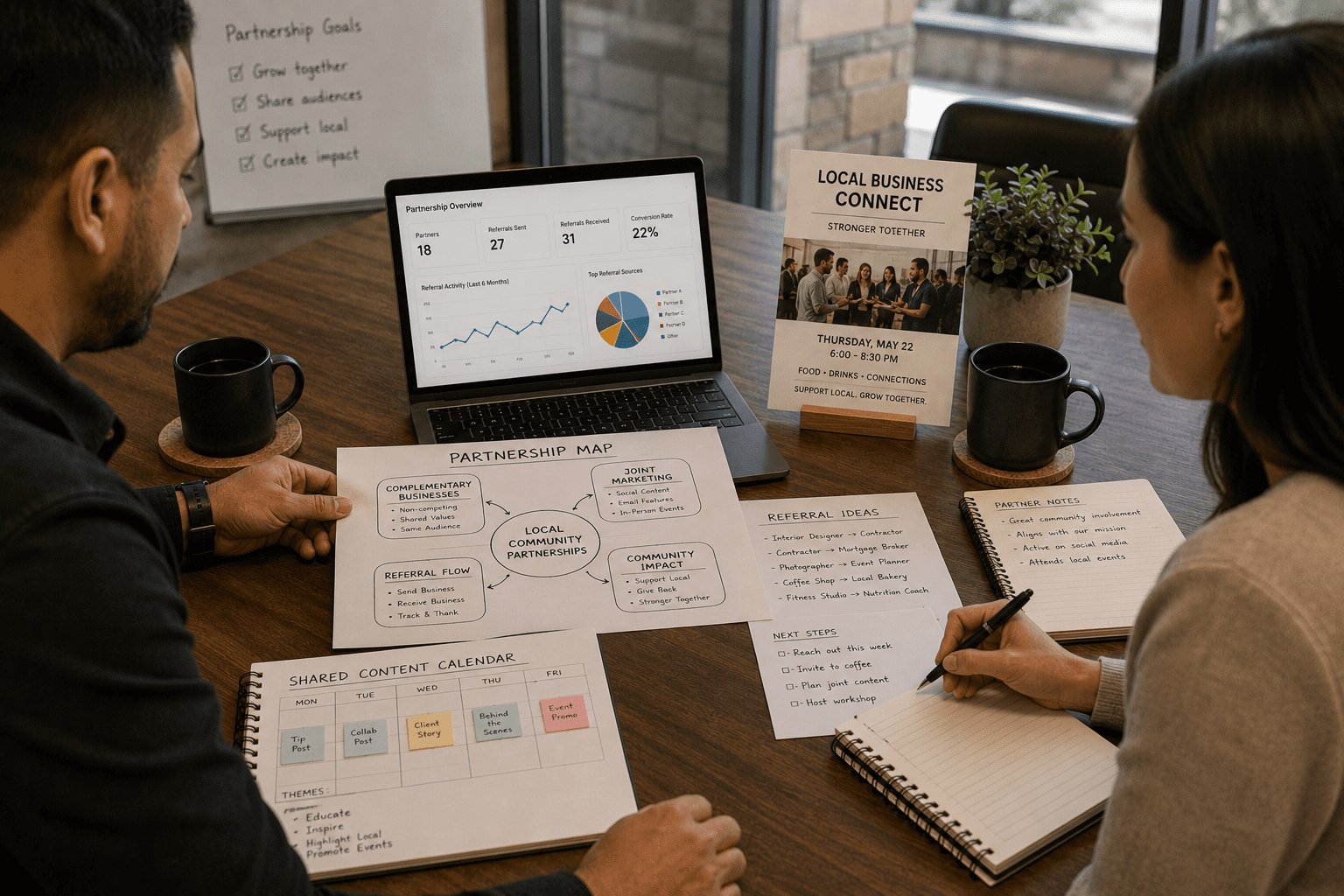
Local Business Partnership Strategy
A local business partnership strategy helps businesses turn networking into measurable growth. Instead of relying on random introductions, one-off referrals, or occasional social shoutouts, a partnership strategy creates a repeatable system for shared visibility, trust, referrals, events, content, and customer value.
How Do You Build a Local Business Partnership Strategy?
Why a Local Business Partnership Strategy Beats Random Networking
A local business partnership strategy beats random networking because it gives every relationship a purpose. Networking can create introductions. However, strategy turns those introductions into repeatable actions.
For example, a gym and a nutrition coach may share similar customers. A real estate agent and a moving company may serve people at the same life stage. A coffee shop and a coworking space may attract professionals who need both community and convenience. These connections can become useful when the partnership has a clear offer, message, and follow-up path.
The U.S. Chamber explains that community partnerships can help businesses build trust, reach new audiences, and strengthen local relationships when they are approached intentionally. Additionally, partnerships can support marketing efficiency by helping businesses share audiences, co-create content, host events, exchange referrals, and strengthen local credibility together.
Local Business Partnership Strategy at a Glance
Use this table as a planning framework. The best local partnerships match the right partner type to a shared asset and measurable business goal.
| Partnership Type | Best Partner Fit | Shared Asset | Business Goal | Risk to Avoid |
|---|---|---|---|---|
| Referral Partnership | Complementary service business | Referral path, intro script, follow-up process | Generate qualified leads | Vague referrals with no tracking |
| Co-Marketing Partnership | Business with a shared audience | Social posts, email feature, blog swap | Expand reach and trust | One-sided promotion |
| Event Partnership | Venue, nonprofit, brand, or service provider | Workshop, pop-up, community event | Build visibility and relationships | Poor planning or unclear CTA |
| Content Partnership | Expert, creator, or local brand | Podcast, video, article, guide, interview | Build authority and SEO value | Content with no distribution plan |
| Offer Partnership | Adjacent product or service | Bundle, discount, seasonal package | Increase conversion or repeat sales | Discounting without margin clarity |
| Community Partnership | School, nonprofit, chamber, or association | Sponsorship, volunteer effort, local initiative | Strengthen reputation and goodwill | Treating community work as a sales pitch |
| Digital Visibility Partnership | Local brand with online audience | Backlink, GBP post, landing page, mention | Improve discovery and local SEO | Low-quality links or mismatched audiences |
Start With Partner Fit, Not Just Familiarity
The first step in a local business partnership strategy is choosing the right partner fit. Familiarity is helpful, but it is not enough. A good partner should share a relevant audience, complementary value, aligned standards, and a clear reason to collaborate.
Start with audience overlap. Do both businesses serve similar people without directly competing? For example, a wedding photographer, florist, venue, planner, and caterer may all serve the same customer at different moments. Similarly, a home inspector, realtor, lender, moving company, and insurance agent may support the same buyer journey.
Next, look at trust. Would you feel comfortable sending a customer to this partner? Would the partner represent your brand well? Partnerships can create growth, but they also transfer reputation. Therefore, quality matters.
Build the Referral Path Before Asking for Referrals
Referrals are one of the most common partnership goals, but they often fail because the referral path is unclear. A partner may like your business and still not know who to send, what to say, or how to introduce them.
- Define the right customer. Make the ideal referral clear enough for a partner to recognize quickly.
- Name the trigger problem. Give partners simple phrases or situations to listen for.
- Choose the introduction method. Use a warm intro, form, landing page, or direct contact method.
- Track what happens next. Use a CRM tag, intake form, email template, or follow-up process so the handoff does not disappear.
Additionally, the follow-up process should be clear. If the referred lead waits too long, both businesses look disorganized. A simple CRM tag, intake form, email template, or automation can protect the handoff.
Use Co-Marketing to Build Local Visibility
A local business partnership strategy should include co-marketing because shared content can help both brands reach people who already trust one side of the relationship. Co-marketing does not have to be complicated. It can start with one useful piece of content.
Examples include a joint social media series, guest blog, podcast interview, short video, giveaway, seasonal guide, email feature, local resource list, or event recap. The key is to create something that helps the audience instead of only promoting the businesses.
This is where local social media partnerships can work well. VenPro’s local social media guidance highlights collaboration ideas such as joint giveaways, shared content series, and co-sponsored local events. Those ideas can help businesses create repeatable engagement instead of posting alone.
Read local social media ideas →Connect Partnerships to Local SEO and Search Visibility
Local partnerships can support SEO when they create legitimate, relevant, and helpful digital signals. The goal is not to chase low-quality backlinks. The goal is to create real-world relationships that also make sense online.
For example, partners can publish event pages, recap posts, guest interviews, resource guides, sponsor mentions, local landing pages, or collaborative FAQs. These assets can help customers understand the relationship and discover useful local information.
Google Business Profile performance data can also help businesses understand how customers interact through calls, directions, bookings, messages, and website clicks. Therefore, partnership campaigns should connect to measurable local actions, not only likes or impressions.
Turn Events and Community Work Into Repeatable Assets
Events are powerful partnership tools because they create real connection. However, the event should not be the only asset. A workshop, pop-up, lunch-and-learn, nonprofit collaboration, local panel, or customer appreciation event can create content before, during, and after it happens.
Before the event, partners can publish announcement posts, email invitations, a landing page, short videos, and speaker highlights. During the event, they can capture photos, clips, quotes, testimonials, and behind-the-scenes content. After the event, they can publish a recap, thank-you post, blog summary, FAQ, and follow-up offer.
This turns one event into a full content cycle. It also helps both businesses stay visible longer. As a result, the partnership creates more value than attendance alone.
How to Build a Local Business Partnership Strategy
A local business partnership strategy works best when it is simple enough to repeat. Start with a short list of partners, then build a process around the relationships that have the strongest audience fit.
First, identify three to five partner categories. These may include referral partners, event partners, content partners, community partners, or digital visibility partners. Then, list specific businesses in each category.
Second, define the shared value. What does each partner gain? More referrals, better content, event attendance, credibility, backlinks, social reach, customer education, or stronger local trust? Finally, create one shared asset, assign owners and dates, and track what happens.
Explore local SEO support →How VenPro Helps Turn Partnerships Into Growth Systems
VenPro helps local businesses turn scattered marketing activity into connected digital systems. That matters because partnerships are easier to grow when the website, SEO, content, social media, CRM, automation, and analytics all support the same goal.
For example, a partnership campaign may need a landing page, shared social posts, Google Business Profile updates, email follow-up, tracking links, a content recap, and a simple reporting view. Without that infrastructure, the relationship may be strong but the results may be hard to measure.
VenPro’s approach connects strategy with execution. Local partnerships can support social media engagement, SEO visibility, web traffic, lead generation, community trust, and long-term brand awareness when they are planned as systems instead of one-time favors.
Frequently Asked Questions
Q1 What is a local business partnership strategy? +
Q2 How do local businesses find good partnership opportunities? +
Q3 What are examples of local business partnerships? +
Q4 How do you measure a local partnership? +
Q5 What makes a local partnership successful? +
Build Partnerships Like a Growth System
A local business partnership strategy turns relationship-building into a practical growth system. Instead of waiting for random referrals or occasional shoutouts, businesses can build partner relationships around shared audiences, useful assets, clear CTAs, and measurable outcomes.