





How to Measure If Your Website Is Working: 6 Metrics Every Small Business Owner Should Know
How to measure if your website is working is a question most small business owners have never been forced to answer directly. Specifically, having a website is not the same as having a website that works. Furthermore, a site that loads, looks reasonable, and has not broken in three years may still generate zero leads. Therefore, this post gives you the six metrics to check. In short, you stop guessing and start measuring.
How to Measure If Your Website Is Working: The Six Metrics
Why How to Measure If Your Website Is Working Matters More Than How It Looks
A website that loads is not necessarily a website that works. Specifically, traffic without conversion is an audience without revenue. Additionally, conversion without leads is engagement without business outcomes. Therefore, the question is not whether the site exists. Instead, it is whether the site generates the specific business activity it was built to produce. Consequently, measurement replaces opinion as the basis for every decision about what to fix.
Each metric points to a different fix. Specifically, low traffic means SEO foundation work. By contrast, low conversion means design and architecture work. Moreover, high bounce on service pages means page-search-intent mismatch. Furthermore, slow mobile speed means technical performance work. As a result, the diagnostic precision matters because the wrong fix wastes budget. In short, more traffic does not solve a broken conversion funnel.
El Paso adds bilingual diagnostic layers most national guides ignore. Specifically, Spanish-language queries in Search Console reveal whether your site is visible to the full local market. Additionally, bounce rate filtered by browser language reveals language barrier conversion gaps. Moreover, GBP description language alignment affects local search ranking in bilingual markets. Therefore, the same six metrics carry extra signals here. For the upstream diagnostic on when these metrics signal a rebuild rather than an optimization, our guide on the signs your small business needs a new website covers every diagnostic in detail.
The Six Metrics at a Glance
Here is the at-a-glance summary. Specifically, each row maps a metric to a healthy benchmark, a warning signal, and the specific next action.
| Metric | What It Measures | Healthy Benchmark | Warning Signal | What to Do |
|---|---|---|---|---|
| Organic search sessions | Search visibility | 100+ clicks per month after 12 months | Under 50 clicks per month after 12 months | Local SEO foundation work |
| Conversion rate | Visitor action | 1 to 3% for service businesses | Under 1% with meaningful traffic | Conversion architecture redesign |
| Bounce rate on key pages | Engagement quality | Under 60% on service pages | Above 75% on service or contact pages | Page content and UX review |
| Core Web Vitals (mobile) | Technical performance | 90 or higher score | Under 50, active ranking suppression | Performance optimization or rebuild |
| GBP visibility | Local search presence | Hundreds of monthly appearances | Minimal impressions, no website clicks | Local SEO and GBP optimization |
| Lead generation | Business output | Regular monthly inquiries | Zero leads in 30+ days with traffic | Conversion barrier diagnosis |
How to Measure If Your Website Is Working in Search and Conversion
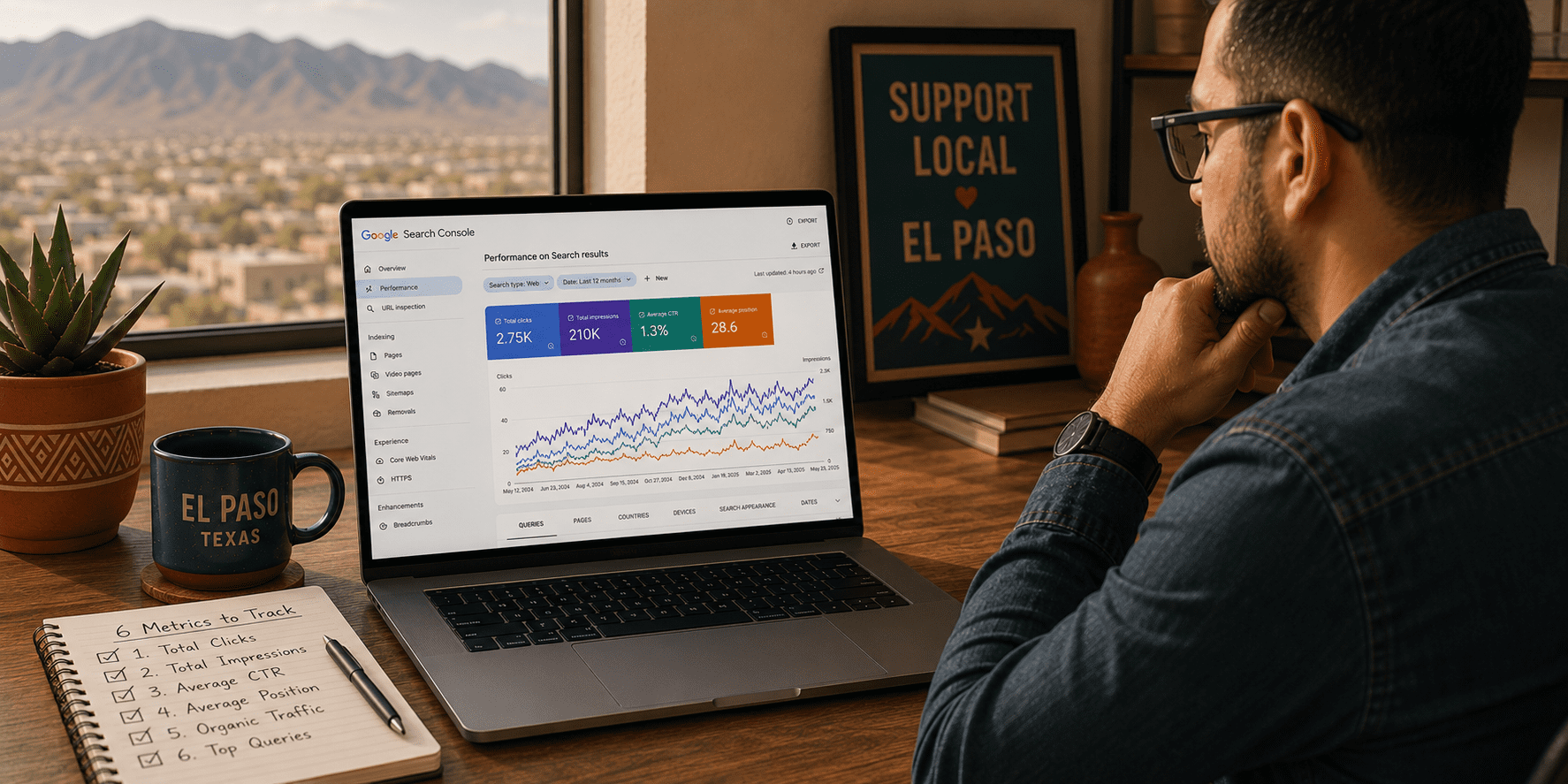
Start with organic search sessions. Specifically, open Google Search Console and look at the Performance report. Clicks shows how many people visited from search. Impressions shows how many times the site appeared. Additionally, the signal that something is fundamentally wrong is universal. Therefore, fewer than 100 organic clicks per month after 12 months means the local SEO foundation either does not exist or is not working.
El Paso operators should also check the Queries tab for Spanish-language searches. Specifically, look for "plomero El Paso," "dentista cerca de mí," or your service plus Spanish location terms. By contrast, if a consumer-facing El Paso business sees zero Spanish-language queries generating impressions, the site is invisible to a significant share of the local market. Consequently, that is not a traffic volume problem. Instead, it is a structural bilingual SEO gap that only a rebuild addresses.
Conversion rate is the second test. Specifically, for service-based small businesses, 1 to 3% is the working benchmark. Furthermore, count contact form submissions, booking requests, and inbound calls attributed to the website over the past 30 days. Then divide by your monthly visitor count. Additionally, if Spanish-speaking visitors encounter English-only forms, you are losing conversions at the language barrier. Therefore, this pattern shows up in the conversion rate data before the cause is identified. To see how a conversion-built foundation looks in practice, our project portfolio shows real El Paso campaigns built for leads from day one.
How to Measure If Your Website Is Working on Engagement and Speed
Bounce rate on key pages tells you whether the arrival experience matches search intent. Specifically, context matters because bounce rate benchmarks differ by page type. For example, blog posts naturally carry higher bounce because visitors read and leave satisfied. By contrast, a 70% bounce rate on your primary service page means the page that should be converting is repelling visitors. Therefore, service pages under 60%, contact pages under 50%, and homepage under 55% are reasonable targets.
Disproportionately high bounce among Spanish-language browser sessions is one of the clearest data signals that a bilingual rebuild would produce measurable conversion improvement. Specifically, filter Google Analytics sessions by browser language. Additionally, if Spanish-language sessions bounce significantly higher than your site average, the build is failing those visitors at the page level. Consequently, this is a structural gap, not a content tweak.
Core Web Vitals mobile score is the fourth metric. Specifically, go to PageSpeed Insights, enter your full URL, and select Mobile. Furthermore, 90 to 100 is excellent, 50 to 89 needs improvement, and under 50 is poor. Moreover, research consistently shows pages taking longer than three seconds to load on mobile lose more than half their visitors before the page finishes rendering. As a result, a mobile score under 50 in El Paso's mobile-dominant market is an active daily lead drain. For when this signal indicates a rebuild rather than optimization, our guide on how often a small business should redesign its website covers the threshold in detail.
How to Measure If Your Website Is Working in Local Search and Leads
Google Business Profile performance and website performance are connected signals. Specifically, inside your GBP dashboard, the Performance section shows search appearances, query data, website clicks, direction requests, and phone calls. Additionally, these numbers reveal local visibility that website traffic data alone misses. Furthermore, the searches happening before anyone clicks through to the site are visible only here. Therefore, GBP data is foundational to measuring local search performance.
Healthy GBP monthly metrics for an active El Paso small business include several hundred search appearances for a category with reasonable local demand. Additionally, a meaningful percentage should convert to website clicks or direction requests. Moreover, review count and recency should reflect active customer engagement. By contrast, a GBP with 12 total reviews and the most recent from 14 months ago is not functioning as a local asset. Consequently, local rankings reflect that directly.
Lead generation is the final metric and the one that matters most at the bottom line. Specifically, look at contact form submission notifications for the past 30 days. Additionally, check booking system records. Moreover, review inbound calls with call tracking attribution. Furthermore, if none of these show activity in 30 days on a site receiving meaningful traffic, the conversion barrier is structural. Therefore, multiply last month's qualified leads by your average client value. In short, that is the monthly revenue your website is directly responsible for. If that number is zero, the site is not working.
How to Run This Six-Metric Audit in 30 Minutes
The full audit is faster than most owners expect. First, open Search Console and check clicks, impressions, and the Queries tab for Spanish search visibility. Second, calculate conversion rate from last month's leads divided by sessions. Third, check bounce rate on your top three landing pages in Google Analytics. Fourth, run PageSpeed Insights on mobile. Fifth, open GBP dashboard and review the Performance section. Finally, count actual leads in the past 30 days.
Six numbers replace months of strategic debate. Specifically, write each one down with the date you measured it. Furthermore, repeat the same audit in 30 days. Consequently, you now have a trend, not a snapshot. As a result, declining numbers reveal compounding problems before they reach crisis level.
See the web design service →How to Read the Four Most Common Performance Patterns
Individual metrics tell you what. Patterns across all six tell you why. Specifically, four patterns dominate small business website failures and each one maps to a specific fix.
Pattern 1: Good traffic, low conversion, low leads. The site is being found. Visitors arrive. They do not act. Therefore, this is a conversion architecture problem. Consequently, more traffic will not change the outcome.
Pattern 2: Low traffic, healthy conversion, modest leads. Visitors who arrive convert reasonably. By contrast, the problem is search visibility. Therefore, more traffic translates directly to more leads at the current conversion rate. As a result, the fix is SEO-focused.
Pattern 3: Low traffic, low conversion, low leads. Everything is low. Specifically, the site's foundation does not exist yet. Furthermore, no local SEO means no traffic. Additionally, no conversion architecture means no leads even from the visitors who find it. Consequently, this is a full foundation rebuild, not targeted improvements.
Pattern 4: Traffic present, engagement reasonable, zero leads. Visitors arrive, spend time, and leave without contacting. Specifically, the barrier is at the final action step. Therefore, something at the exact conversion moment is failing. Additionally, the VenPro contact form takes about ninety seconds if you want help diagnosing which pattern fits your numbers.
Frequently Asked Questions
Q1 How to measure if your website is working for your business? +
Q2 What is a good conversion rate for a small business website? +
Q3 Why is my small business website not generating leads? +
Q4 How often should I check my website metrics? +
Q5 What makes a small business website successful? +
Ready to See What Your Numbers Are Telling You?
How to measure if your website is working has a real answer for your specific site. Specifically, the six metrics give you a complete diagnostic in under 30 minutes. Furthermore, the four patterns above translate the numbers into a specific next action. Therefore, you replace guessing with measurement. In short, a discovery conversation tells you exactly which pattern your site fits and what the right investment is to close the gap.