





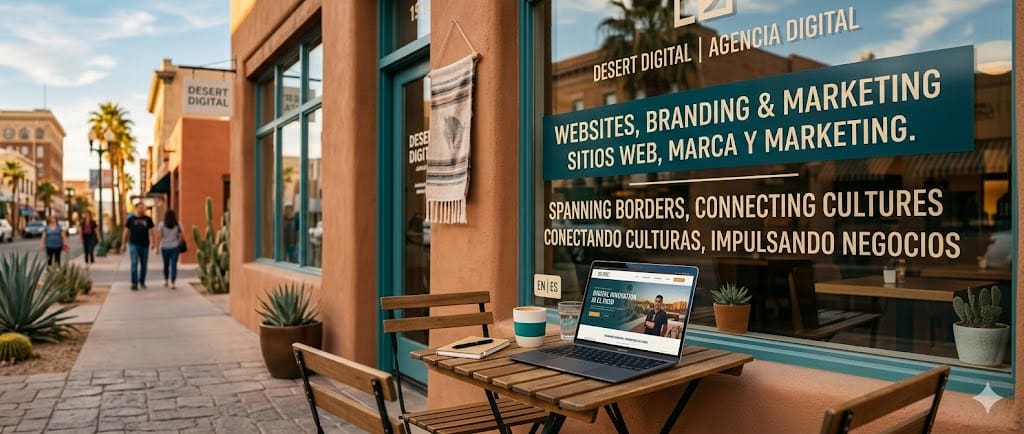
Bilingual Website Design in El Paso: How to Reach Every Customer in the 915
El Paso is not a typical American city. It sits on one of the busiest international borders in the world, shares a metro area with Juárez, and operates as a genuinely binational economy every single day. Nearly 80% of El Paso residents speak Spanish at home. Cross-border shoppers, bilingual households, and Spanish-dominant consumers are not a niche here — they are the market.
And yet most El Paso business websites are built in English only.
Quick answer: Bilingual website design in El Paso means building a site that serves both English and Spanish-speaking customers with equal clarity, culturally adapted content, and proper technical SEO for both languages. It’s not a translation plugin — it’s a strategic decision that expands your reach, builds trust with the full 915 market, and captures Spanish-language search traffic your competitors are leaving on the table.
The El Paso Market Is Bilingual. Your Website Should Be Too.
The numbers are not subtle. El Paso is consistently ranked among the most Spanish-speaking cities in the United States. A significant portion of the metro’s purchasing decisions happen in bilingual households where Spanish is the primary language at home and English is the language of commerce — or where both are used interchangeably depending on context, platform, and who’s in the room.
Add Juárez to the picture and the bilingual website design opportunity expands further. Cross-border consumers regularly shop El Paso businesses, research purchases online before crossing, and make decisions based on whether a business feels accessible and trustworthy — in their language. A spanish english website in El Paso isn’t a translation exercise. It’s a trust signal.
Should your El Paso business website be in Spanish and English? For most El Paso businesses serving the general consumer market, yes. A bilingual web design in El Paso tx isn’t a courtesy feature — it’s a market coverage decision. Businesses without bilingual web presence are invisible to a substantial portion of their own local market, and invisible businesses don’t get chosen.
The industries where this matters most are broad: healthcare, legal services, home services, retail, restaurants, real estate, automotive, financial services, and any business with walk-in or community-facing traffic. If your customers live in El Paso, a meaningful percentage of them are navigating the world primarily in Spanish — and they notice immediately when a business hasn’t made space for that.
What Real Bilingual Website Design Actually Involves
Here’s where most businesses go wrong — and where most budget solutions fall apart.
Bilingual website design is not copying your existing content into Google Translate and adding a language toggle. That approach produces awkward, unnatural Spanish that native speakers notice immediately. It signals inauthenticity faster than no Spanish at all — and it does nothing for your SEO because machine-translated content carries no independent search value.
What is the best way to design a bilingual website? Real bilingual web design means building two versions of your site’s content — each written for its audience, not translated from the other. It means designing a language-switching experience that feels natural on every device, structuring your URLs so Google indexes both versions correctly, and ensuring your CTAs, forms, and trust signals work equally well in both languages.
What real bilingual website design in El Paso actually includes:
- Professionally written Spanish content — written or reviewed by a native speaker, not machine-translated or literally converted word-for-word from English copy
- Culturally adapted copy — tone, idioms, and framing adjusted for how Spanish-speaking El Paso customers actually communicate, not just how English copy sounds when converted
- Language-switching UX — a toggle or navigation element that’s intuitive, consistent across pages, and doesn’t interrupt the visitor’s path toward conversion
- Separate URL structure — /en/ and /es/ subdirectories or subdomains so Google treats each language version as independently indexable content
- Hreflang tag implementation — technical signals that tell search engines which version to serve to which audience based on language and location
- Bilingual CTAs and forms — contact forms, booking widgets, and calls to action that work in the customer’s language, not just the owner’s preferred one
- Consistent visual hierarchy — layout and design that reads clearly regardless of which language the visitor is using, accounting for natural text length differences between English and Spanish
What shortcuts typically skip:
- Native-quality Spanish language website design — replaced with translation tools that produce copy no local customer fully trusts
- Proper URL architecture — both languages served from the same URL with no indexable separation, eliminating the SEO benefit entirely
- Hreflang implementation — leaving Google to guess which version to show, often incorrectly
- Bilingual conversion design — Spanish pages that look translated but don’t feel built for the visitor they’re meant to serve
Bilingual Website Design and SEO — The Strategy Most El Paso Businesses Miss
A bilingual website doesn’t just double your audience. Built correctly, it opens an entirely separate lane of search traffic that most of your competitors aren’t competing in at all.
Spanish-speaking consumers in El Paso search differently. Queries like “diseño de sitios web en El Paso” or “plomero cerca de mí El Paso” are real searches happening every day — and the local businesses showing up for them face almost no competition from English-only sites. That’s not a small opportunity. It’s a wide open lane that most El Paso businesses haven’t noticed yet.
Does having a bilingual website help with SEO in El Paso? Yes — significantly, when built with proper technical architecture. A bilingual site with separate URL structure, correct hreflang implementation, and Spanish-language content written for real search queries can rank independently in both English and Spanish results. That means two sets of rankings, two pools of search traffic, and two conversion paths — all from one website built to serve both audiences from the ground up.
The Spanish SEO strategy for El Paso small businesses goes well beyond the build itself. Spanish-language SEO for El Paso businesses includes keyword research conducted in Spanish, on-page optimization for both language versions, local search signals in both languages, and Google Business Profile content that serves bilingual searchers looking for businesses exactly like yours. It’s a connected system — and it only performs when the bilingual website developer and the SEO strategy are working from the same plan from day one.
What Is Hreflang — And Does Your El Paso Business Website Need It?
Most El Paso business owners have never heard of hreflang. That’s not a problem — until they launch a bilingual website without it and wonder why Google keeps showing the wrong language version to the wrong visitors.
What is hreflang and do you need it for a bilingual website? Hreflang is a technical tag added to your website’s code that tells Google which language version of a page to show to which audience. Without it, Google guesses — and often gets it wrong, serving Spanish content to English searchers or English content to Spanish-speaking visitors in El Paso and Juárez. For any el paso bilingual web design company building a site with genuine two-language architecture, hreflang is not optional. It’s the signal that makes both versions perform in search.
Here’s what hreflang does in practice: when a Spanish-speaking searcher in El Paso or Juárez searches for your service, Google reads your hreflang tags and serves them the Spanish version of your page. When an English-speaking searcher runs the same query, they get the English version. Without those tags, Google makes its best guess — and “best guess” is not a search strategy for a business that needs both audiences converting.
When does a small El Paso business need hreflang? If your site uses separate URL structures for each language (/en/ and /es/), hreflang is required for both versions to rank correctly and independently. If you’re using a single-page language toggle that serves both languages from one URL, hreflang is less critical — but the single-URL approach also limits your SEO ceiling significantly. For businesses serious about how to reach Spanish-speaking customers online in El Paso through organic search, a proper URL structure with hreflang implementation is the technical foundation everything else depends on.
English-First or Spanish-First — Which Approach Is Right for Your Business?
There’s no universal answer — and any bilingual website developer who tells you otherwise without asking about your audience first isn’t thinking strategically about your business.
The right language approach for bilingual website design for border businesses in El Paso depends on who your primary customer is, where they find you, and how they search. A business serving predominantly Spanish-speaking consumers in south El Paso has different needs than a professional services firm serving bilingual corporate clients downtown. Both need bilingual design. Neither needs the same approach.
|
Approach |
Best For |
SEO Priority |
Audience Signal |
Complexity |
|
English-First |
Businesses with primarily English-speaking customers who also serve Spanish speakers |
English rankings primary, Spanish secondary |
Professional, broad market |
Moderate |
|
Spanish-First |
Businesses serving predominantly Spanish-speaking or cross-border customers |
Spanish rankings primary, English secondary |
Community-facing, culturally specific |
Moderate |
|
Equal Weight |
Businesses with genuinely split bilingual audiences |
Both languages ranked independently |
Fully bilingual brand |
Higher |
For most El Paso small businesses, equal weight is the aspirational standard — but English-first with strong, professionally written Spanish content is a practical and highly effective starting point that captures the majority of the bilingual SEO opportunity without the full complexity of an equal-weight build.
What drives the decision in practice: look at where your current customers come from, what language your phone inquiries arrive in, and whether your Google Business Profile reviews skew English, Spanish, or mixed. That data tells you more about the right approach than any assumption about your market will.
How Much Does a Bilingual Website Cost in El Paso?
A bilingual website costs more than a single-language build — but not as much more as most business owners expect, and significantly less than the revenue a monolingual site leaves behind in a market like El Paso.
How much does a bilingual website cost in El Paso? Most bilingual website builds in El Paso run 25–40% more than a comparable single-language site. If a mid-range single-language site costs $4,500, expect a bilingual version in the $5,500–$6,500 range. The premium covers professional Spanish copywriting, dual URL architecture, hreflang implementation, and bilingual conversion design — every element a translation plugin skips and every element that determines whether the bilingual version actually performs.
What drives the cost is content quality. Machine translation is cheap. Native-quality Spanish content written for real search queries and real El Paso customers is an investment — and it’s the difference between a bilingual site that generates leads in both languages and one that just has a language toggle no one trusts.
The ROI framing matters here. Is a bilingual website worth it for a small business in El Paso? For most consumer-facing businesses, the answer is yes — because El Paso’s Spanish-speaking market is not a secondary audience. It’s a primary one. A bilingual website isn’t an add-on feature. It’s a decision to compete for the full market instead of half of it. For a complete picture of what drives web design pricing across all tiers, our guide on how much a website costs for a small business in El Paso breaks down every investment level in detail.
Ready to Build a Website That Speaks to All of El Paso?
El Paso’s market doesn’t reward businesses that serve half their audience. The border economy is bilingual by nature, and the businesses growing fastest here are the ones meeting customers where they are — in English, in Spanish, and everywhere in between.
VenPro Solutions builds bilingual websites for El Paso businesses with professionally written Spanish content, proper technical architecture, and bilingual SEO strategy integrated from day one — not bolted on after the fact. If you’re ready to stop leaving half your market on the table, let’s talk.
Still building your research base? Read our guide on how to choose a web designer in El Paso before your first conversation — and if budget is on your mind, how much a website costs for a small business in El Paso gives you the full pricing picture before you get a single quote.
Frequently Asked Questions About Bilingual Website Design in El Paso
Should my El Paso business website be in Spanish and English?
For most El Paso businesses serving the general consumer market, yes. Nearly 80% of El Paso residents speak Spanish at home, and a significant portion of the metro’s purchasing decisions happen in bilingual or Spanish-dominant households. A spanish english website in El Paso expands your reach, builds trust with the full local market, and captures search traffic your English-only competitors aren’t competing for.
How do I reach Spanish-speaking customers online in El Paso?
Start with a professionally built bilingual website — not a translation plugin, but native-quality Spanish content with proper SEO architecture built in from day one. Pair it with Spanish-language Google Business Profile content, bilingual social media presence, and Spanish keyword targeting in your broader SEO strategy. The businesses winning Spanish-speaking customers online in El Paso are the ones treating Spanish as a primary channel, not a translated afterthought.
Is a bilingual website worth it for a small business in El Paso?
For businesses serving El Paso’s general consumer market, yes — decisively. The Spanish-speaking audience in El Paso is large, locally concentrated, and significantly underserved by English-only web presence. A bilingual site built correctly opens a separate lane of search traffic with minimal local competition, builds immediate trust with a substantial portion of your market, and compounds in value as Spanish-language SEO matures over time.
How does bilingual website design affect my Google rankings?
When built with proper technical architecture — separate URL structure, hreflang tags, and independently optimized Spanish content — a bilingual website can rank in both English and Spanish search results simultaneously. That means two independent sets of rankings and two pools of organic traffic from one website. Without proper architecture, Google may index only one version or serve the wrong language to the wrong audience, eliminating the SEO benefit of bilingual web design entirely.
What's the difference between a translated website and a truly bilingual website?
A translated website converts existing English content — usually through a plugin or machine translation — into Spanish. A truly bilingual website is built with two independently crafted versions: each written for its audience, optimized for its language’s search behavior, and designed to convert visitors in that language. Translation produces awkward copy that native speakers distrust immediately. Real bilingual website design in El Paso produces a site that feels built for them — because it was.