Brand Strategy
logo design vs visual identity system
May 29, 2026
Logo Design vs Visual Identity System: What Every El Paso Business Owner Needs to Know
The logo design vs visual identity system question is the most common confusion in brand work — and the most expensive one to resolve after the fact. Most El Paso businesses commission a logo, call it branding, and then spend the next two years wondering why their Instagram looks nothing like their website, why print materials feel off from their digital presence, and why customers recognize their name but cannot describe what their brand looks like. The logo was not the problem. The absence of a system was. This post draws a clear line between the two, shows what a visual identity system actually contains, and gives you a self-diagnosis framework to determine which one your business actually needs right now.
Quick answer block
What Is the Difference Between Logo Design vs Visual Identity System?
40–60 word direct answer
Logo design produces a single visual mark — a symbol, wordmark, or combination — that represents your brand in its simplest form. A visual identity system is the complete, documented set of design elements and usage rules that ensure your brand looks consistent across every touchpoint. A logo tells people what your brand is called. A visual identity system tells people what your brand is, every time they encounter it.
23%
Average revenue increase from consistent brand presentation (Lucidpress)
3.5x
More visible than inconsistent competitors
33%
Higher brand recall from consistent visual identity (Adweek)
3x
Conversion lift from VenPro's Xplor Pay identity system rebuild
The 5 Symptoms of a Logo-Only Brand
Before getting to what a system contains, it helps to diagnose whether you already have the problem. Logo-only brands show recognizable patterns — and most El Paso business owners who read this list will recognize at least three of them in their current situation.
Symptom 1
Your Instagram grid looks nothing like your website. Different color temperatures, different fonts, different visual energy. Both technically use your logo — but they do not feel like the same company. Visitors arriving from social media experience a visual discontinuity that erodes trust before they read a single word of copy.
Symptom 2
Your vendor produced something off-brand and you could not explain why. A print shop, contractor, or marketing vendor delivers work that looks wrong — but when you try to correct it, you realize you cannot articulate the problem. You do not have HEX codes. You do not have a specified typeface. You have a logo file and a vague sense that it should feel different.
Symptom 3
Your brand looks inconsistent across screen and print. Your logo is navy on your website, slightly purple on business cards, and royal blue on your banner. Without technical color specifications — HEX for digital, CMYK for print, Pantone for physical production — your brand color is whatever the output device produces by default.
Symptom 4
A new team member created collateral that felt visibly off. There were no guidelines to consult, so they used a font they liked, chose a layout that seemed appropriate, and produced something competent but clearly not your brand. Brand guidelines exist precisely to prevent this — and without them, every new person who touches your brand introduces visual entropy.
Symptom 5
You have rebranded once already and it cost more than the original design. The most expensive symptom is the rebrand required because the original logo was created without a system — and as the business grew, the inconsistency became visible enough to demand correction. Fixing a logo-only brand at scale costs significantly more than building a visual identity system from the start.
If three or more of these describe your current situation, you do not have a logo problem. You have a system problem — and the remainder of this post shows you exactly what the solution contains.
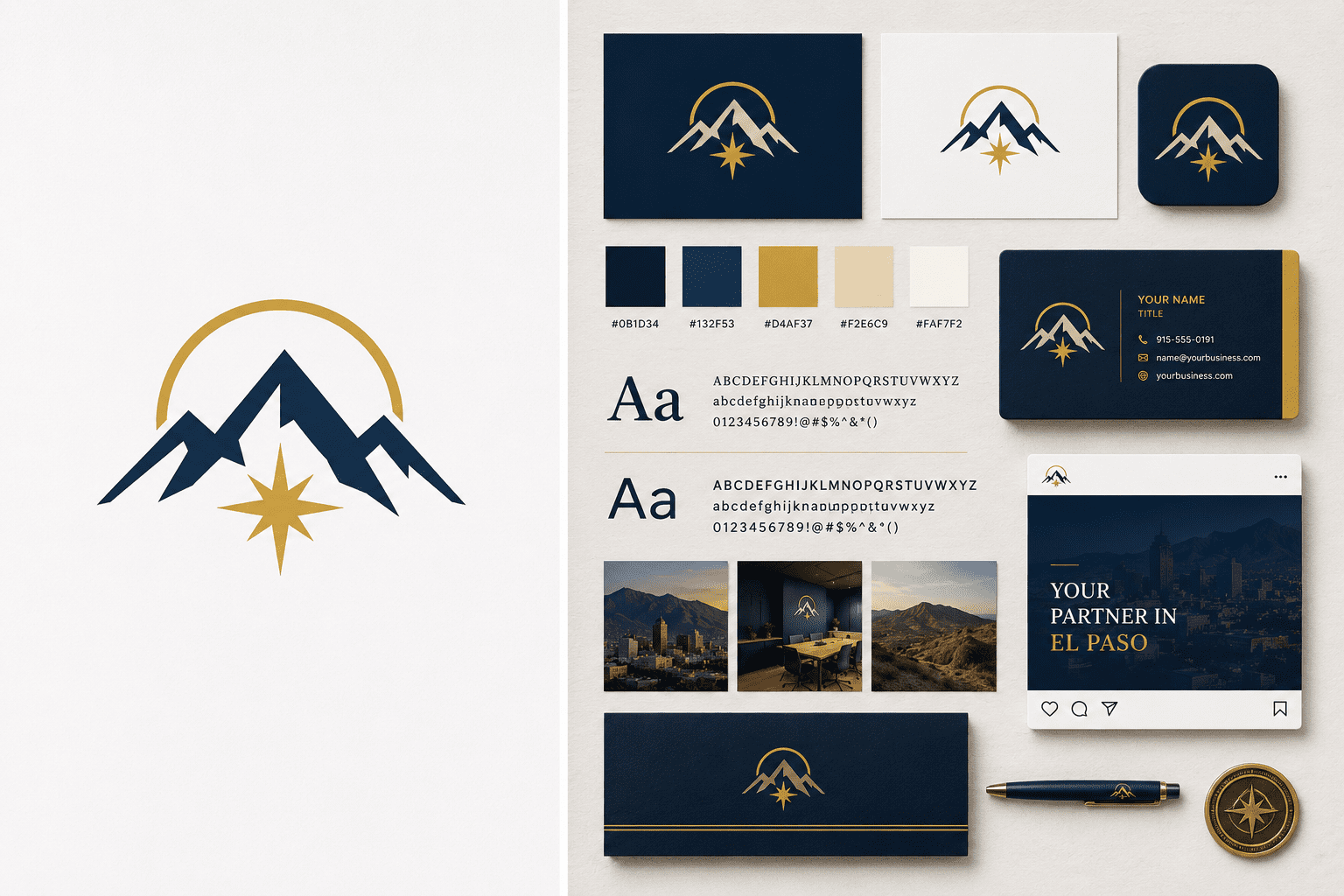
What a Visual Identity System Actually Contains: 6 Core Components
A complete visual identity system has six core components. Each one exists to answer a specific consistency question that a logo design alone cannot answer — and each one becomes more valuable as your business grows, your team expands, and your brand touchpoints multiply.
1
Logo System — Not Just a Logo
A logo system includes the primary mark plus all variations required to apply it consistently: horizontal and vertical lockups for different layout orientations, a standalone icon or monogram for small-scale applications like favicons and profile pictures, dark and light versions for use on contrasting backgrounds, and minimum size specifications with protected space rules. Without these, every application becomes a judgment call — and judgment calls produce inconsistency at scale.
2
Color Palette With Full Technical Specifications
A color palette defines your primary brand color, two to three secondary colors, and a neutral scale — with technical specifications for every environment: HEX for digital and web, RGB for screen, CMYK for print, and Pantone for physical production. Without these specifications, your brand color is whatever the output device produces by default. For El Paso businesses spanning digital marketing, physical signage, vehicle wraps, and trade show materials, color specification consistency is a recognition investment with measurable ROI.
3
Typography System
A typography system specifies the typefaces used for headlines, subheadings, body copy, and UI elements — with size hierarchy rules, weight specifications, and usage guidance for both digital and print applications. Typography is often the most neglected element of brand identity and one of the most immediately recognizable when it goes wrong. The difference between a brand that feels cohesive and one that feels assembled from parts is usually the consistent application of a defined type system rather than any single design decision.
4
Imagery and Photography Direction
Imagery direction specifies photography style, color treatment, composition principles, and subject matter guidelines governing every image used in brand communications — lifestyle versus product-focused, light versus dark, candid versus staged. Without imagery direction, every photo selection creates a new opportunity for visual inconsistency. For El Paso businesses in home services, healthcare, legal, and hospitality where photography is a primary trust-building channel, imagery direction is often the component with the highest per-use ROI.
5
Graphic Language and Supporting Brand Elements
Beyond the logo, strong visual identity systems include a graphic language — supporting elements creating visual richness across applications: patterns, textures, iconography, illustration styles, data visualization treatments, and layout principles. These elements make a brand recognizable even when the logo is not present. That level of recognition is only possible when the supporting graphic language is as defined and consistently applied as the primary mark itself.
6
Usage Guidelines With Application Examples
The sixth component — most often omitted from logo-only deliverables — is documented usage guidelines showing how all elements work together in real contexts: a social media post, a business card, a proposal cover, a website hero section, an email signature, a vehicle wrap. Guidelines without application examples create ambiguity. Application examples without guidelines create one-off decisions. The system is only complete when both exist together and can be handed to any vendor or team member to produce on-brand work independently.
Logo Design vs Visual Identity System: The Decision Matrix
Knowing which investment is right depends on your business stage, team structure, and growth trajectory. This table maps common situations to the right investment and the specific reason why.
Decision matrix comparing logo design versus visual identity system investment across seven business situations, including what is needed and why for each.
| Your Situation |
What You Need |
Why |
| Pre-launch, solo founder, minimal collateral |
Logo + basic color and type spec |
You need a starting point, not a full system yet |
| 1–5 people creating materials independently |
Visual identity system |
Team size creates consistency problems only a system solves |
| Growing team producing content without guidelines |
Visual identity system + brand guidelines |
Without documented rules, every new person introduces visual entropy |
| Commissioning a website redesign |
Visual identity system first |
Web designers need a system to work from, not just a logo file |
| Expanding to new markets or channels |
Full visual identity system audit |
Growth exposes inconsistency — fix the system before it scales |
| Preparing for investment or acquisition |
Full visual identity system |
Brand equity is evaluated as a transferable asset — systems transfer, logos do not |
| Recent rebrand that cost more than expected |
System-first rebuild |
The rebrand happened because the original was not systematic — rebuild correctly this time |
How Visual Identity Systems Produce Measurable Business Outcomes
The business case for a visual identity system is not aesthetic. It is financial and operational. Lucidpress research tracking 1,800 global brands across 14 industries confirmed that consistent brand presentation produces up to a 23% revenue increase. Brands with consistent presentation are 3.5 times more visible than inconsistent competitors. Adweek research shows consistent branding increases brand recall by 33% compared to inconsistent strategies. And McKinsey's Design Index data shows companies with the strongest design systems outperformed the S&P 500 by a 2-to-1 margin over five years.
The operational case is equally compelling. A documented visual identity system reduces the time vendors spend interpreting brand direction, reduces revision rounds on design deliverables, enables non-designers to produce on-brand content independently, and dramatically reduces the cost of the eventual rebrand that becomes necessary when inconsistency compounds over time without correction.
VenPro's brand work demonstrates this directly. The Xplor Pay fintech brand identity engagement — a full brand repositioning that included visual identity system development alongside strategic positioning and messaging — produced a 3x lift in conversion rates. That result did not come from a better logo. It came from a coherent visual identity system that communicated institutional credibility, reduced perceived risk, and made every touchpoint feel like the same trustworthy company. Consistency was the conversion mechanism — and it is always the conversion mechanism when brand work is done correctly.
How to Audit Your Brand's Logo Design vs Visual Identity System in 15 Minutes
Before commissioning new brand work, run this six-point audit to understand whether you have a logo-only situation or a functioning visual identity system. Test on your real brand assets — not what you think you have, but what you can actually hand to a vendor right now.
✓
Logo Variations: Do you have horizontal, vertical, icon-only, dark background, and light background logo versions — or just one primary file in one or two formats?
✓
Color Specifications: Can you provide HEX, RGB, CMYK, and Pantone values for your brand colors right now — without guessing or sampling from a screenshot?
✓
Typography Documentation: Can you name the specific typefaces used in your brand communications and provide a license or source for a new vendor to access them?
✓
Imagery Direction: If you hired a photographer for a brand shoot tomorrow, could you give them a written brief describing your photography style, color treatment, and composition principles?
✓
Application Examples: Do you have documented examples showing how your brand elements appear on a social post, business card, proposal, and website page — all looking like the same company?
✓
Vendor-Readiness: Could a new designer, printer, or marketing contractor produce on-brand work from the files you currently have — without calling you to ask clarifying questions?
Score 5–6: Functioning System
You have a visual identity system worth building on. Focus on keeping it current as the business grows and channels multiply.
Score 3–4: Partial System
You have strong foundations with identifiable gaps. A targeted system audit will surface exactly what is missing and prioritize the build order.
Score 0–2: Logo-Only Brand
Your brand is operating without a system. The inconsistency this produces is costing you recognition, trust, and revenue every day it remains unaddressed.
See VenPro Visual Identity Case Studies →
What to Expect From a Visual Identity System Engagement
Understanding the scope of a visual identity system project helps El Paso business owners evaluate what they are commissioning — and whether a proposed deliverable represents a complete system or a logo with supporting files dressed up as one.
A complete visual identity system engagement includes a discovery process that uncovers positioning, audience, competitive context, and brand personality before any design work begins — this is the element most often skipped in logo-only engagements, and its absence is why logo-only brands require rebuilds. From there, the engagement covers logo system development with all necessary variations and format deliverables; color palette with full technical specifications; typography system; imagery and photography direction; graphic language and supporting brand elements; application examples across the most relevant touchpoints for the specific business type; and documented brand guidelines enabling every future vendor, team member, and platform to apply the system consistently.
For El Paso businesses in healthcare, legal, home services, and professional services — categories where trust is the primary purchase driver and multiple touchpoints precede every conversion — a documented visual identity system is not a luxury brand investment. It is the infrastructure that makes every marketing dollar more effective by ensuring the brand it represents looks like the same company everywhere a customer encounters it.
Start a Brand Identity Strategy Call with VenPro →
Frequently Asked Questions
Q1
What is the difference between logo design vs visual identity system?
+
Logo design produces a single visual mark — a symbol, wordmark, or combination — that represents your brand in its simplest form. A visual identity system is the complete, documented set of design elements and usage rules ensuring your brand looks consistent across every touchpoint: logo variations, color palette with technical specifications, typography system, imagery direction, graphic language, and application guidelines. A logo tells people what your brand is called. A visual identity system tells people what your brand is — every time they encounter it, regardless of channel, medium, or who produced the asset.
Q2
How much does a visual identity system cost compared to logo design?
+
Logo-only design projects typically range from $500–$3,000 for professional freelance work and $2,000–$8,000 for agency work in 2026. Complete visual identity systems typically range from $5,000–$25,000 depending on scope, business complexity, and the number of touchpoints requiring application examples. The investment gap is significant — but the cost of the eventual rebrand required when a logo-only brand becomes inconsistently applied at scale typically exceeds the difference. Lucidpress research finding that consistent branding produces up to 23% revenue increase makes the system investment highly defensible against the logo-only alternative.
Q3
Do I need a visual identity system before building my website?
+
Yes — and this is the single most common sequencing mistake El Paso businesses make. A web designer handed only a logo file will make hundreds of color, typography, layout, and imagery decisions based on their own judgment. Without a visual identity system as a design brief, those decisions are not documented and not transferable. The next vendor who touches the site will make different decisions. A visual identity system built before the website ensures every design decision is intentional, documented, and replicable — producing a website that remains on-brand regardless of who builds or updates it.
Q4
What does a visual identity system include for a small business?
+
For most small businesses, a complete visual identity system includes six components: a logo system with all necessary variations and formats; a color palette with HEX, RGB, CMYK, and Pantone specifications; a typography system specifying typefaces, weights, and hierarchy; imagery and photography direction; a graphic language of supporting visual elements; and brand guidelines with application examples showing how all elements work together across the most relevant touchpoints — website, social media, business cards, proposals, and any print or physical materials specific to the business type and market.
Q5
When is logo design sufficient without a full visual identity system?
+
A logo-only deliverable is sufficient at two specific stages: a pre-launch stage where a solo founder needs a starting point before positioning is fully developed, and a minimal viable brand stage where the business operates across only one or two channels with no team members producing independent content. At any point where a team member, vendor, or platform needs to represent the brand independently — or where the business operates across more than two visual channels — a logo alone will produce inconsistency. The question is not whether inconsistency will develop without a system, but how quickly and how visibly it will develop.
Logo Design vs Visual Identity System: The Investment That Compounds
The logo design vs visual identity system distinction is ultimately a question of what kind of brand infrastructure you are building. A logo is a starting asset. A visual identity system is a business asset — documented, transferable, and capable of producing consistent recognition at scale regardless of who executes it. The 23% revenue lift associated with brand consistency is not a design department metric. It is a business outcome produced by showing up as the same company everywhere a customer encounters you — and a visual identity system is the only mechanism that makes that consistency operationally possible without micromanaging every design decision made on your behalf.
At VenPro Solutions, brand identity work always begins with the system, not the symbol. The Xplor Pay fintech rebrand that produced a 3x conversion lift was not a logo project — it was a visual identity system engagement built on strategic positioning, and the conversion improvement came from the coherence of the system, not from any individual design element within it. That same system-first approach is available to every El Paso business ready to build a brand that communicates the same thing everywhere a customer looks.
Visual Identity
Logo Design
Brand Strategy
El Paso
Brand Consistency
Brand Guidelines