





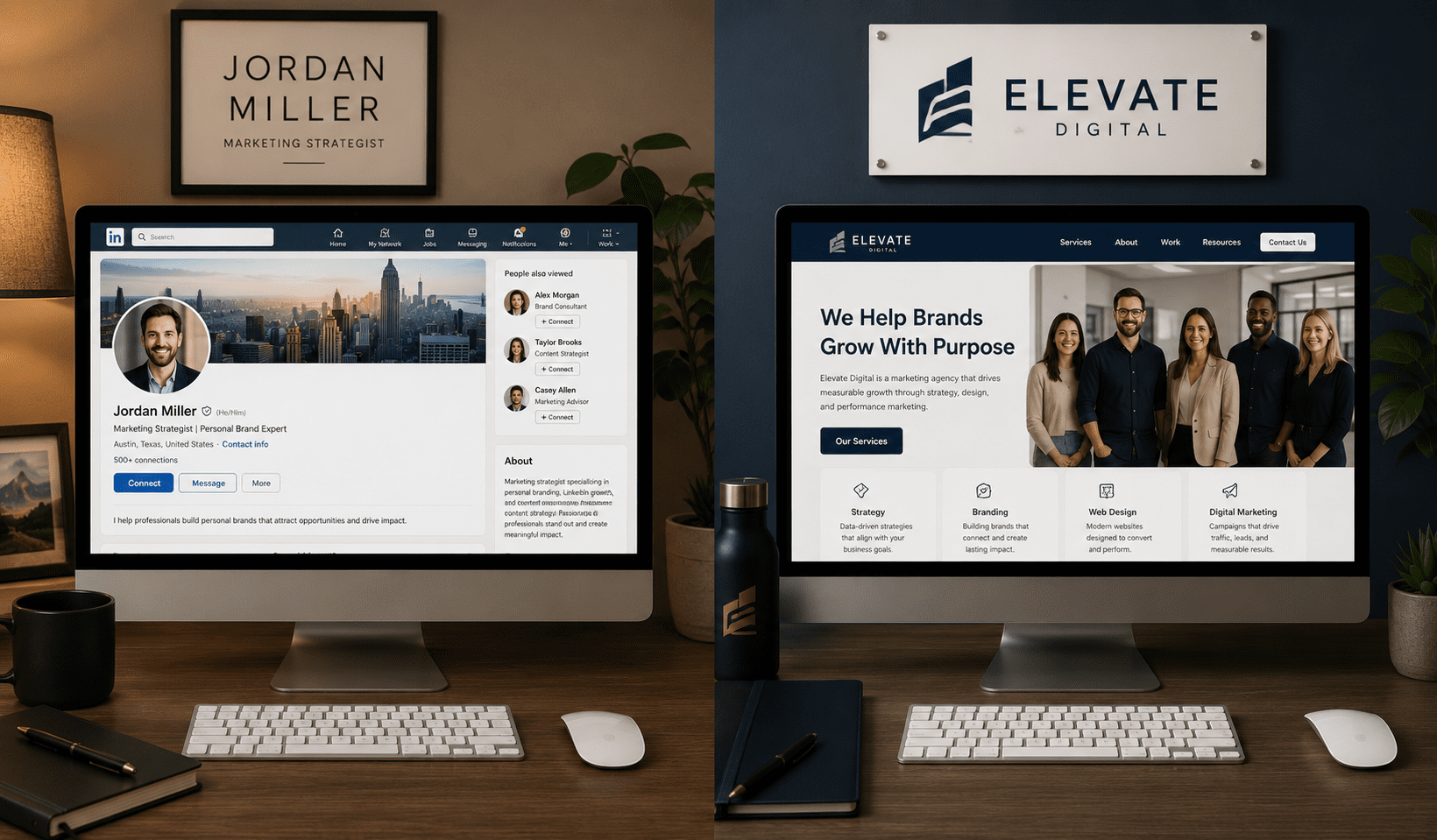
Personal Brand vs Business Brand Strategy: How to Decide, Build, and Scale the Right One
The personal brand vs business brand strategy debate comes up in every founder's journey — usually at the worst possible time. You are six months into building, clients are finding you through your personal LinkedIn presence, and then someone asks: "Is this you, or is this a company?" The question that felt cosmetic suddenly reveals itself as structural. The answer shapes your pricing, your exit options, your team's ability to grow without you, and how much your business is worth the day you decide to step back. This guide gives you a criteria-based framework — not a generic pros-and-cons list — built around where you are now and where you want to go.
What Is the Difference Between Personal Brand vs Business Brand Strategy?
Why the Personal Brand vs Business Brand Strategy Decision Matters More in 2026
Three forces have made this choice genuinely consequential for El Paso entrepreneurs and founders in ways that did not exist at this scale even three years ago. First, personal brands now hold a structural reach advantage. LinkedIn data shows that personal profiles generate 561% more reach than company pages, and a CEO with 5,000 connections achieves the same engagement as a company page with 300,000 followers. For early-stage founders, a personal brand is currently the fastest and cheapest path to visibility and inbound trust — the algorithm has built a preference for human voices that no ad budget can override.
Second, business brands carry irreplaceable exit and scalability value that personal brands cannot replicate. Investors and acquirers evaluate company brand equity that exists independently of the founder. When your business brand is inseparable from your personal identity, the valuation ceiling drops — because what a buyer is acquiring is not a system, it is a person. For any founder with intentions of scaling a team or eventually selling, a business brand that operates without them is a financial asset, not just a marketing preference.
Third, the trust equation has evolved in both directions simultaneously. Edelman's 2026 Trust Barometer confirms that business remains the most trusted institution globally. At the same time, 82% of consumers say they are more likely to trust a company when its CEO and leadership team are visibly active on social media. Trust now flows through both channels — the company that feels established and the person behind it who feels real. Running only one of them leaves half the equation unresolved and half the available trust on the table.
Personal Brand vs Business Brand Strategy: Decision Matrix at a Glance
The right starting point depends on your business model, growth stage, and long-term goals. This table maps the core trade-offs across seven factors so you can locate your situation and act on it rather than remain in the debate.
| Factor | Personal Brand | Business Brand | Hybrid Model |
|---|---|---|---|
| Trust-building speed | Fast — face and name build rapport quickly | Slower — requires consistent brand exposure over time | Fastest — personal opens doors, business closes them |
| Scalability | Limited — tied to your time and energy | High — team and systems grow independently | High — founder drives awareness, company holds the asset |
| Exit and sale value | Low — personal equity cannot be transferred | High — brand equity transfers with the business | High when structured correctly from day one |
| LinkedIn reach | 561% more reach than company pages | Lower organic reach, stronger paid performance | Personal reach amplifies company brand growth |
| Key-person risk | Maximum — business stops if you stop | Minimal — operations independent of founder | Manageable — founder leads without bottlenecking |
| Ideal for | Consultants, coaches, solopreneurs | Product companies, agencies, franchises | Service businesses planning to scale or exit |
| Revenue stage fit | $0–$500K fastest via personal brand | $500K+ where institutional credibility matters | All stages when built intentionally from day one |
The Case for Leading With a Personal Brand Strategy First
Personal brands win on trust velocity and reach. LinkedIn users are 3x more likely to trust content from an individual than from a brand. Founders with strong niche authority personal brands see 3–7x higher conversion rates compared to traditional corporate marketing. For service businesses — consultants, attorneys, financial advisors, healthcare practices — where the buyer is fundamentally evaluating a person's judgment before buying anything, a personal brand is not a vanity project. It is the product itself, and leading with it is the strategically correct choice.
The practical case is equally strong. Personal brands cost almost nothing to start. Your expertise, your perspective, and your consistency are the primary inputs. For El Paso entrepreneurs in service industries, where word-of-mouth and community trust are primary growth drivers, a personal brand that shows up with genuine insight and local context builds the kind of credibility that no amount of corporate logo polish can shortcut. Additionally, personal brand audiences are portable in a way business brand audiences are not — if you pivot, launch a new offer, or enter a new market, that audience follows the person, not the company name.
The Case for Leading With a Business Brand Strategy First
Business brands win on scalability, institutional credibility, and transferable value. If your goal is to build a company that operates without you — that can hire a team, serve clients without your direct involvement, and eventually be sold or acquired — then your brand needs an identity that does not require your face at every touchpoint. Key-person risk is the structural vulnerability that personal-brand-only businesses carry at every stage. Specifically, when 80% or more of your revenue depends on one person's reputation and presence, your business has a single point of failure. An algorithm change, a health issue, or simply the desire to take a real vacation becomes an existential business event rather than a temporary absence.
Moreover, certain audiences require institutional credibility before they engage at all. Enterprise buyers, government contracts, regulated industries, and procurement-driven purchasing decisions evaluate the company — not the founder's social following. For El Paso businesses pursuing B2B contracts, government work, or partnerships with larger regional employers, a business brand that communicates stability, systems, and longevity opens doors that personal brand authority simply cannot. Forty-four percent of a company's market value is directly attributable to CEO reputation — but that value only transfers in a sale if a business brand infrastructure exists to hold it independently.
Why the Hybrid Model Is the Right Personal Brand vs Business Brand Strategy for Most Growing Businesses
The most important insight in the personal brand vs business brand strategy conversation is that the choice is rarely either/or. The hybrid model — a business brand with a visible human face at its center — delivers the trust velocity of a personal brand and the scalability of a business brand simultaneously, when built with intention from the start. The architecture works like this: the business brand holds the domain, the legal entity, the service offerings, and the client relationships. The founder's personal brand drives awareness and thought leadership on social platforms, funneling that attention back into the company. Over time, the founder gradually moves from being the sole visible voice to one of several, as team members build their own brand presence within the company framework.
VenPro's own brand work reflects this architecture in practice. The fintech client whose full brand repositioning produced a 3x lift in conversion rates was a business brand challenge — clarifying the company's value proposition and visual identity so the brand communicated institutional credibility, not just founder enthusiasm. The Miss SunCity USA personal brand project was the inverse — building an individual's presence with the polish and consistency of a business brand system. Both required the same underlying discipline: clarity on who the brand is for, what it is promising, and how every touchpoint reinforces that promise consistently.
How to Build Your Personal and Business Brand Strategy Together Without Creating a Mess
If the decision matrix points toward a hybrid approach — which it does for most El Paso service businesses planning to grow — here is the build sequence that avoids the expensive rebrand most founders face when they have accidentally built a personal brand and then realize they need a business brand underneath it.
- Start with the business brand architecture first. Register the company domain, establish a business name that is not your personal name, and build your website around the company identity. As your personal brand grows on social platforms, it points to a company — not just to you personally.
- Use your personal brand as the awareness engine. Post consistently as yourself on LinkedIn and wherever your audience lives. Your voice, perspective, and expertise are what people trust first. Let that trust flow downstream to the business brand intentionally, not accidentally.
- Create explicit brand separation in your content. Some content belongs to you — opinions, lessons, personal experiences. Other content belongs to the company — case studies, service explanations, team stories. Maintaining that separation from day one prevents the identity confusion that makes later transition expensive.
- Build company reputation parallel to your own. Client testimonials should reference the company. Case studies should be published on the company blog. Awards and recognition should accrue to the business entity. These are the assets that transfer in a sale. Personal reputation cannot be packaged and acquired by a buyer.
- Plan the transition before you need it. Founders who transition smoothly from a personal-brand-led phase to a business-brand-led phase are the ones who designed that transition before it was urgent. Introduce team members as brand voices early. Shift core service offers under the company brand progressively. The goal is a business that runs with you — and eventually, without you if needed.
How to Know Which Personal Brand vs Business Brand Strategy Is Right for Your Business Right Now
Before committing to a direction, run through these five questions. They surface the strategic answer faster than any template — and they are the same questions VenPro works through with every brand strategy client before touching a logo, a website, or a content calendar.
What is your three-year revenue and team goal? If the answer involves a team of more than five people or revenue above $1M, the business brand needs to be established now — before the personal brand has grown so dominant that separating them feels like starting over.
Do you intend to sell, raise investment, or pursue enterprise contracts? If yes to any of these, build the business brand as the primary asset from day one. Personal brand equity does not transfer in a sale or investment round. Company brand equity does — and the earlier it is established, the more it compounds.
Is your buyer evaluating you personally or evaluating a company? High-touch service buyers in local markets often buy the person first. Product buyers, institutional buyers, and procurement-driven buyers evaluate the company. Knowing which buyer you serve determines which brand should lead — and which should support.
How dependent is your current revenue on your personal presence? If the answer is completely dependent, start building the business brand architecture immediately — not to replace your personal brand, but to ensure the company has an identity that can operate alongside or without you when circumstances demand it.
See VenPro Brand Strategy Case Studies →Frequently Asked Questions
Q1 What is the core difference between personal brand vs business brand strategy? +
Q2 Which drives more revenue — personal brand or business brand? +
Q3 What is key-person risk and why does it matter for brand strategy? +
Q4 Can I build a personal brand and a business brand at the same time? +
Q5 When should an El Paso business owner prioritize business brand over personal brand? +
Your Personal Brand vs Business Brand Strategy Starts With One Clear Decision
The personal brand vs business brand strategy debate has a practical answer for most founders: lead with your personal brand to build trust and generate early revenue, while building the business brand architecture in parallel so the company has an identity that can grow beyond you. The mistake is not choosing personal over business, or business over personal. The mistake is building one without intentionally designing the other — and realizing too late that an unplanned rebrand costs far more than a strategy session at the start would have.
At VenPro Solutions, brand strategy is where we start with every client before we touch a logo, a website, or a content calendar. Positioning, messaging, and visual identity need to be built around a clear decision about what kind of brand you are building — and who it needs to serve as the business grows. That clarity is what turned a confused fintech identity into a 3x conversion lift, and what built a personal brand platform strong enough to win Miss SunCity USA. The same clarity is available to every El Paso founder willing to make the decision with intention rather than by default.