





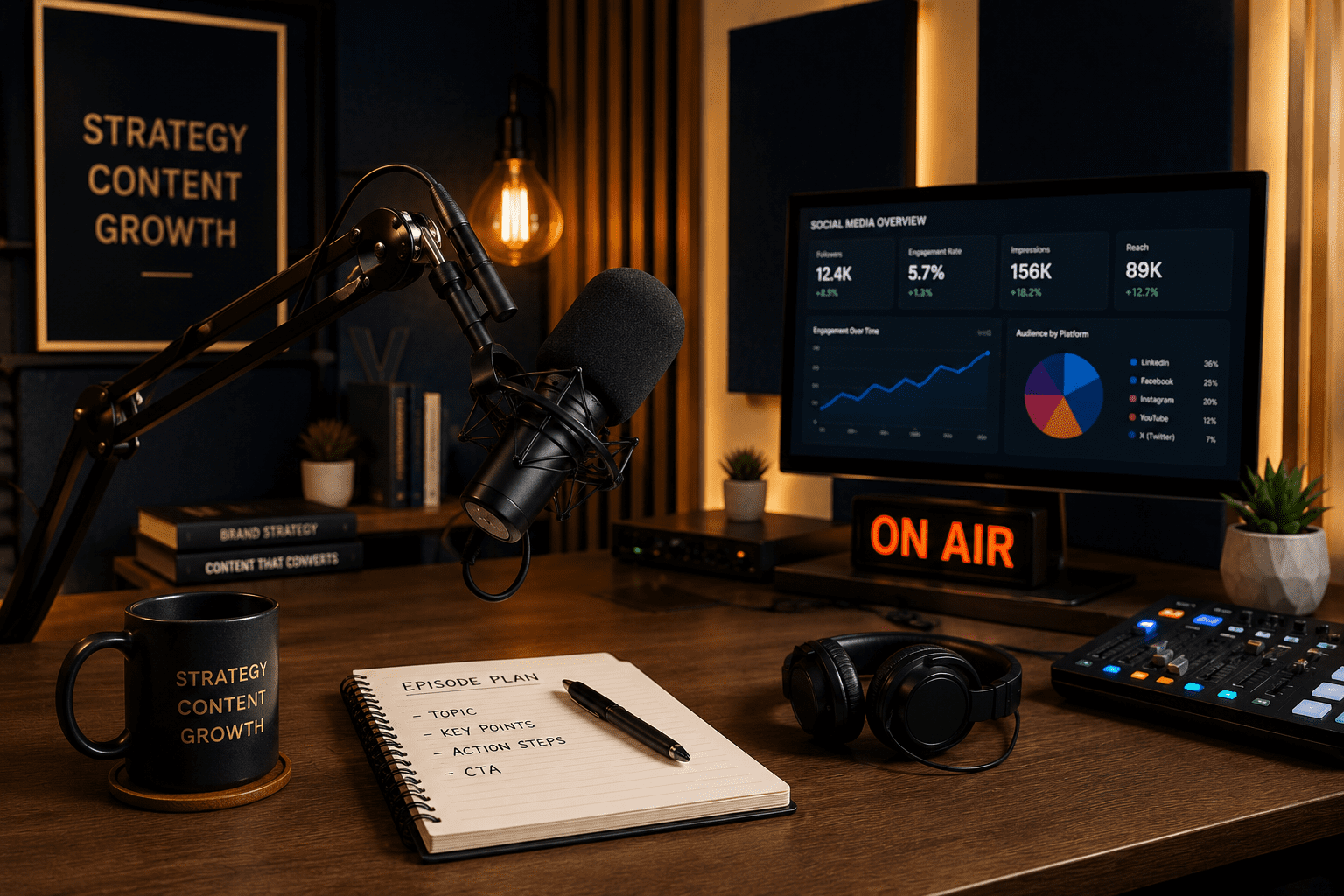
Do I Need a Podcast for My Business in 2026? An Honest Answer
Do I need a podcast for my business in 2026 — or is this another marketing channel that sounds better than it performs? The honest answer is that podcasting is one of the highest-leverage brand-building tools available to service businesses today, but only when it is built around a clear purpose, a specific audience, and a production standard that reflects well on your brand. This post gives you the data, the decision framework, and a direct answer so you can stop wondering and start deciding.
Do I Need a Podcast for My Business? The Direct Answer
Why Podcasting Has Become a Serious Business Tool in 2026
The numbers behind podcasting in 2026 are no longer niche-interest statistics — they are mainstream marketing data. Over 619 million people worldwide listen to podcasts regularly, with 58% of Americans tuning in monthly. Specifically, 83% of senior executives report listening to at least one podcast in the past week, spending twice as much time with audio content as the general population. That is a decision-maker audience consuming long-form content during commutes, workouts, and downtime — and actively influencing purchasing decisions while they listen.
The brand impact data is equally compelling. Companies with branded podcasts achieve 89% higher brand awareness and 57% higher brand consideration compared to those without. After hearing podcast episodes, 61% of listeners report feeling more favorable toward a brand. Moreover, podcast listeners demonstrate 2.7x higher close rates than other marketing-qualified leads — a figure that reframes podcasting from a branding play to a genuine pipeline asset worth measuring alongside paid media and SEO.
What has shifted most in 2026 is how podcasting intersects with AI-powered search. Podcasts with full transcripts, detailed show notes, and structured content are precisely the kind of long-form, conversational assets that AI Overview engines prefer to cite. Additionally, 46% of brands now view podcasts as more effective for establishing authority than any other content medium — a ranking that directly reflects how AI engines weight original, expert-driven content when generating answers to industry-specific queries.
Is a Business Podcast Right for You? Decision Matrix at a Glance
Not every business benefits equally from podcasting. The table below maps five common business profiles to the strategic fit, primary benefit, and recommended format for each — so you can see where your business lands before committing resources.
| Business Type | Primary Goal | Podcast Fit | Biggest Benefit | Recommended Approach |
|---|---|---|---|---|
| B2B Service / Agency | Thought leadership + relationships | Strong | Guest-to-client pipeline | Interview decision-makers from target accounts |
| Local Service Business | Community trust + brand awareness | Moderate–Strong | Local authority + E-E-A-T | Hyper-local topics, neighborhood and community focus |
| E-commerce / Product Brand | Brand affinity + repeat purchase | Moderate | Customer loyalty + retention | Lifestyle content tied to product use and values |
| Solopreneur / Coach | Personal brand + audience ownership | Strong | Direct audience relationship | Solo or co-hosted educational format |
| Enterprise / Corporate | Executive positioning + internal comms | Strong | Thought leadership at scale | Branded series with guest industry experts |
The Real Benefits of a Business Podcast for My Business in 2026
Authority that compounds over time is the most underrated benefit of business podcasting. Every episode you publish is a permanent piece of intellectual property attached to your brand. Over 70% of podcast listeners finish most or all of each episode — an engagement depth no other digital format currently matches. Listeners who stay with a show for 10–15 episodes develop a level of trust and familiarity that no ad, landing page, or social post can build in the same timeframe. That trust is what converts listeners into clients, referrals, and long-term relationships.
Content multiplication is the most practical argument for starting a show. A single well-produced podcast episode is the raw material for a blog post, a LinkedIn video clip, a YouTube short, an email newsletter segment, and social media quotes — all from one recording session. For time-pressed business owners, this leverage effect transforms a 60-minute recording into a week's worth of distributed content across every channel in your marketing stack. The recording session is the investment; everything downstream is compounding output.
Trust transfer is the mechanism most businesses underestimate. Over 59% of listeners consider podcast hosts more trustworthy than social media influencers. Host-read content and branded episodes perform 4–5x better in recall than display ads because the audience has already chosen to trust the voice behind the microphone. For El Paso businesses specifically, consistent podcast presence builds community recognition — the kind that generates referrals, strengthens reviews, and keeps your brand top-of-mind when a neighbor asks for a recommendation.
When a Business Podcast Does NOT Make Sense in 2026
Honesty matters here. Podcasting is not the right move for every business, and starting a show without the right foundation is worse than not starting at all — abandoned episodes signal inconsistency to anyone who researches your brand. Skip it if your goal is immediate lead generation. Podcasting builds trust slowly and compounds over time. It is not a short-cycle demand-generation channel. If you need leads in the next 30–60 days, paid search and local SEO will outperform a podcast every time and deserve the budget first.
Skip it if you cannot commit to consistency. Research consistently identifies "podfade" — shows that publish a handful of episodes then go dark — as the most common outcome for business podcasts. Publishing sporadically signals unreliability to both listeners and search engines. If you cannot commit to at least two episodes per month for a minimum of six months, the resources are better deployed elsewhere. Similarly, skip it if your audience does not consume audio. Podcasting is powerful for reaching professionals and executives; it is less effective for audiences whose attention lives primarily in short-form visual platforms.
Finally, never launch without a production standard. Audio quality impacts listener retention more than show topic — a finding consistent across multiple studies. A poorly produced episode does not just underperform; it actively damages brand perception. Professional production, or at minimum a professional-grade recording environment, is a prerequisite for a show that represents your brand at the level your business deserves.
How to Start a Business Podcast the Right Way in 2026
If your decision matrix points toward yes, here is the sequence that separates successful shows from abandoned ones. Follow it in order — skipping steps is how most business podcasts end up in the podfade graveyard.
- Define the one job your podcast does. Relationship building, thought leadership, community trust, content multiplication — pick one primary purpose and design every episode around it. A show without a clear job drifts, loses audience, and eventually stops.
- Choose your format before your equipment. Solo commentary, guest interviews, co-hosted conversation, or a narrative format each serve different goals and require different production approaches. Interview formats tend to serve B2B service businesses best because every guest is a potential relationship, referral, or client.
- Invest in your recording environment first. Room treatment, a quality microphone, and consistent audio levels matter more than advanced editing software or elaborate intros. A professional studio eliminates this variable entirely — and the perceived authority of a well-produced show compounds with every episode.
- Build your repurposing workflow before you record Episode 1. Decide in advance how each episode becomes a blog post, a social clip, an email, and a quote graphic. The repurposing system is what turns one recording session into a full week of content across channels — without additional time investment.
- Commit to a cadence you can sustain. Biweekly is more sustainable than weekly for most small businesses and still builds audience loyalty over time. Consistency beats frequency — a biweekly show that publishes reliably for a year will outperform a weekly show that burns out after two months.
How to Know If Your Business Needs a Podcast Right Now
Before committing budget and time, run through these five questions. They will surface the answer faster than any pros-and-cons list — and they are the same questions we work through with El Paso businesses before recommending a studio engagement.
Who is your audience, and do they listen to podcasts? If your customers are professionals aged 25–54, the data strongly favors podcasting — this demographic leads all consumption. If your customers are primarily seniors or audiences whose attention lives in visual-first platforms, the case is weaker and the resources may serve you better elsewhere.
Do you have a point of view worth sharing for 20–40 minutes at a time? Podcasting rewards depth and specificity. If you can talk about your industry, your process, and your clients' problems with genuine insight and without running dry, you have the raw material for a compelling show that builds real authority over time.
Can you commit to six months of consistent publishing before evaluating results? Podcast audiences take time to find and trust a show. Evaluating ROI at the two-month mark is like judging an SEO campaign after two weeks. The compounding benefits — authority, trust, search visibility, AI citations — require patience and consistency to materialize.
Is someone on your team genuinely excited to own this? Podcasting without internal enthusiasm fades fast. The host who dreads recording days will produce episodes that sound like it. A show needs a champion, not just a budget line — someone who sees it as a platform, not a task.
See VenPro Case Studies →Frequently Asked Questions
Q1 Do I need a podcast for my business in 2026 if I already have strong social media? +
Q2 How many listeners do I need for a business podcast to be worth it? +
Q3 How much does it cost to start a business podcast in 2026? +
Q4 How long does it take to see results from a business podcast? +
Q5 Is it too late to start a business podcast for my business in 2026? +
Your Business Podcast Decision Starts With One Question
If your business depends on trust, expertise, and relationships — and most service businesses do — a podcast is one of the highest-leverage brand-building tools available in 2026. The format rewards depth, builds authority that compounds over time, and creates content assets that work across every channel in your marketing stack. The question was never really whether you need a podcast for your business in 2026. The real question is whether you are ready to treat it as a strategic asset, show up consistently, and invest in the production quality your brand deserves.
For El Paso businesses ready to make that commitment, VenPro's Podcast & Media Studio is built exactly for this. Professional recording and production, branded content strategy, and a distribution approach designed to turn your voice into measurable business growth — without the overhead of building a studio from scratch. The equipment is ready. The process is proven. The only variable is your decision.