





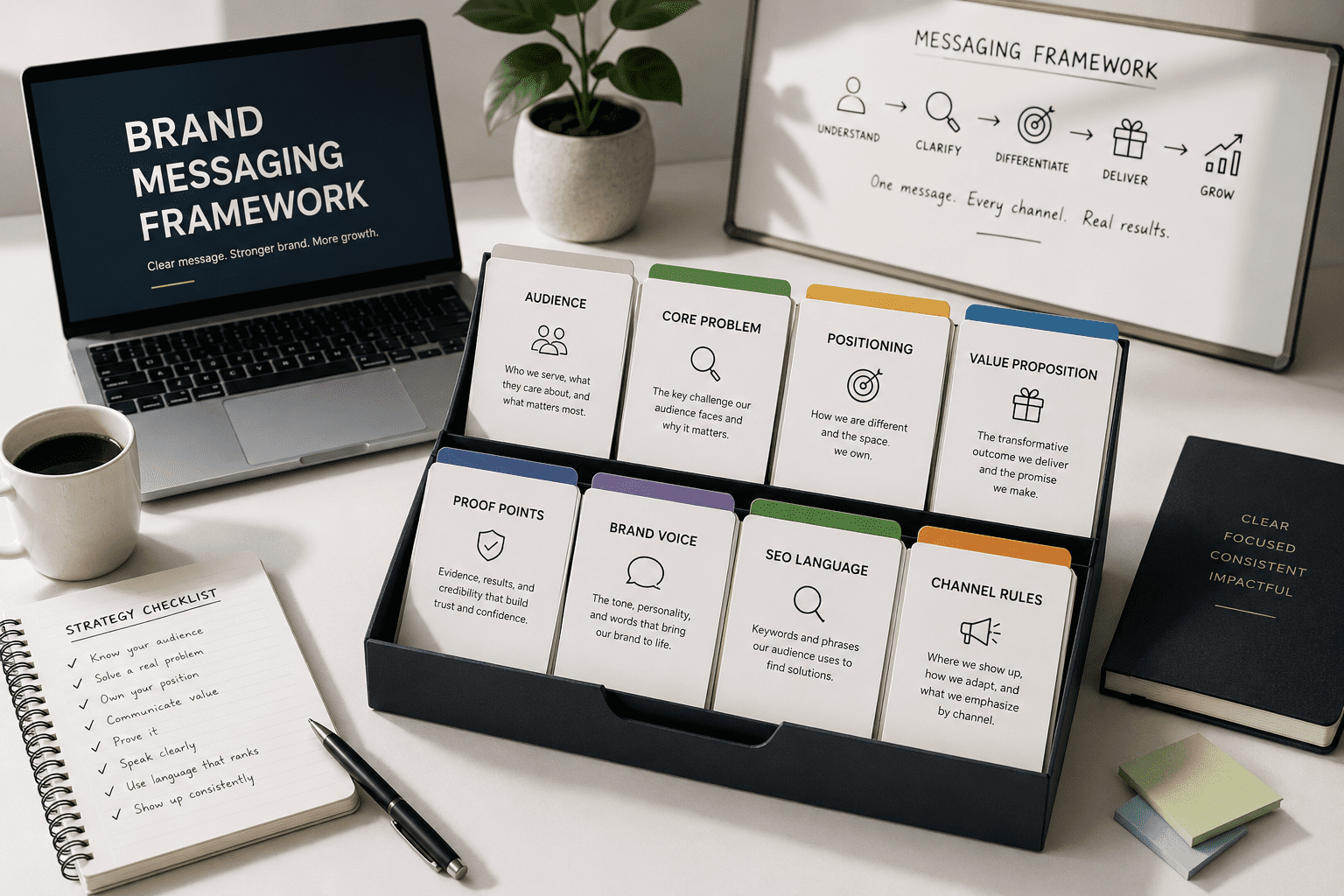
Brand Messaging Framework Template
A brand messaging framework template helps your business stop rewriting the same idea a dozen different ways. When your homepage, SEO pages, sales scripts, ads, emails, and social posts all sound disconnected, customers feel that friction. They may understand what you sell, but they may not remember why your brand is the right choice.
What Is a Brand Messaging Framework Template?
Why a Brand Messaging Framework Template Matters for Growth
A brand messaging framework template matters because growth adds complexity. As your business adds new offers, team members, campaigns, locations, or audiences, your message needs to scale without getting messy.
Clear messaging helps customers understand your value faster. It also helps internal teams make better decisions. Marketing knows what to say. Sales knows which proof points to use. Designers know the emotional direction. SEO teams know which problems and outcomes to emphasize.
Additionally, consistent brand messaging improves trust. Asana’s brand messaging framework guidance emphasizes that messaging helps brands communicate value, connect with audiences, and maintain consistency across channels. That same principle becomes more important when a business is active across search, social, email, ads, sales, and AI-assisted discovery.
Brand Messaging Framework Template at a Glance
Use this mini-template as a working structure. Each layer answers a practical question, then turns the answer into reusable copy.
| Framework Layer | Question It Answers | Template Prompt | Where to Use It | Growth Purpose |
|---|---|---|---|---|
| Audience | Who are we speaking to? | Our best-fit customer is ___, and they struggle with ___. | Homepage, SEO pages, ads, sales scripts | Sharper relevance |
| Core Problem | What pain are they trying to solve? | The main problem our audience faces is ___, which causes ___. | Headlines, blog intros, landing pages | Clearer demand capture |
| Positioning | Why should they choose us? | We help ___ achieve ___ through ___, unlike ___ who ___. | Homepage hero, pitch decks, proposals | Stronger differentiation |
| Value Proposition | What outcome do we promise? | Customers choose us because we help them ___ without ___. | CTAs, service pages, email campaigns | Faster decision-making |
| Proof Points | Why should they believe us? | We prove our promise through ___, ___, and ___. | Case studies, sales pages, proposals | More trust |
| Brand Voice | How should we sound? | Our voice is ___, ___, and ___, but never ___. | Social, blogs, email, website copy | Consistent recognition |
| Channel Rules | How does the message adapt? | On ___, we lead with ___ because the audience needs ___. | SEO, ads, email, social, sales | Reusable execution |
Start With the Audience Before the Tagline
The first part of any brand messaging framework should define the audience. Not a vague audience like business owners. A useful audience profile names who the message is for, what they care about, and what pressure they are under.
For example, a growing service business may not only need marketing help. It may need more qualified leads, a better website, stronger search visibility, and a clearer reason for customers to choose them. That is a much sharper messaging starting point.
Next, define the customer’s problem in their language. What do they say when they are frustrated? What are they tired of fixing manually? What do they wish worked better? This matters because the best messaging often sounds familiar to the buyer before it sounds clever to the brand.
Turn Positioning Into Repeatable Copy
Positioning is the core of your brand messaging framework. It explains where your brand fits, who it serves, what it solves, and why the customer should believe you.
A practical positioning statement might follow this structure: “We help [audience] achieve [outcome] through [method], unlike [alternative] that [limitation].” This is not always the exact sentence you publish. Instead, it is the internal source of truth for everything you write later.
Once positioning is clear, turn it into repeatable copy blocks. Write a homepage version, a short social bio version, a sales version, and an SEO version. Each version should sound slightly different, but the promise should stay the same.
Connect Brand Messaging to SEO and AI Discovery
A brand messaging framework template should include search language. Otherwise, the brand may sound polished but remain hard to find. Google’s Search Essentials recommend using words people would use to find your content and helping Google understand pages through clear, accessible content and links.
Start by mapping the language customers use before they know your brand. They may search for brand messaging template, how to write brand messaging, positioning statement examples, website copy framework, or brand voice guide. Those phrases can shape blog sections, FAQ answers, service page headings, and internal links.
However, SEO language should never flatten the brand voice. Instead, it should sharpen it. A good framework turns search terms into useful answers, clear claims, and stronger page structure. This is also important for AI discovery because answer engines tend to extract definitions, comparisons, checklists, tables, and direct answers.
Build a Brand Voice Guide Your Team Can Use
Brand voice should be practical, not poetic. If your team cannot apply it in daily work, it is too abstract. Start with three to five voice traits, then define what those traits mean in actual writing.
For example, a brand may be clear, confident, helpful, direct, and strategic. “Confident” might mean leading with recommendations, not over-explaining every decision. “Helpful” might mean giving examples, not just definitions.
Next, add do and do not examples. This helps writers, designers, salespeople, and AI tools stay aligned. For instance, say: “We build connected growth systems.” Do not say: “We offer innovative digital solutions.” The first is specific. The second could belong to anyone.
How to Use This Brand Messaging Framework Template
A brand messaging framework template works best when it becomes part of your content and sales process. Do not fill it out once and forget it. Use it whenever you create or review a customer-facing asset.
First, gather inputs. Review customer calls, reviews, competitor pages, search queries, sales objections, and website analytics. Messaging should be based on market reality, not only internal preference.
Second, complete the core sections: audience, problem, positioning, value proposition, proof points, voice, and channel rules. Then, turn the framework into assets such as a homepage hero, service page intro, FAQ bank, sales blurb, social bio, email opener, and ad angle.
Explore VenPro SEO services →How VenPro Builds Messaging Into a Growth System
For VenPro, messaging is not isolated from the rest of the digital ecosystem. It connects to brand identity, SEO, web design, automation, AI discovery, and performance marketing.
That matters because a great message still needs the right infrastructure. If the website is confusing, the message gets buried. If SEO pages target the wrong intent, the message reaches the wrong people. If follow-up emails feel disconnected, the brand loses momentum after the first touch.
VenPro’s SEO services connect messaging to search visibility, content strategy, authority signals, and lead tracking. Meanwhile, VenPro’s web design approach connects brand identity, website structure, AI integration, and performance marketing so the message has a stronger place to convert.
See VenPro web design →Frequently Asked Questions
Q1 What is a brand messaging framework template? +
Q2 What should a brand messaging framework include? +
Q3 How do you create brand messaging for a small business? +
Q4 What is the difference between brand messaging and brand voice? +
Q5 Why does brand messaging matter for SEO? +
Turn Brand Clarity Into a Repeatable System
A brand messaging framework template gives your team a better way to write, sell, publish, and grow. Instead of starting from a blank page, your team starts from a clear system: audience, problem, promise, proof, voice, and channel rules. That clarity helps your brand show up consistently across search, websites, sales conversations, social media, emails, and ads.