





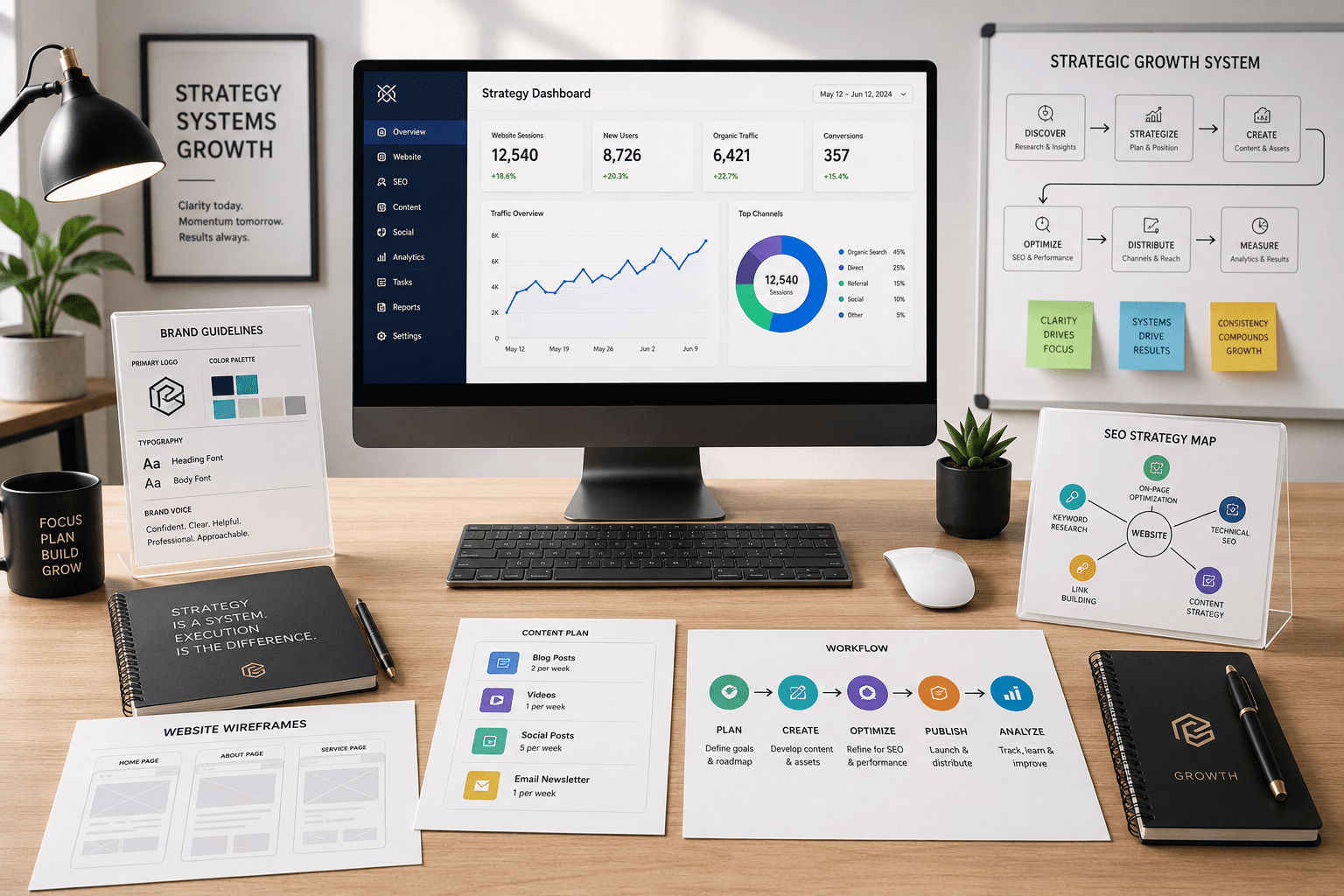
Scalable Brand Strategy Framework for Growth
A scalable brand strategy framework keeps your message clear when growth starts adding noise. When a company adds new offers, markets, locations, team members, content channels, or sales motions, the brand can either sharpen or scatter. The difference is usually not talent. It is the system behind the brand. For growing businesses, brand strategy should guide SEO, website copy, sales conversations, creative decisions, automation, and measurement.
What Is a Scalable Brand Strategy Framework?
Why a Scalable Brand Strategy Framework Beats One-Off Campaigns
A campaign can bring attention for a moment. However, a connected brand growth system compounds trust over time. Without that system, every new landing page, social post, ad, proposal, or email risks sounding like it came from a different company.
As a result, buyers may understand the offer but miss the bigger reason to choose you. That is expensive, especially when people compare several brands before they ever book a call. A stronger brand strategy framework gives every department the same source of truth.
Google’s Search Essentials also point brands toward clear, descriptive content that people can find and understand. Therefore, brand language, search language, and conversion language should work together instead of competing for attention.
Brand Strategy Framework at a Glance
A strong brand growth system connects the strategic layer to the channels where customers make decisions. Use this table as a working map for scalable marketing, SEO-backed brand strategy, and repeatable execution.
| Framework Layer | What It Defines | Channel Impact | Proof Signal | System to Build |
|---|---|---|---|---|
| Positioning | Who you serve and why you win | Website, sales, ads | Clear offer recall | Messaging guide |
| Search Language | How buyers describe the problem | SEO, AI discovery, blogs | Better qualified traffic | Keyword and content map |
| Visual Identity | How the brand feels and looks | Web, social, proposals | Faster recognition | Brand kit and templates |
| Conversion Path | What action comes next | Landing pages, forms, CRM | More calls and leads | Website and funnel flow |
| Measurement | What proves progress | Reporting, strategy, budget | Smarter decisions | KPI dashboard |
| Automation | What repeats without manual work | Follow-up, routing, nurture | Faster response time | Workflow playbooks |
Start With Positioning Before Channels
Positioning should come before the website, before SEO, and before paid campaigns. Otherwise, the channels may be active but unclear. Start by defining the buyer, the pain, the promise, the proof, and the point of difference.
For example, a service business may not simply sell marketing. It may help local companies turn search visibility into calls, clicks, and customers. That language is clearer, more useful, and easier to scale.
Next, convert the positioning into reusable messaging. Write the one-sentence brand promise. Then, write the proof points that support it. Also, define what the brand should not sound like, so generic copy does not creep into future campaigns.
Connect SEO and Branding Early
SEO-backed brand strategy helps people and search engines understand the same story. It also keeps content from drifting into random topic chasing. In particular, search data can reveal how buyers describe their pain before they know your solution.
For VenPro, this is a natural bridge. The VenPro SEO services page emphasizes Google Search, Maps, AI discovery, content strategy, authority signals, and lead tracking. Therefore, the framework should define how the brand becomes discoverable across modern search experiences.
A practical workflow includes mapping buyer language, turning keywords into messaging, building internal links intentionally, matching claims with proof, and tracking action instead of traffic alone. In short, SEO and branding should reinforce the same promise.
Build the Website as Brand Infrastructure
A website should not be treated as a digital brochure. For a growing company, it is brand infrastructure. That means the site has to carry positioning, content, proof, navigation, conversion paths, and technical clarity at the same time.
The site should answer the buyer’s next question before they have to ask it. What do you do? Who is it for? Why should someone believe you? What happens next? How does a prospect start?
Also, the website should make the internal team faster. If a campaign needs a landing page, the page structure should already exist. If a blog supports a service, the internal link path should be obvious. This is how a conversion-ready web system prevents growth from leaking away.
Use AI Discovery Without Losing the Human Voice
AI discovery is changing how people find and compare companies. Buyers may ask a search engine, chatbot, map result, or voice assistant for recommendations before they ever visit a website. So, brands need clean signals and clear answers.
That does not mean writing for robots. Actually, it means writing more clearly for humans. AI systems tend to extract definitions, comparisons, FAQs, and direct answers. Therefore, a brand strategy framework should define the questions the business wants to be known for answering.
Use plain explanations. Add short answer blocks. Keep service descriptions consistent. Also, connect related pages so authority can build across the site. When content, website structure, and reputation point in the same direction, AI discovery has cleaner signals to work with.
How to Build a Scalable Brand Strategy Framework
This framework works best when it is simple enough to use and strong enough to guide real decisions. First, run a brand clarity audit across your homepage, service pages, ads, social profiles, proposals, and email sequences.
Second, define the strategic core: audience, category, offer, promise, proof, tone, visual cues, and key objections. Third, build channel rules for SEO, web design, social media, paid ads, email, AI-assisted content, and sales follow-up. Finally, create reusable assets such as page templates, CTA language, FAQ banks, design components, and reporting dashboards.
Measurement keeps the system honest. Think with Google’s measurement resources focus on audience insights, attribution modeling, and campaign optimization, which supports the idea that growth systems need feedback loops, not guesswork.
Explore VenPro SEO services →How to Choose the Right Brand Strategy Partner
The right partner should understand strategy, creative, search, web systems, automation, and measurement. If one piece is missing, the framework may look good but fail in execution. Use these questions before choosing a team.
Can they connect brand strategy to search demand? The partner should know how customers actually look for your solution, not just how the company describes itself.
Can they build the digital system around the message? Strategy should flow into website structure, content, landing pages, internal links, and conversion paths.
Can they measure what happens next? A brand growth system should track visibility, engagement, leads, and momentum. Otherwise, it is hard to know what to improve.
VenPro’s positioning fits this kind of work because the company ties creative strategy, SEO, digital infrastructure, AI integration, automation, and performance marketing into one connected growth ecosystem.
See VenPro web design →Frequently Asked Questions
Q1 What is a scalable brand strategy framework? +
Q2 What should a brand strategy include? +
Q3 What is the difference between brand strategy and marketing strategy? +
Q4 How does SEO support brand strategy? +
Q5 How do you create a brand strategy that scales? +
Build a Brand That Can Grow Without Getting Messy
Growth exposes gaps. If the message is fuzzy, more traffic creates more confusion. If the website is weak, more attention leaks away. A scalable brand strategy framework gives your business a cleaner way forward by turning brand clarity into search visibility, stronger web experiences, better sales conversations, and measurable growth systems.