





Who Owns Website Agency Built: What Payment Actually Covers
The question of who owns website agency built work has a less comfortable answer than most people expect. You paid the invoice. The site went live. So it feels settled, and for most relationships it never comes up again. Then somebody asks for the source files, or you decide to move platforms, and the answer suddenly matters a great deal. Here is what an invoice actually transfers, and what you have to ask for by name.
Who Owns Website Agency Built Work, In Short
The Assumption Almost Everyone Makes
The assumption is simple and reasonable. I paid for it, so it is mine. That is how buying a chair works, and nobody thinks twice about it.
However, created work behaves differently from a chair. What you buy is defined by the agreement rather than by the payment, and plenty of agreements say less than either side remembers. So the gap is not usually anyone being clever. In fact, most of the time nobody discussed it at all, and the silence gets read in different directions by each party later.
Also, this rarely surfaces during a good relationship. Your agency sends what you ask for because they want you to stay. Then the question only becomes real at the exit, which is exactly when goodwill is at its lowest.
There is a simple way to find out where you stand. Open the agreement and search it for the word ownership. If nothing comes back, search for assignment, then for licence. So three searches take a minute and tell you most of what you need.
Licence Versus Assignment, In Plain Terms
Two words do most of the work here. A licence is permission to use something that somebody else still owns. An assignment moves the ownership itself.
So a licence can be perfectly adequate for a live website you never intend to change hands. Then it becomes limiting the moment you want to hand the files to a different team, reuse the design elsewhere, or take the work with you. Of course, an assignment is not automatically the right answer for every project either, and some vendors price the two differently. Granted, that is a fair conversation to have, provided somebody actually has it before the work starts.
Ask which one you have in plain language. Do I own this work, or do I have permission to use it? A vendor with clean paperwork answers in a sentence. Then you know where you stand without reading a single clause yourself.
Who Owns Website Agency Built Code, Content And Platform
A website is not one asset, and that is the root of most confusion. It is at least four: the code, the content, the design, and the platform it sits on.
So each can travel differently. Your content is almost always yours, since you supplied or approved it. The custom code and the design depend on the assignment language. Then the platform underneath is a separate question again, because a theme or a page builder is usually licensed to somebody rather than owned by anyone. Also, check whose account holds that platform licence, since a licence bought under a vendor's account can lapse the moment they stop renewing it. The build itself is covered in El Paso web design and development.
List what your site actually runs on before you need to know. The platform, the theme, any page builder, and every plugin doing real work. So one page of notes covers it. Then you can check each licence account in an afternoon.
What Payment Covers, Asset By Asset
Here is the whole picture in one place. Read the first column as the asset, then the rest as where it comes from and what you would notice at a handover.
| Trait | What it means | Where it comes from | What you notice |
|---|---|---|---|
| Your content | Copy, product information and anything you supplied. | Your own business | So this is yours regardless of the wording. |
| Custom code | Templates and functionality written for your site. | The agreement, not the invoice | Then assignment language decides it. |
| Design files | The layered originals behind every finished export. | The designer's working files | Also, exports are outputs rather than sources. |
| Logo and brand | Vector originals in an editable format. | The design agreement | In fact, a flat image cannot be resized cleanly. |
| Stock imagery | Photos and video bought under a licence. | A third-party stock library | So many of these do not transfer at all. |
| Themes and plugins | Third-party components your site depends on. | Whoever holds the licence account | Then updates stop if that account lapses. |
Editable Source Files Versus Exported Files
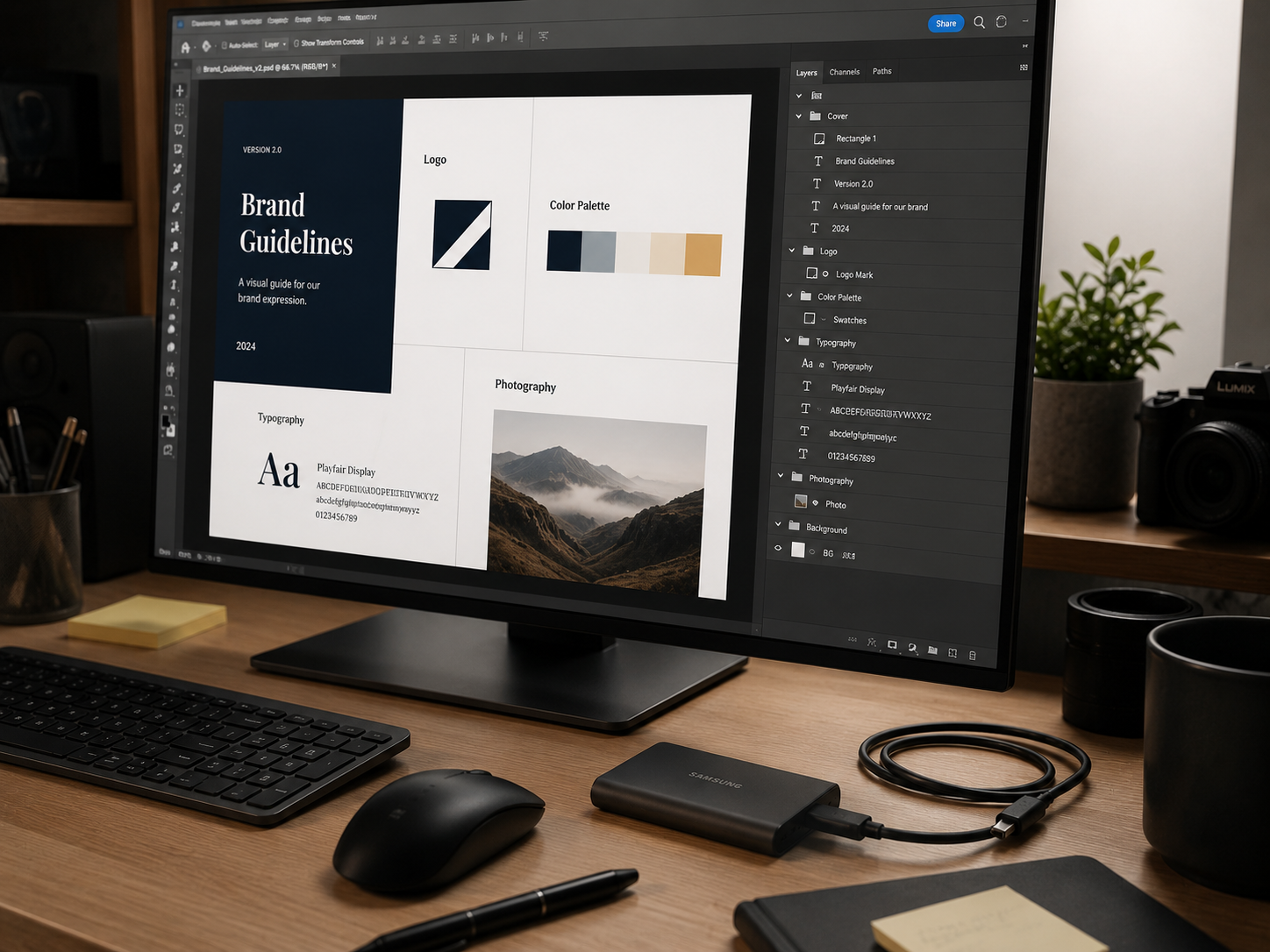
This distinction costs businesses more than any other item on the page. A source file is the working original. An export is a picture of it.
So a delivered image or a finished PDF looks complete and cannot be edited meaningfully. Then a small change, like a new phone number on a brochure, means recreating the whole thing from scratch. Also, the same applies to video projects, where the timeline and the assets matter far more than the finished file. In fact, asking for sources is easy at delivery and awkward two years later, which is the entire argument for asking early.
Ask for the files in a format you can open. A folder of working files helps nobody if your team has no software that reads them. So ask what each file needs, and ask for a common format alongside it where that makes sense.
Logos, Vectors And Stock Licences
Your logo deserves its own request, in vector format. A vector scales to any size without losing quality, which is why it is the version that matters for signage, print and anything larger than a screen.
Stock imagery works differently and surprises people. Licences are issued to the purchaser, and many are not transferable at all. So an image on your site may be licensed to your agency rather than to you. Then a vendor change can mean replacing photography you assumed you had bought. Of course, none of this is hidden, and a straightforward question at the start settles it. The visual side of this sits alongside aligning branding and website design.
How to buy a website in El Paso →What To Request, And The Wording To Use
Be specific, because a general request produces a general answer. Ask for four things by name rather than asking for "the files".
First, assignment of the custom code and design on payment. Second, the editable source files for design and video. Third, the logo in vector format. Finally, a written list of any third-party licences your site depends on and whose account holds each one. So the request fits in one short email. Then a reasonable partner sends a drive link within the week, and a lawyer should review any assignment wording before you sign it. General footing on how vendor agreements should read sits in the SBA small business guidance.
Send the request while the project is still fresh. Teams archive working files after a few months, and archives get harder to search every year. So the same email costs an hour at delivery and half a day two years later.
Recovering Files After The Project Ended
If the work finished years ago and nobody discussed any of this, you are asking rather than requiring. Four things make that ask more likely to succeed.
- Ask for named items. So request the vector logo and the layered homepage file, not "everything you have".
- Keep it warm and brief. Then the request reads as housekeeping rather than as the opening of a dispute.
- Offer to pay for the time. Also, digging out archived files is real work, and offering to cover an hour of it removes the main objection.
- Set your own deadline quietly. Finally, decide when you stop asking and start recreating, so the question cannot run for months.
Most vendors say yes to a specific, friendly request. Indeed, the ones who hesitate are usually protecting an arrangement they never explained rather than guarding anything valuable. If you do end up rebuilding, it is worth doing deliberately, which is the argument in turning a site into a growth engine. Google documents site verification and the access levels around it in Google's Search Console documentation, which matters whenever a site changes hands. More of the series sits in the VenPro marketing insights archive.
Frequently Asked Questions
Q1 In practice, who owns website agency built files after the invoice is paid? +
Q2 Does paying for a website mean I own it? +
Q3 What are editable source files? +
Q4 Do stock photo licences transfer to me? +
Q5 Can I get source files after the project ended? +
Settle Who Owns Website Agency Built Work Before The Project Ends
Deciding who owns website agency built work takes one sentence at the start and a long email chain at the end. So ask for assignment on payment, ask for the source files by name, and ask which licences sit in somebody else's account. Then the invoice and the ownership finally describe the same thing.