





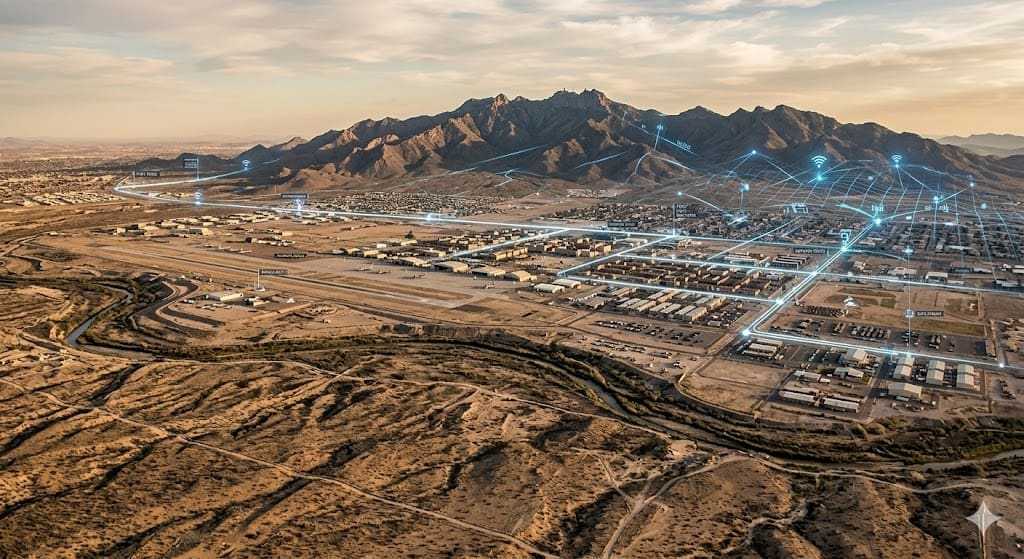
Fort Bliss Data Center El Paso: What We Know About the $2 Billion Carlyle Deal, the Community Concerns, and the Listening Session on April 22
El Paso is at the center of one of the largest military-private infrastructure deals in recent U.S. history. On March 26, the Department of the Army announced a conditional agreement to enter exclusive negotiations with global investment firm Carlyle to build a hyperscale data center on approximately 1,384 acres of underutilized Fort Bliss property. The project is estimated at $2 billion in private investment, could create around 2,000 jobs, and is designed to accelerate artificial intelligence capabilities for national defense. No taxpayer dollars are involved.
But for many El Pasoans, the announcement raised more questions than it answered. How much water will this facility consume in a desert city that already watches every drop? What happens to electricity prices when a massive data center plugs into the grid? And who decided that 1,384 acres of land next to residential neighborhoods was the right place for it? On Wednesday, April 22, the Army is giving the community a chance to ask those questions directly. Here is everything you need to know before you walk through the door.
| Project Component | Detail & Impact |
| Project Name | Fort Bliss Hyperscale Data Center |
| Private Partner | Carlyle (Global Investment Firm) |
| Total Investment | ~$2 Billion (Private capital; $0 taxpayer cost) |
| Land Usage | ~1,384 acres of underutilized Fort Bliss property |
| Estimated Jobs | ~2,000 positions |
| Primary Concerns | Water consumption, grid stability, and utility costs |
| Current Status | Conditional agreement; Exclusive negotiations ongoing |
| Listening Session | April 22, 2026 |
| Target Opening | Fiscal Year 2027 (Initial Operating Capability) |
What the Deal Actually Is
First, what this is — and what it is not.
The Department of the Army has reached a conditional agreement to enter into exclusive negotiations with Carlyle. That means a deal is not finalized. Terms are still being worked out. What has been decided is that Carlyle was selected through a competitive process as the preferred private partner for this specific site.
The mechanism is called an Enhanced Use Lease. The Army leases underutilized military land to a private entity, which then builds and operates the facility using entirely private capital. The federal government does not spend taxpayer dollars on construction or operations. In return, the Army gains access to computing infrastructure that supports its AI and national defense priorities.
The site is approximately 1,384 acres on Fort Bliss property in Far East El Paso. The project’s Initial Operating Capability is targeted for Fiscal Year 2027, meaning portions of the facility could be operational within the next 18 months.
Fort Bliss is not the only installation involved. The Army simultaneously announced a parallel deal with CyrusOne — backed by KKR and BlackRock — to develop approximately 1,201 acres at Dugway Proving Ground in Utah under the same Enhanced Use Lease model. Together, the two projects represent roughly $4 billion in private infrastructure investment on military land.
Why Fort Bliss and Why Now
This project did not appear out of nowhere. It is part of a Department of Defense directive that identifies 2026 as the year the military “emphatically raises the bar for Military AI Dominance.” The DOD’s updated Artificial Intelligence Strategy calls for accelerated development of AI compute infrastructure across multiple installations, with Fort Bliss and Dugway as the first two sites to move forward.
Fort Bliss was selected for several reasons. The installation has vast amounts of underutilized land — the base spans more than 1.1 million acres, making it one of the largest military installations in the country. El Paso offers grid access, a workforce, and a strategic position near the U.S.-Mexico border that aligns with defense priorities.
There is also broader context. El Paso is rapidly becoming a data center hub beyond the military. Meta’s data center expansion in the region represents a roughly $10 billion investment. Combined with the Fort Bliss project, El Paso is now positioned at the intersection of two of the most capital-intensive industries in the country — defense technology and hyperscale computing.
Fort Hood and Fort Bragg have also been listed as potential future sites for similar military data center projects, but Fort Bliss and Dugway are first in line.
The Community Concerns El Paso Is Raising
Not everyone sees this as good news. Multiple community groups and residents have raised serious concerns about the project’s impact on a region that already faces resource constraints.
Water is the most urgent issue. The average mid-sized data center consumes approximately 300,000 gallons of water per day — the equivalent of what 1,000 homes use. Data centers require massive amounts of water for cooling systems that keep servers from overheating. In a desert city where water has always been a finite resource, that number is difficult to ignore. Across Texas, data centers are projected to consume 399 billion gallons by 2030, representing roughly 7 percent of the state’s total water usage.
Fort Bliss has taken a preliminary step to address this. In March, $4 million was earmarked to increase water production capacity at the Kay Bailey Hutchison Desalination Plant. The facility design also requires that developers build independent power and water infrastructure rather than relying entirely on existing municipal systems. But for residents, those assurances are not yet detailed enough to answer the fundamental question: will this project strain El Paso’s water supply?
Electricity and utility costs are the second major concern. Residents in Far East El Paso — particularly in Montana Vista and surrounding communities — worry that a facility of this scale will place strain on the electrical grid and drive up utility prices for households that are already stretched. Several of these neighborhoods sit adjacent to existing power plants and industrial facilities, and residents have raised concerns about cumulative environmental burden.
Air quality is also on the table. Data centers require backup generators and significant energy infrastructure that can contribute to local emissions. Communities represented by the Sembrando Esperanza Coalition — an alliance of nine El Paso County neighborhoods focused on environmental and economic justice — have cited pollution concerns alongside water and energy issues.
EACH (Empowering Area Communities and Households), led by community organizer Ralph Carrasco, has been among the most vocal groups raising questions about the project’s impact on residents who live closest to the proposed site.
What the Army and Carlyle Are Saying
The Army has framed the project as a national defense priority that will bring significant economic benefits to El Paso — jobs, private investment, and infrastructure — without costing taxpayers a dollar.
Maj. Gen. Curtis Taylor, commander of the 1st Armored Division and Fort Bliss, acknowledged community concerns directly in the April 13 press release announcing the listening session:
“We recognize that El Pasoans and members of the wider Borderplex Region have concerns about potential impacts to the community. We are holding this session to review what we know now about the conditional agreement and proposed data center project, and then we want to hear from you to help inform planning.”
The key phrase is “help inform planning.” The agreement is conditional and negotiations are ongoing. The Army is positioning this listening session not as a post-decision briefing, but as an opportunity for community input to shape how the project moves forward.
Carlyle, for its part, brings experience in large-scale energy and digital infrastructure projects. The firm operates data centers through its portfolio company Ark Data Centers and employs approximately 6,500 people across more than 30 portfolio companies. The Fort Bliss project represents a significant expansion into military and government AI infrastructure.
One detail worth noting: the facility design stipulates that excess energy generated by the data center can be sold to civilian grids. If implemented effectively, this could potentially benefit the local energy market rather than strain it. But the specifics of that arrangement have not yet been made public.
The Listening Session on April 22 — What You Need to Know
This is the part that matters most right now.
Fort Bliss is hosting a community listening session specifically about the data center project. Here are the details:
Date: Wednesday, April 22, 2026
Time: Doors open at 6:00 PM. Opening comments begin at 6:30 PM. Session runs until 7:30 PM.
Location: Wyndham El Paso Airport Hotel Conference Center
Format: Leaders and representatives from the Department of the Army, Fort Bliss, and Carlyle will provide a brief overview and status update on the project. The floor will then open for community members to provide feedback and ask questions.
Who should attend:
– Residents of Far East El Paso, Montana Vista, and surrounding communities
– Business owners and workers who may be affected by or benefit from the project
– Anyone with questions about water usage, energy impact, jobs, land use, or environmental concerns
– Community leaders and organizers
– Anyone who wants their voice on record before negotiations are finalized
This is not a town hall after the fact. The deal is conditional. Negotiations are ongoing. The feedback collected at this session has the potential to influence how the project takes shape — or whether certain community protections are built into the final agreement.
If you have concerns, this is the time to raise them. If you support the project, this is the time to say so. Either way, showing up is the only way to make sure your position is counted.
Conclusion
El Paso is at a crossroads. A $2 billion data center on Fort Bliss land could bring thousands of jobs, position the city as a national hub for AI infrastructure, and generate economic momentum that lasts for decades. It could also place new demands on water, energy, and air quality in a region where those resources are already under pressure.
The only way to influence what happens next is to be in the room on April 22. Doors open at 6:00 PM at the Wyndham El Paso Airport Hotel Conference Center. Opening comments start at 6:30. The Army says it wants to hear from you. Take them up on it.
Frequently Asked Questions About El Paso Tech Hub Military Investment
What is the Fort Bliss data center project?
The Department of the Army has reached a conditional agreement with global investment firm Carlyle to build a hyperscale data center on approximately 1,384 acres of underutilized Fort Bliss property in Far East El Paso. The project is designed to support AI capabilities for national defense and is estimated at $2 billion in private investment through an Enhanced Use Lease. No taxpayer dollars are involved.
How much will the Fort Bliss data center cost?
The estimated investment is approximately $2 billion, funded entirely through private capital from Carlyle. The Enhanced Use Lease model means the federal government and El Paso taxpayers do not bear construction or operating costs. The project is expected to create around 2,000 jobs.
Will the data center use El Paso's water?
This is one of the most significant community concerns. The average mid-sized data center uses approximately 300,000 gallons of water per day for cooling. Fort Bliss has earmarked $4 million to increase water production capacity at the Kay Bailey Hutchison Desalination Plant, and the facility design requires developers to build independent power and water infrastructure. Specific water consumption details for this project have not yet been made public.
When is the Fort Bliss data center community listening session?
The listening session is scheduled for Wednesday, April 22, 2026, from 6:30 to 7:30 PM at the Wyndham El Paso Airport Hotel Conference Center. Doors open at 6:00 PM. Representatives from the Army, Fort Bliss, and Carlyle will present an overview before opening the floor to community questions and feedback.
How many jobs will the Fort Bliss data center create?
The project is estimated to create approximately 2,000 jobs and generate billions in private investment for the El Paso region. Initial Operating Capability is targeted for Fiscal Year 2027.
This is the final post in VenPro Solutions’ seven-part series on the Fort Bliss data center and what it means for El Paso. We have covered the deal, the economics, the history, the business opportunities, and the vision of what this city can become. We believe in El Paso — and we believe that the businesses, institutions, and residents of this community have everything it takes to build something remarkable. If you are ready to position your brand for what comes next, we would love to be part of that journey.
Explore more at venpro.solutions/insights