





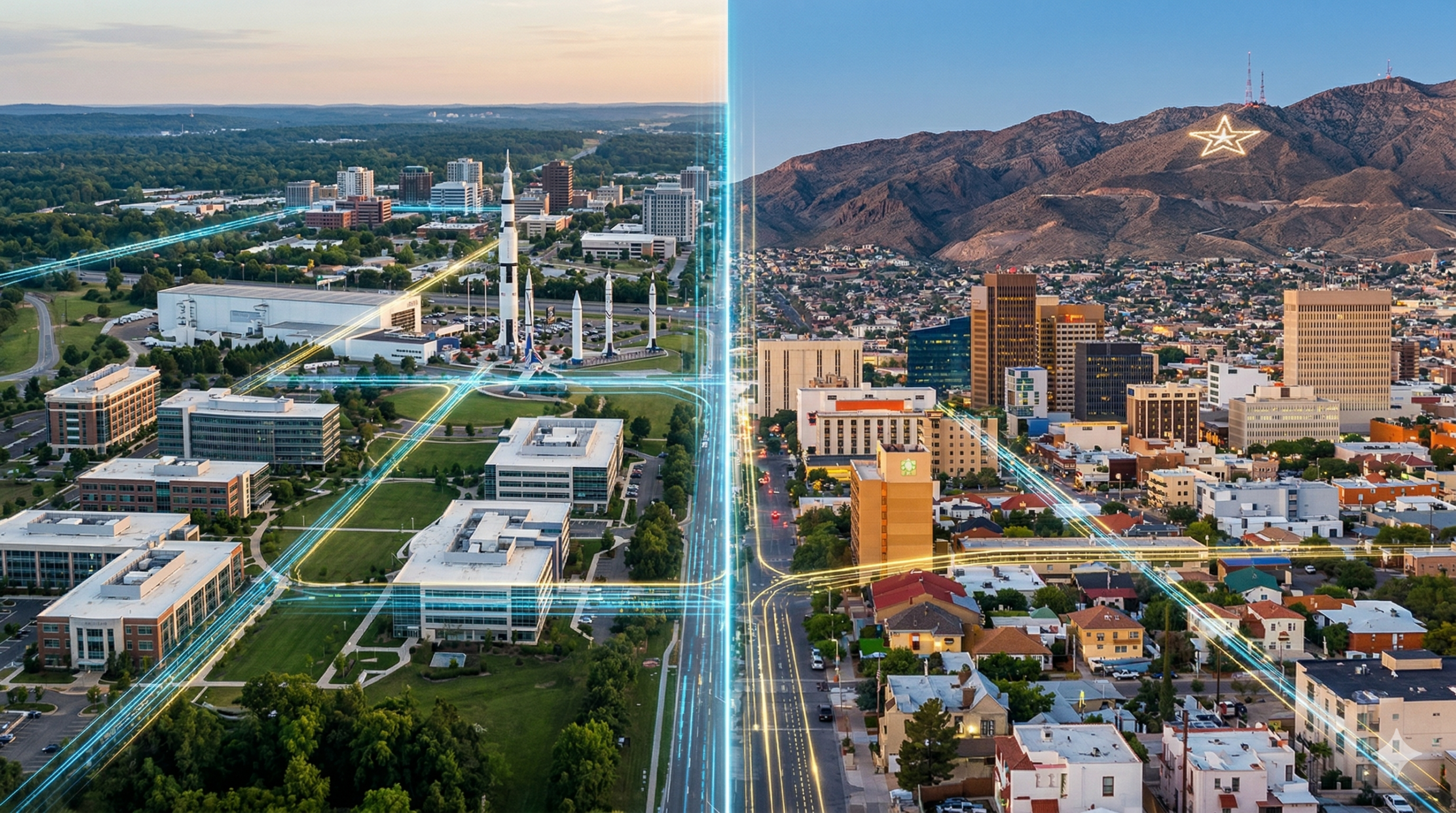
El Paso Has Everything It Needs to Become a Defense Tech Hub — The Fort Bliss Data Center Is Just the Start
There is a version of El Paso’s future that looks very different from its past. A version where this city is not just known as a military town on the border — but as one of America’s leading centers for defense technology, artificial intelligence infrastructure, and innovation. A version where UTEP graduates stay in El Paso because the career opportunities here are too good to leave. Where technology companies from across the country set up operations here because the ecosystem makes sense. Where Fort Bliss is not just the city’s largest employer but the anchor of a thriving, diversified economy that attracts investment from every direction.
That version of El Paso is not a fantasy. It is a realistic destination — one that other cities have already reached by making deliberate choices at exactly the kind of inflection point El Paso is standing at right now. The Fort Bliss data center deal is not the finish line. It is the starting gun. And understanding what it takes to get from here to there is the most important conversation El Paso can be having today.
| El Paso Defense Tech Asset | Details |
|---|---|
| Fort Bliss | One of the largest U.S. Army installations in the world by land area |
| 1st Armored Division | Major combat division headquartered at Fort Bliss |
| White Sands Missile Range | Premier U.S. military testing and research facility — 30 miles from El Paso |
| University of Texas at El Paso | R1 research university producing engineering and technology graduates annually |
| El Paso Community College | Workforce training pipeline for technical and trades positions |
| Fort Bliss Data Center | Billions in private investment — 2,000 jobs projected |
| Border Position | Strategic southwestern location connecting U.S., Texas, and Mexico |
| Workforce | Large, growing population of veterans, engineers, and skilled trades workers |
| Growth Trajectory | One of the fastest-growing metros in Texas by population |
What Does a Defense Tech Hub Actually Look Like?
Before we talk about where El Paso is going, it helps to be clear about what the destination actually looks like. A defense tech hub is not just a city with a military base. Nearly every major military installation in the country sits inside or near a city. What separates the cities that become true defense tech hubs from the ones that stay military-adjacent is a combination of deliberate choices, institutional alignment, and private sector confidence.
In a genuine defense tech hub, the military installation is the anchor — but it is surrounded by a constellation of supporting industries and institutions. Defense contractors with local offices. Cybersecurity firms that serve both government and private clients. Technology companies that hire from the same talent pool the military draws from. Universities that have built research programs specifically aligned with defense priorities. Startups spinning out of those universities and finding funding because the investor community understands the market.
The result is an economy that is resilient because it is diversified — one where military investment attracts private investment, private investment attracts talent, and talent attracts more companies. It is a self-reinforcing cycle. And once it gets going, it is very hard to stop. The cities that have achieved it — Huntsville, Colorado Springs, San Antonio — are not looking back. And they all started with a moment that looked a lot like the one El Paso is living right now.
The Huntsville Story — How a Small Alabama City Became America's Defense Tech Capital
Huntsville, Alabama is the most instructive example of what El Paso could become — and the comparison is more apt than most people realize. Forty years ago, Huntsville was a small city in northern Alabama known primarily for its connection to NASA and Redstone Arsenal, the Army’s missile and rocket development center. It had military roots. It had engineering talent. It had potential. But it had not yet become what it would eventually become.
The transformation happened because of a series of deliberate choices made by local leaders, institutions, and businesses over decades. The University of Alabama in Huntsville built research programs directly aligned with the defense and aerospace priorities of Redstone Arsenal. Local leaders worked aggressively to attract defense contractors to set up operations in the city — giving them access to the talent and infrastructure the Arsenal provided. The business community treated every military investment as an anchor and built outward from it consistently and patiently.
The results speak for themselves. Today Huntsville is home to more engineers per capita than almost any other city in the United States. It hosts the headquarters or major operations of virtually every significant defense contractor in the country. It has been one of the fastest-growing cities in the southeastern United States for over a decade. Its economy is diverse, resilient, and deeply tied to the defense and technology sectors in ways that insulate it from the economic volatility that affects less specialized cities.
Huntsville did not get lucky. It got intentional. And it started from a foundation that, in many important ways, looks a lot like El Paso’s today.
The Colorado Springs Blueprint — Building a Cyber and Space Defense Ecosystem
Colorado Springs offers a different but equally instructive model. The city is home to multiple major military installations — including the Air Force Academy, Peterson Space Force Base, Schriever Space Force Base, and the famous Cheyenne Mountain Complex. That military density created a foundation. But what Colorado Springs built on top of that foundation is what makes it remarkable.
The city leaned hard into cybersecurity and space technology — two sectors that were natural extensions of the military missions happening at its installations. Local leaders recruited cybersecurity firms and space technology companies by making the case that Colorado Springs offered something no other city could match — proximity to the installations, the talent, and the security clearances those industries depend on.
The result is a thriving technology ecosystem that has made Colorado Springs one of the most economically dynamic cities in the Mountain West. The military is still the foundation. But the private sector has built a structure on top of that foundation that could stand on its own — and that continues to attract new companies, new investment, and new talent every year.
The lesson for El Paso is clear. You do not build a defense tech hub by waiting for it to happen. You build it by identifying your natural advantages, making the case to the right companies and investors, and creating the conditions that make it easy for the private sector to say yes to your city.
What El Paso Already Has That Those Cities Spent Years Building
Here is the part of this conversation that does not get said enough. El Paso is not starting from zero. The assets that Huntsville and Colorado Springs spent decades assembling — El Paso already has most of them.
Fort Bliss is one of the largest military installations in the world by land area. The 1st Armored Division is headquartered here. White Sands Missile Range — one of the country’s most important military testing and research facilities — sits thirty miles up the road. The University of Texas at El Paso is a fully accredited R1 research university that produces engineering and technology graduates every single year. El Paso Community College runs workforce training programs that build exactly the kind of technical talent a defense tech ecosystem needs.
El Paso also has something that Huntsville and Colorado Springs do not — a border position that creates unique strategic value. The city’s location at the intersection of the United States, Texas, and Mexico gives it connectivity and logistical advantages that no landlocked Midwestern or Mountain city can replicate. For defense contractors and technology companies with cross-border operations, supply chains, or market interests, El Paso’s position is an asset that is genuinely difficult to find anywhere else.
Add to all of that a large and growing population of veterans — people who already have security clearances, technical training, and operational experience that defense and technology companies prize — and the picture becomes even clearer. El Paso is not a city that needs to build a foundation from scratch. It is a city that needs to recognize the foundation it already has and start building on it deliberately.
The Missing Pieces — What El Paso Still Needs to Get Right
Honesty matters here. El Paso has real advantages — but it also has real gaps. Acknowledging those gaps is not pessimism. It is the first step toward closing them.
Talent retention is the most significant challenge. El Paso produces graduates every year from UTEP and EPCC who have the skills the defense tech sector needs. But too many of those graduates leave — drawn to Austin, Dallas, Houston, or out of state by the perception that the opportunities are better elsewhere. Changing that perception requires creating the opportunities that make staying the obvious choice. That is a chicken-and-egg problem that requires intentional effort from businesses, institutions, and city leadership working together.
Private sector attraction is the second gap. El Paso does not yet have the density of defense contractors, technology companies, and cybersecurity firms that Huntsville and Colorado Springs have built up. Attracting those companies requires a coordinated effort — tax incentives, workforce commitments, infrastructure investment, and a compelling story about why El Paso is the right place to grow. That story is getting easier to tell with every major investment announcement. But it needs to be told loudly and consistently.
Brand identity is the third gap — and it is more important than most people realize. El Paso is not yet known nationally as a defense tech destination. Changing that perception takes time and intentional communication. It requires local leaders, institutions, and businesses to consistently position the city in the conversations that matter — at industry conferences, in national media, and in the pitches made to companies considering where to locate their next operation.
None of these gaps are insurmountable. They are the same gaps that Huntsville and Colorado Springs faced — and closed — over time. The question is whether El Paso is willing to do the work.
What the Next Five Years Could Look Like for El Paso
Here is a realistic but genuinely exciting vision of where El Paso could be five years from now if the city makes the right moves starting today.
The Fort Bliss data center is operational. Carlyle’s investment has attracted the attention of other technology infrastructure companies who see El Paso as a proven location for this kind of project. A second major investment announcement follows — perhaps a cybersecurity firm, a defense contractor expanding its southwestern operations, or a technology company drawn by the talent and infrastructure the data center has helped create.
UTEP has launched or expanded research programs specifically aligned with defense technology priorities — AI, cybersecurity, unmanned systems — producing graduates who have clear career pathways in El Paso rather than reasons to leave. EPCC is running certification programs that are directly feeding the data center and its supporting industries with trained technicians.
The business community has organized around this opportunity. A defense tech association has formed. Local companies are winning subcontracts on major projects. New startups — founded by UTEP graduates and Fort Bliss veterans — are finding funding and customers without having to leave El Paso to do it.
And the city’s story has changed. National publications are writing about El Paso as an emerging defense tech hub. Companies considering where to expand are putting El Paso on their shortlists. The talent that used to leave is starting to stay — and talent from other cities is starting to arrive.
That is not a fantasy. It is a projection based on what other cities have achieved starting from exactly where El Paso is today. Five years is enough time to make real progress — if the work starts now.
How Every El Pasoan Has a Role in What Comes Next
The transformation of a city is never the work of a single institution or a single investment. It is always the result of many people — in many different roles — making choices that add up to something bigger than any one of them could create alone.
If you are a business owner, your role is to position your company for this moment. Build your brand. Develop your digital presence. Build relationships in the defense and technology sectors. Make your business visible and credible to the companies and decision-makers this investment is bringing to El Paso.
If you are an educator or institution leader, your role is to align your programs with the workforce needs this ecosystem requires. Talk to the companies involved. Understand what skills they need. Build the pipelines that keep El Paso talent in El Paso.
If you are a resident — a parent, a neighbor, a community member — your role is to believe in this city and say so out loud. The story El Paso tells about itself matters enormously. Cities that believe in their own potential attract investment. Cities that undersell themselves drive it away. El Paso has every reason to tell a confident, ambitious story about where it is going — and every resident who tells that story helps make it true.
The Fort Bliss data center is the start. What comes next depends on all of us.
Frequently Asked Questions About El Paso Tech Hub Military Investment
Can El Paso realistically become a defense tech hub like Huntsville or Colorado Springs?
Yes — and the comparison is more grounded than it might seem. El Paso already has Fort Bliss, White Sands Missile Range, UTEP, a large veteran population, and now a major private data center investment. The foundation is real. What is required now is the same deliberate effort that Huntsville and Colorado Springs made over time — attracting private sector companies, retaining local talent, and consistently positioning El Paso as a destination for defense technology investment.
What industries are most likely to follow the Fort Bliss data center investment into El Paso?
Cybersecurity firms, defense contractors, AI development companies, technology infrastructure providers, and logistics and supply chain companies with defense sector clients are all natural candidates. Companies in these industries look for locations with military proximity, technical talent, security clearance density, and proven infrastructure investment — all of which El Paso is building.
How long did it take Huntsville to become a defense tech hub?
Huntsville’s transformation happened over several decades — driven by consistent choices made by local leaders, universities, and businesses starting in the 1970s and accelerating through the 1990s and 2000s. El Paso’s advantages are significant enough that a meaningful transformation could happen faster — but it requires sustained, intentional effort over at least five to ten years.
What can UTEP and EPCC do to support El Paso's defense tech ambitions?
Both institutions are well positioned to play a major role. UTEP can expand research programs aligned with defense technology priorities — AI, cybersecurity, unmanned systems, materials science. EPCC can develop and scale certification programs that directly feed the technical workforce needs of the data center and related industries. Both should be in active dialogue with the companies and military leaders driving this investment.
What does El Paso need to do to attract defense technology companies?
A combination of competitive incentives, workforce commitments, infrastructure investment, and consistent brand positioning. Companies making location decisions want to know that the talent will be there, the infrastructure will support them, and the city is serious about being a long-term partner. El Paso’s leadership — in business, government, and education — needs to make that case loudly and consistently.
How does the Fort Bliss data center fit into El Paso's long-term economic strategy?
It is the most significant private infrastructure investment in recent memory — and it signals to the broader market that El Paso is a serious location for defense technology development. Every future investment pitch El Paso makes to a technology or defense company gets easier because of this deal. It establishes credibility, demonstrates infrastructure capacity, and puts El Paso on the radar of companies that may not have been paying attention before.
This is the final post in VenPro Solutions’ seven-part series on the Fort Bliss data center and what it means for El Paso. We have covered the deal, the economics, the history, the business opportunities, and the vision of what this city can become. We believe in El Paso — and we believe that the businesses, institutions, and residents of this community have everything it takes to build something remarkable. If you are ready to position your brand for what comes next, we would love to be part of that journey.
Explore more at venpro.solutions/insights